
Strategic Objectives, Operational Significance, and Transformational Scope of BPR
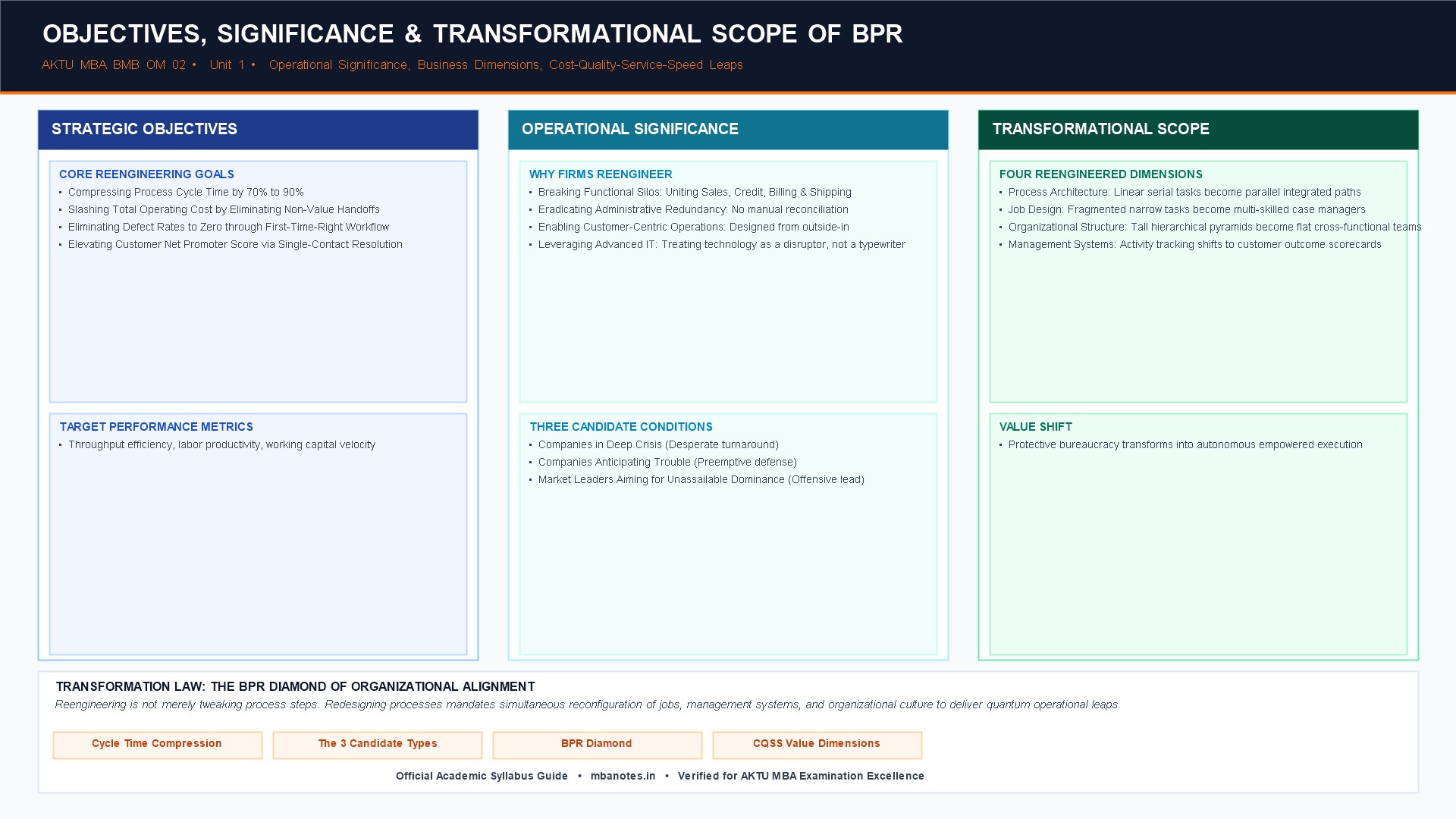
1. Strategic Objectives of Business Process Reengineering
Organizations do not undertake the profound disruption and risk of Business Process Reengineering to achieve marginal operational gains. BPR is an aggressive strategic intervention targeting four transformative performance breakthroughs:
- Radical Cycle Time Compression: Compressing end-to-end process lead times by 70% to 90%. By eliminating unnecessary supervisory handoffs, inter-departmental transit, and batched queue delays, multi-week processes are collapsed into hours or minutes.
- Substantial Total Operating Cost Reduction: Slashing administrative overhead expenses by 30% to 60%. Eliminating redundant verification checks, reconciliation clerks, and paper documentation directly lowers operating cost per transaction.
- Breakthrough Quality & Defect Elimination: Achieving first-time-right operational precision. By building automated error-proofing (Poka-Yoke) into digital systems, rework cycles and customer billing discrepancies are eliminated at the source.
- Customer Service Transformation: Enhancing the customer experience by providing a single point of contact (Case Manager) who possesses complete visibility and authority to resolve customer inquiries immediately.
2. Operational Significance in Operations Management
In modern operations management, BPR holds immense significance because it shatters the traditional iron triangle trade-offs. Historically, operations managers assumed that higher quality required higher costs, and shorter lead times required expensive expedited freight.
BPR proves that eliminating non-value-added administrative handoffs simultaneously lowers cost, accelerates speed, and eradicates quality defects:
The Operational Significance Paradigm
In traditional functional operations, less than 5% of total elapsed time is spent on actual value-added transformation; over 95% is wasted in idle queues, inter-office transit, and manual reconciliation. BPR obliterates this non-value-added waste, unlocking massive latent enterprise capacity without investing in brick-and-mortar factories.
3. Candidate Company Typologies: Who Needs Reengineering?
Hammer and Champy classified organizations undertaking BPR into three distinct corporate archetypes:
Type 1: Companies in Deep Crisis (The Desperate)
Firms facing imminent insolvency, drastic market share loss, or catastrophic cost disadvantages (e.g., Ford Accounts Payable in the 1980s trailing Mazda by 500% in labor efficiency). These firms have no alternative; reengineering is an existential matter of survival.
Type 2: Companies Anticipating Future Crisis (The Preemptive)
Firms currently profitable, but whose leadership recognizes looming market threats—such as aggressive new digital competitors, deregulation, or technological shifts. They reengineer proactively before crisis erodes their balance sheet reserves.
Type 3: Market Leaders in Peak Condition (The Aggressive Dominators)
Industry leaders seeking to widen their competitive moat and build unassailable barriers to entry (e.g., Walmart deploying cross-docking; Amazon deploying one-click fulfillment). They reengineer to redefine competitive standards and force rivals into obsolescence.
4. Transformational Scope: The BPR Diamond Architecture
Reengineering is not merely altering process diagrams. Hammer conceptualized enterprise transformation through the BPR Diamond, illustrating that altering business processes forces systemic realignments across four interconnected organizational facets:
The core workflows that create value. Moving from fragmented, linear departmental tasks to integrated, cross-functional value streams.
Process changes transform job designs. Simple, narrow, repetitive clerical tasks are replaced by multi-dimensional case workers and self-governing case teams. Hierarchical pyramids flatten into horizontal process networks.
Supervisors transition from policing rules to coaching workers. Reward systems shift from tracking departmental hours and task activity to rewarding end-to-end customer outcomes and process cycle times.
Corporate culture shifts from internal political turf protection to external customer obsession. Workers transition from passive order-takers to autonomous, accountable problem-solvers.
5. Performance Dimensions: Cost, Quality, Service & Speed (CQSS)
All BPR initiatives are evaluated across the foundational CQSS Framework:
- Cost: Total landed activity cost per transaction, labor productivity ratio, and inventory carrying cost.
- Quality: First-pass yield, defect parts per million (PPM), and invoice billing accuracy.
- Service: Customer resolution on first contact, transparency in order status, and customer satisfaction (CSAT) scores.
- Speed: Order-to-delivery lead time, quote generation time, and new product development cycle.
University Examination Question Bank & Model Solutions
Designed as per Dr. A.P.J. Abdul Kalam Technical University (AKTU) MBA Examination Pattern.
Part A: Conceptual 2-Mark Short Answer Questions
Q1 [2 Marks]: Identify the four core performance dimensions targeted by BPR (CQSS).
Ans: 1. Cost, 2. Quality, 3. Service, 4. Speed.
Q2 [2 Marks]: What percentage of cycle time in traditional processes is typically non-value-added?
Ans: In traditional, un-reengineered functional processes, over 90% to 95% of total elapsed cycle time is non-value-added waiting time, transit delay, and supervisory review.
Q3 [2 Marks]: List the three types of companies that undertake BPR according to Hammer and Champy.
Ans: 1. Companies in deep crisis (desperate for survival), 2. Companies anticipating future crisis (preemptive reengineering), 3. Market leaders in peak condition (building unassailable dominance).
Q4 [2 Marks]: What are the four components of the BPR Diamond?
Ans: 1. Business Processes, 2. Jobs and Structures, 3. Management and Measurement Systems, 4. Values and Beliefs (Culture).
Part B & C: Analytical 10-Mark Detailed Solutions & Numerical Blueprints
Question 1 [10/15 Marks]: Examine the strategic objectives and operational significance of BPR in operations management. How does BPR break the traditional trade-off between cost, quality, and speed? (10 Marks)
Model Examination Answer Blueprint:
- Introduction & Strategic Objectives: Frame BPR as an aggressive operational tool. Detail its core targets: 70-90% cycle time compression, 30-60% administrative cost reduction, zero defect rates, and customer service revolution.
- Shattering the Iron Triangle Trade-Off:
- Explain traditional operational beliefs: speed costs money (expediting), quality costs money (inspection).
- Explain the BPR revelation: Non-value-added handoffs represent 95% of process elapsed time. Eliminating these handoffs simultaneously lowers cost (no clerical checking), accelerates speed (no queue dwell), and increases quality (no data transcription errors). - Candidate Company Profiles: Detail the 3 archetypes (Crisis, Preemptive, Dominant) with enterprise examples.
- Conclusion: Emphasize that BPR creates sustainable competitive advantage by altering operational cost structures permanently.
Question 2 [10/15 Marks]: Explain the 'BPR Diamond' framework. Demonstrate why reengineering business processes requires simultaneous restructuring of jobs, management systems, and organizational values. (10 Marks)
Model Examination Answer Blueprint:
- The Interconnected Nature of Organizational Change: Explain that reengineering fails when treated purely as a process or IT project. Process redesign forces changes in jobs, systems, and culture.
- Detailed Deconstruction of the 4 Diamond Vertices:
- Processes: Cross-functional horizontal workflows.
- Jobs & Structure: Shift from narrow task specialists to multi-skilled case managers; flattening organizational hierarchies.
- Management & Measurement: Shift from supervisory policing to coaching; rewarding customer outcomes instead of task hours.
- Values & Beliefs: Cultural shift from bureaucratic turf defense to empowered customer ownership. - Systemic Failure Analysis: Show what happens if one vertex is ignored (e.g., redesigning processes without changing management reward systems leads to employee regression).
- Exam Diagram: Draw the classic 4-vertex BPR Diamond with bidirectional interconnecting arrows.
Strategic Executive Summary: 2. BPR Objectives, Significance & Scope
- BPR targets radical cycle time compression (70-90%), operating cost reduction (30-60%), and dramatic quality improvements.
- By eliminating non-value-added administrative handoffs, BPR shatters the traditional trade-off between speed, cost, and quality.
- Three company archetypes undertake BPR: firms in deep crisis, firms anticipating trouble, and aggressive market leaders.
- The BPR Diamond proves that process redesign mandates simultaneous alignment across job designs, management measurement systems, and organizational values.
Frequently Asked Questions (Academic & Practitioner FAQ)
Q1. Why is cycle time reduction the central metric in BPR?
Cycle time reduction is the most comprehensive diagnostic indicator of process health. When process cycle time drops from weeks to hours, it proves that non-value-added waiting, handoffs, and rework have been successfully eliminated.
Q2. What is a Case Manager in BPR?
A Case Manager (or Case Worker) is an empowered employee who performs all or most of the sequential steps of an entire business process from end-to-end, acting as the single point of contact for the customer.
Q3. Can a small business implement BPR?
Yes. While small businesses have fewer bureaucratic layers, reengineering customer ordering, inventory restocking, and billing processes using modern low-code workflow platforms yields massive efficiency gains.
Discussion & Questions
0 CommentsAcademic insights, questions, and conceptual clarifications from students & faculty.
No questions or comments yet
Have a doubt about this topic, an exam tip, or a conceptual perspective? Start the discussion below!
Leave a Comment / Ask a Question
Your email address will not be published. Required fields are marked *