
Traditional vs. Reengineered Processes: Comparative Matrix, BPR Myths, and Critical Success Factors (CSFs)
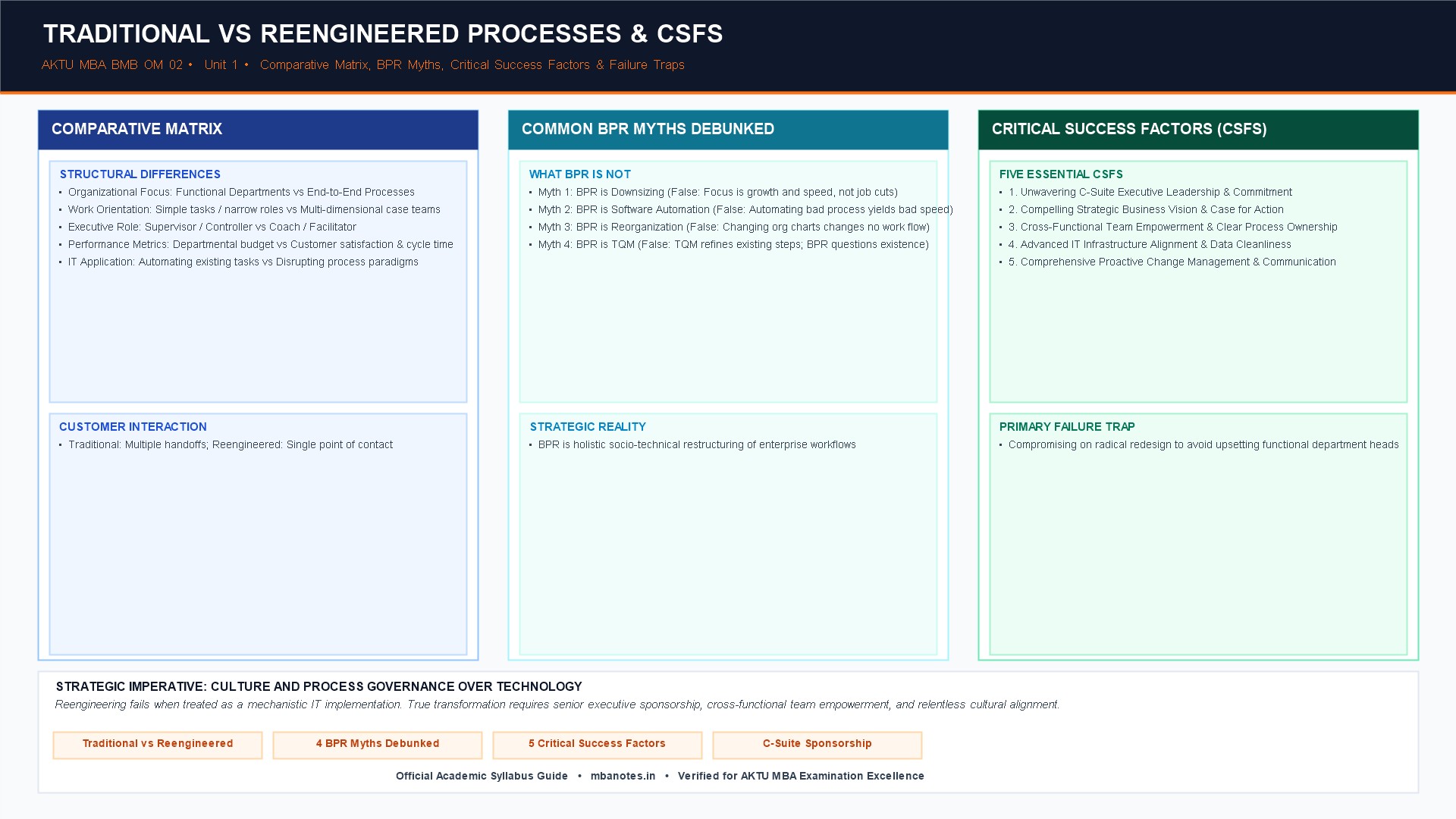
1. Traditional vs. Reengineered Organizations: Comparative Matrix
The transition from a traditional functional organization to a reengineered process enterprise represents a profound structural and philosophical transformation. The comparative matrix below highlights the core differences across all operational dimensions:
| Organizational Dimension | Traditional Functional Organization | Reengineered Process Enterprise |
|---|---|---|
| Structural Unit | Functional Departments (Sales, Accounting, Shipping). | Process Teams & Cross-Functional Value Streams. |
| Work Orientation | Task-focused; narrow, simple, repetitive tasks. | Process-focused; multi-dimensional, complex work. |
| Worker Role | Controlled, supervised, passive order-takers. | Empowered decision-makers; autonomous case workers. |
| Managerial Role | Supervisors, checkers, and administrative controllers. | Coaches, facilitators, and resource enablers. |
| Organizational Structure | Tall, hierarchical pyramids with multiple tiers. | Flat, horizontal networks governed by Process Owners. |
| Measurement & Compensation | Activity-based; hours worked; departmental budget compliance. | Outcome-based; customer satisfaction, cycle time, value created. |
| Application of IT | Automating existing manual steps faster. | Disrupting old rules and enabling radical new business models. |
2. The Core Structural Shifts in Job Design & Culture
When an enterprise reengineers, the nature of work undergoes three profound structural shifts:
- From Simple to Multi-Dimensional Jobs: Instead of performing an isolated task (e.g., verifying invoice numbers), workers execute entire processes (e.g., handling customer enrollment from application to policy dispatch). This requires broad cross-skilling and continuous learning.
- From Controlled to Empowered Workers: Workers no longer seek supervisory permission for standard operational deviations. Armed with computerized decision engines, they possess the authority and budget to resolve customer issues instantly.
- From Protective to Customer-Obsessed Culture: Employees stop asking, "Did I follow the departmental procedure?" and begin asking, "Did the customer receive exactly what they needed on time?"
3. Four Major BPR Myths Debunked
Misunderstanding BPR has led many corporate initiatives into severe failure. Operations leaders must dispel four widespread myths:
Myth 1: BPR is Just a Euphemism for Downsizing (Headcount Reduction)
Reality: Downsizing simply does less with less; it cuts costs by firing workers while leaving broken, inefficient processes intact. BPR does more with less; it reconfigures processes to handle massive volume growth without proportional headcount inflation.
Myth 2: BPR is Software Automation
Reality: Automating a bad process merely cements bad habits. Technology is an enabler, not the reengineering itself. Radical redesign must precede software coding.
Myth 3: BPR is Organizational Restructuring (Changing the Org Chart)
Reality: Redrawing corporate organizational boxes changes who reports to whom, but does nothing to change how physical work flows across the enterprise. BPR focuses on work flows, not reporting hierarchies.
Myth 4: BPR is the Same as TQM
Reality: TQM refines existing steps through incremental kaizen gains. BPR rejects the premise of the existing process entirely, starting over with a clean sheet of paper.
4. Five Critical Success Factors (CSFs) in BPR
Empirical post-mortems of hundreds of corporate reengineering initiatives isolate five non-negotiable Critical Success Factors:
Because BPR crosses departmental boundaries, it threatens middle-management fiefdoms. Only the CEO or COO has the executive authority to resolve inter-departmental warfare and enforce radical redesign.
Leadership must clearly articulate why the firm must change and what catastrophic fate awaits if it maintains the status quo, generating organizational urgency.
Appointing a senior executive as Process Owner with end-to-end accountability, supported by dedicated, full-time cross-functional reengineering team members.
Deploying flexible ERP, cloud BPM, and modern data platforms capable of supporting real-time cross-functional execution rather than rigid legacy mainframes.
Managing employee anxiety, reskilling workers, restructuring incentive compensation, and celebrating early pilot wins to anchor new operational behaviors into corporate DNA.
5. Implementation Anti-Patterns & Avoidance Protocols
To ensure BPR project survival, management must guard against three deadly anti-patterns:
- The Compromise Trap: Settling for minor 15% process tweaks to avoid upsetting powerful departmental heads. This produces the disruption of BPR without any of the breakthrough payoffs.
- Analysis Paralysis: Spending years mapping microscopic details of the current broken AS-IS process rather than designing the future TO-BE process.
- Delegation to IT: Treating BPR as a computer software project and handing it off to the CIO without business executive ownership.
University Examination Question Bank & Model Solutions
Designed as per Dr. A.P.J. Abdul Kalam Technical University (AKTU) MBA Examination Pattern.
Part A: Conceptual 2-Mark Short Answer Questions
Q1 [2 Marks]: Differentiate between task-oriented and process-oriented work designs.
Ans: Task-oriented work fragments jobs into narrow, repetitive, specialized micro-tasks managed by functional departments. Process-oriented work organizes jobs into multi-dimensional, end-to-end workflows executed by cross-functional teams focused on customer outcomes.
Q2 [2 Marks]: Why is BPR not synonymous with corporate downsizing?
Ans: Downsizing merely reduces headcount while keeping broken, inefficient processes intact. BPR fundamentally redesigns workflows to eliminate non-value handoffs, enabling the enterprise to handle massive volume growth without proportional headcount expansion.
Q3 [2 Marks]: List three Critical Success Factors (CSFs) for BPR initiatives.
Ans: 1. Unwavering C-Suite Executive Leadership, 2. Compelling Business Case for Action, 3. Proactive Change Management & Cultural Realignment.
Q4 [2 Marks]: What is 'Analysis Paralysis' in BPR projects?
Ans: Analysis Paralysis occurs when project teams spend excessive months or years over-documenting and analyzing the legacy AS-IS process instead of boldly designing the radical TO-BE reengineered workflow.
Part B & C: Analytical 10-Mark Detailed Solutions & Numerical Blueprints
Question 1 [10/15 Marks]: Contrast a Traditional Functional Organization with a Reengineered Process Enterprise across structure, job design, management roles, and measurement systems. (10 Marks)
Model Examination Answer Blueprint:
- Introduction: Define the structural shift from vertical functional silos to horizontal process-centric value streams.
- Detailed Dimensional Comparative Analysis:
- Structure: Hierarchical departmental pyramids vs flat horizontal networks governed by Process Owners.
- Job Design: Narrow, repetitive, simple tasks vs multi-dimensional, empowered case workers.
- Managerial Role: Supervisors acting as controllers/policemen vs coaches and facilitators.
- Measurement: Departmental budget adherence and task hours vs customer satisfaction, cycle time, and end-to-end value created.
- IT Deployment: Mechanized automation of existing tasks vs disruptive inductive enabler. - Cultural Implications: Contrast protective turf battles with cross-functional customer obsession.
- Conclusion: Summarize that high-performance organizations must evolve into process enterprises to survive modern competitive velocity.
Question 2 [10/15 Marks]: Debunk the four common myths of BPR. Examine the Five Critical Success Factors (CSFs) essential to ensure that reengineering initiatives do not fail. (10 Marks)
Model Examination Answer Blueprint:
- BPR Myths Analysis:
- Myth 1: BPR is Downsizing (Explain why cutting people without fixing process causes catastrophic service collapse).
- Myth 2: BPR is Software Automation (Paving cow paths).
- Myth 3: BPR is Reorganization (Changing org charts without changing workflows).
- Myth 4: BPR is TQM (Contrast radical clean-sheet redesign with incremental kaizen). - The Five Critical Success Factors (CSFs):
- 1. C-Suite Sponsorship: Why CEO commitment is mandatory to overcome middle-management resistance.
- 2. Clear Case for Action: Establishing organizational urgency.
- 3. Process Ownership: Appointing senior executives with end-to-end accountability.
- 4. Disruptive IT Alignment: Deploying scalable modern platforms.
- 5. Change Management: Overcoming human fear, reskilling, and realigning incentive compensation. - Anti-Patterns to Avoid: Highlight the dangers of compromise traps and analysis paralysis.
Strategic Executive Summary: 4. Traditional vs Reengineered & CSFs
- Reengineered process enterprises replace tall functional hierarchies with flat horizontal networks focused on customer outcomes.
- Job designs transform from narrow, specialized tasks to multi-dimensional, empowered case worker roles supported by digital systems.
- BPR is not downsizing, software automation, organizational restructuring, or incremental TQM.
- The five Critical Success Factors (C-suite sponsorship, clear vision, process ownership, modern IT, proactive change management) determine whether BPR achieves a 10x breakthrough or operational collapse.
Frequently Asked Questions (Academic & Practitioner FAQ)
Q1. Why do middle managers resist BPR more than frontline staff?
Middle managers traditionally derive their corporate status and power from the number of subordinates they supervise and the size of their departmental budgets. BPR eliminates layers of supervisory checking, directly threatening their organizational authority.
Q2. What role does compensation play in sustaining reengineered processes?
If compensation continues to reward individual departmental task outputs, employees will inevitably revert to old silo behaviors. Bonuses must be tied directly to overall process performance (e.g., customer cycle time and order accuracy).
Q3. How long should a typical BPR project take to show results?
Leading methodologies (like Manganelli-Klein Rapid Re) mandate that initial pilot results and short-term wins be demonstrated within 6 to 12 months to maintain executive commitment and organizational momentum.
Discussion & Questions
0 CommentsAcademic insights, questions, and conceptual clarifications from students & faculty.
No questions or comments yet
Have a doubt about this topic, an exam tip, or a conceptual perspective? Start the discussion below!
Leave a Comment / Ask a Question
Your email address will not be published. Required fields are marked *