
Price Bundling Strategies and Non-Linear Pricing Models: Pure vs Mixed Bundling, Two-Part Tariffs and Consumer Surplus Extraction
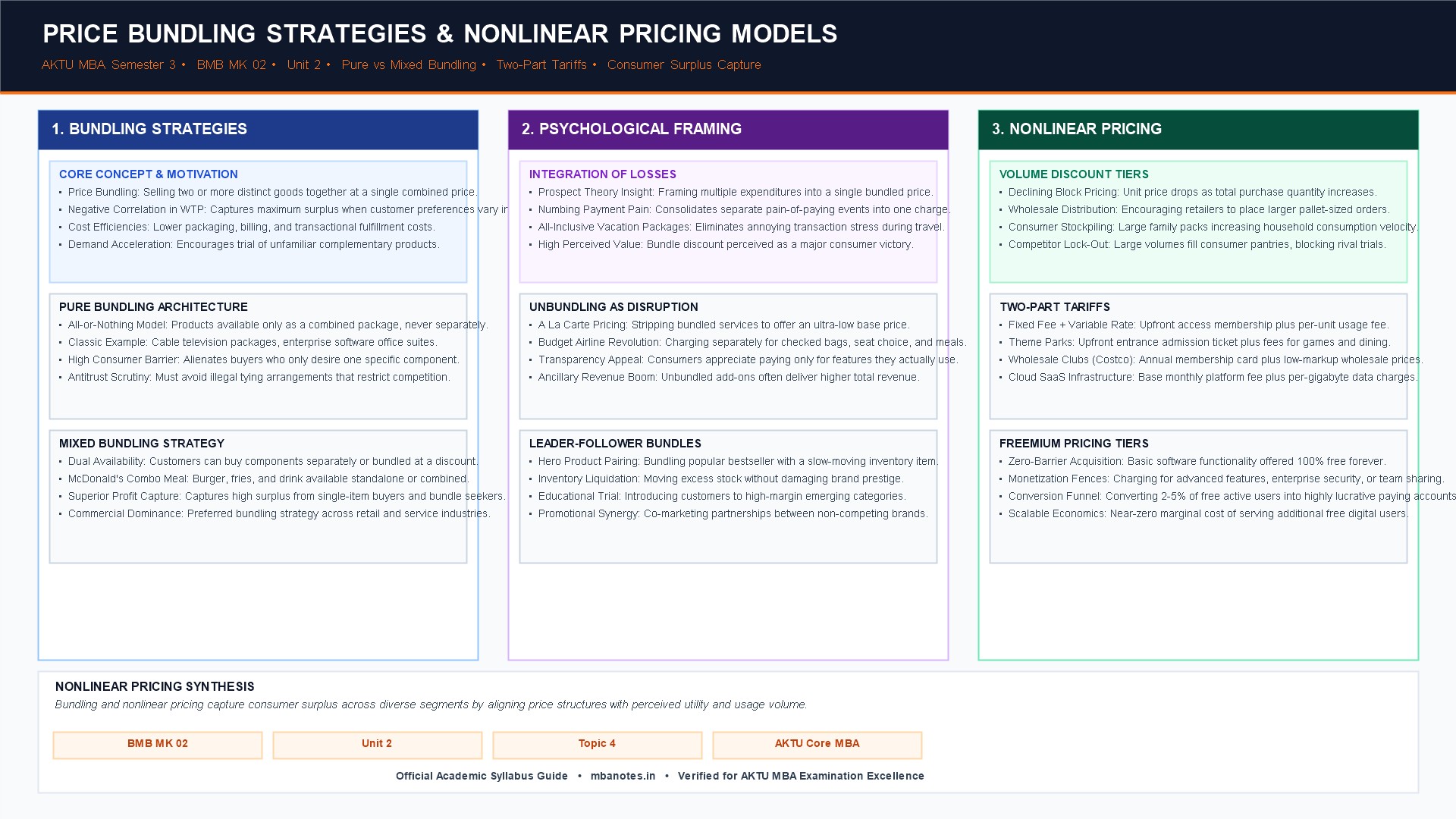
1. Economic Logic and Strategic Typologies of Price Bundling
Price bundling is the commercial practice of marketing two or more distinct products or services together as a single combined package at an integrated price point. Widely practiced across software suites, telecommunications packages, fast-food meal combos, and vacation itineraries, bundling is a powerful analytical mechanism to extract consumer surplus from buyers with heterogeneous, inversely correlated valuations across products.
The strategic typologies and fundamental mechanics of price bundling include:
- Pure Bundling: The firm offers products strictly as a consolidated bundle; customers cannot purchase the individual items separately (e.g., cable television packages historically bundling hundreds of channels together).
- Mixed Bundling: Customers are given the option to purchase the bundled package at a discount or buy each component separately at standard unbundled prices (e.g., a fast-food value meal offering a burger, fries, and drink together at a savings vs individual a la carte prices).
- Leader-Follower Bundling: Packaging a highly popular, dominant category anchor product with a newly launched or slow-moving item to accelerate trial and adoption of the secondary offering.
- Same-Product Bundling (Volume Bundling): Packaging multiples of the exact same product together (e.g., 'Buy 3 for $10'), rewarding higher volume consumption with lower per-unit prices.
- Cross-Industry Bundling (Joint Promotions): Strategic alliances between independent brands creating synergistic packages (e.g., an airline bundling flights with car rentals and hotel stays).
- Operational Cost Efficiencies: Bundling simplifies transaction handling, reduces packaging and logistics expenses, and streamlines order billing across enterprise supply chains.
- Consumer Cognitive Simplification: For buyers, bundling eliminates decision fatigue by providing an integrated, pre-tested solution that guarantees interoperability and seamless convenience.
2. Non-Linear Pricing Architectures: Two-Part Tariffs and Block Pricing
In standard linear pricing, the total amount paid by a consumer is directly proportional to the quantity purchased (a customer buying 5 units pays exactly 5 times the single-unit price). Non-linear pricing architectures decouple total expenditure from strict linearity, altering the effective price per unit based on usage volume, capacity reservation, or consumption timing.
- Two-Part Tariff Structure: Divides total customer payment into two distinct layers: an upfront fixed access fee (the membership or subscription charge) that confers the right to buy, plus a variable usage fee per unit consumed.
- Classic Two-Part Applications: Widely deployed in amusement parks (an entrance admission ticket plus individual ride tokens), golf country clubs (annual membership dues plus green fees per round), and telecommunications (a monthly base line rental plus per-minute call charges).
- Block Pricing (Quantity Tiering): Charging different prices across successive blocks of consumption. In declining block pricing, the first 100 kilowatt-hours of electricity are charged at a high rate, while subsequent consumption blocks are priced progressively cheaper to incentivize heavy usage.
- Peak-Load & Congestion Pricing: Charging higher rates during predictable capacity surges (e.g., Uber surge pricing during rainstorms or electricity premiums during peak afternoon heat) to balance demand against fixed physical infrastructure.
- Freemium Tier Architecture: Offering basic digital utility at zero monetary cost to build massive viral adoption, while monetizing power users through premium subscriptions or micro-transaction upgrades.
- Pay-As-You-Go (PAYG) Utility Models: Cloud infrastructure (AWS, Microsoft Azure) billing customers strictly per second of server compute time, converting enterprise capital expenditure into variable operating expenditure.
- Capacity Reservation Pricing: Charging clients for reserving guaranteed throughput capacity regardless of whether they ultimately utilize it, ensuring predictable baseline revenue for infrastructure providers.
3. Consumer Surplus Extraction, Willingness to Pay and Product Tying
Consumer surplus represents the economic gap between the maximum price a customer is willing to pay and the actual price they pay in the marketplace. Standard unbundled linear pricing invariably leaves substantial consumer surplus on the table from affluent buyers while pricing out low-budget prospects. Bundling and non-linear pricing serve as precision instruments to capture this untapped economic surplus.
- Overcoming Negative Correlation of Valuations: Bundling achieves maximum profit when two customer segments value two products inversely. For example, Segment A values Word Processors at $100 and Spreadsheets at $40, while Segment B values Word Processors at $40 and Spreadsheets at $100. Unbundled, the firm must price at $40 each to sell to both. Bundled at $140, both segments buy the complete bundle, extracting 100% of their combined surplus.
- Product Tying vs Bundling: While bundling sells products together at fixed quantities, tying requires the customer who buys a primary capital good to purchase all future complementary supplies exclusively from the same manufacturer (e.g., commercial Keurig coffee makers requiring proprietary K-Cup pods).
- Legal & Antitrust Considerations: Regulatory competition authorities (such as the Federal Trade Commission or Competition Commission of India) heavily scrutinize tying and pure bundling when practiced by dominant monopolistic platforms, ensuring bundles do not illegally foreclose rival competition.
- Price Discrimination Second-Degree Mechanics: Non-linear pricing structures enable self-selection, allowing consumers to choose their own price-volume tier without violating antitrust laws against explicit personal price discrimination.
- Minimizing Risk of Resale (Arbitrage): To maintain non-linear price structures, firms must establish technical or contractual barriers that prevent high-volume wholesale buyers from unbundling and reselling individual units to retail buyers.
- Psychological Framing of Bundles: Consumers perceive bundled discounts as a generous corporate bonus, mitigating pain-of-paying psychological friction.
4. Comparative Framework: Unbundled vs Pure Bundling vs Mixed Bundling
The comparative evaluation below contrasts pure unbundled pricing, pure bundling, and mixed bundling across strategic flexibility, consumer surplus capture, inventory risk, and regulatory scrutiny.
The Bundling Spectrum
Strategic ModelingEconomic research consistently demonstrates that mixed bundling dominates both pure bundling and unbundled pricing in competitive markets by capturing high willingness-to-pay from bundle buyers while monetizing single-item shoppers.
| Strategic Parameter | Unbundled (A La Carte) Pricing | Pure Bundling Strategy | Mixed Bundling Strategy |
|---|---|---|---|
| Customer Purchase Choice | Customers buy individual components completely separately at standalone prices. | Customers must buy the entire package; individual components cannot be bought. | Customers can buy the bundle at a discount or buy individual components separately. |
| Consumer Surplus Capture | Low; leaves substantial surplus with buyers who hold high multi-product valuations. | High among consumers who value all items, but completely excludes single-item buyers. | Maximized; extracts high surplus from bundle lovers while capturing single-item buyers. |
| Customer Satisfaction | High autonomy, but lacks value-bundle financial discounts. | Low for customers who desire only one item and resent paying for unwanted bloat. | High; preserves customer choice while providing clear economic incentives to bundle. |
| Inventory & Assortment Risk | High inventory imbalances; popular SKUs sell out while slow SKUs accumulate. | Predictable SKU demand; components move through warehouses in fixed lockstep. | Requires balanced inventory forecasting across both standalone and bundled SKUs. |
| Regulatory & Antitrust Scrutiny | Negligible; perfectly standard commercial transaction practice. | High; vulnerable to antitrust charges of anti-competitive tying and product foreclosure. | Low to moderate; offering unbundled alternatives satisfies most regulatory requirements. |
| Common Industry Applications | High-end bespoke audio components, fine dining restaurants, specialized tools. | Cable TV channel tiers, luxury vehicle factory options, enterprise software suites. | Fast-food meal combos, airline vacation packages, Microsoft Office consumer editions. |
6. Corporate Case Vignette: Microsoft 365 Enterprise Productivity Software Bundling
Enterprise Application: How Microsoft Conquered the Enterprise Cloud via Mixed Bundling
Enterprise Cloud Software & SaaSThe Strategic Challenge: In the early 2010s, enterprise software was fragmented. Corporate IT buyers purchased desktop Word and Excel licenses from Microsoft, cloud storage from Box or Dropbox, video conferencing from Zoom, and workplace collaboration chat from Slack, resulting in expensive, disconnected multi-vendor software sprawl.
The Strategic Bundling Masterstroke: Microsoft transitioned its software into the integrated Microsoft 365 cloud subscription bundle. Rather than forcing clients to buy standalone licenses, Microsoft packaged Word, Excel, PowerPoint, Outlook, OneDrive cloud storage, and Teams collaboration software into single per-user monthly subscription tiers (E3 and E5 licenses). To counter standalone rivals like Slack, Microsoft essentially bundled Microsoft Teams into the existing 365 enterprise package at near-zero incremental cost to existing subscribers.
The Commercial Result: Corporate CIOs jumped at the chance to eliminate redundant third-party subscriptions. Microsoft Teams' daily active users surged past 300 million, surpassing Slack, and Microsoft 365 expanded into an enterprise recurring-revenue engine generating over $60 billion annually.
7. AKTU University Exam Practice Drill: Solved Questions
University Examination Review: Model Solutions
AKTU MBA PatternQ1: Distinguish between Pure Bundling and Mixed Bundling with a commercial example.
Answer: In Pure Bundling, products are sold strictly as a package and cannot be purchased individually (e.g., traditional cable TV packages where sports channels could not be bought without news channels). In Mixed Bundling, customers can choose to purchase the combined bundle at a discounted composite price or buy individual items separately at standard a la carte prices (e.g., McDonald's offering a Value Meal combo alongside standalone individual burger, fry, and drink items).
Q2: Explain the economic logic of price bundling and non-linear pricing models. How does a two-part tariff structure allow an enterprise to extract consumer surplus while expanding total sales volume?
Answer Structure Guide:
- Introduction & Conceptual Definition: Define price bundling as marketing two or more distinct products together at an integrated price. Contrast linear pricing with non-linear pricing architectures.
- The Economic Logic of Bundling:
- Explain Consumer Surplus extraction and heterogeneous customer valuations.
- Demonstrate how bundling resolves inversely correlated valuations across buyer segments.
- Discuss operational and logistics efficiencies and reduction of consumer cognitive decision fatigue.
- Typologies of Bundling: Detail Pure Bundling, Mixed Bundling, Leader-Follower bundles, and volume discounting.
- Non-Linear Pricing & Two-Part Tariffs:
- Explain the mechanics of a Two-Part Tariff: Fixed Access Fee (entrance fee) + Variable Usage Fee (per-unit rate).
- Provide real-world examples: amusement parks, country clubs, telecommunications, and SaaS cloud computing.
- Explain how the fixed fee extracts consumer surplus upfront while the low per-unit fee encourages high consumption volume.
- Strategic & Regulatory Considerations: Discuss antitrust and anti-competitive tying scrutiny under competition laws (citing the Microsoft Teams scrutiny).
- Conclusion: Summarize that modern pricing analytics leverages bundling and non-linear tariffs to align pricing structures with customer usage patterns, driving sustainable enterprise growth.
Discussion & Questions
0 CommentsAcademic insights, questions, and conceptual clarifications from students & faculty.
No questions or comments yet
Have a doubt about this topic, an exam tip, or a conceptual perspective? Start the discussion below!
Leave a Comment / Ask a Question
Your email address will not be published. Required fields are marked *