
Social Media Analytics: Multi-Platform Measurement, Audience Telemetry and Business ROI Tracking
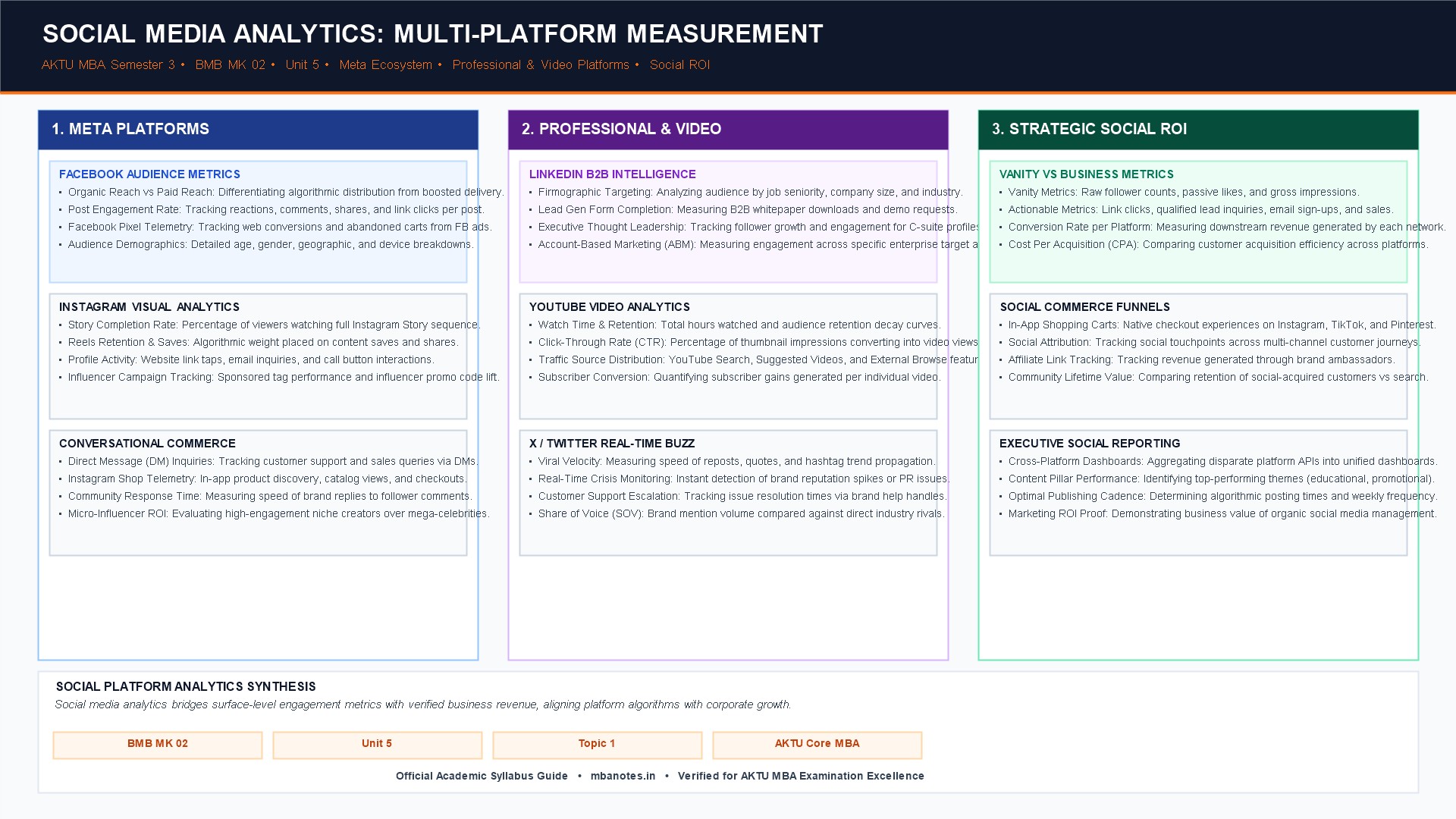
1. Multi-Platform Social Media Analytics Ecosystem and API Telemetry
Social media analytics is the practice of gathering, processing, and analyzing conversational and behavioral data from social media networks to guide strategic marketing decisions and measure corporate brand health. Modern consumers spend billions of hours on social platforms, sharing opinions, reviewing products, and seeking peer recommendations. For modern marketing managers, social media analytics transforms unstructured public digital chatter into quantifiable commercial insights.
The structural foundations and technological architecture of social media analytics encompass:
- Programmatic Application Programming Interfaces (APIs): Analytics platforms ingest real-time social telemetry via official platform APIs (Meta Graph API, X API, YouTube Data API, LinkedIn Marketing API), gathering impression counts, engagement events, and profile interactions.
- Aggregation of Owned, Earned, and Paid Social: Unifying performance metrics from owned brand profiles (organic posts), paid advertising campaigns (promoted posts, influencer sponsorships), and earned word-of-mouth customer mentions.
- Audience Demographic & Psychographic Profiling: Extracting anonymized aggregated audience attributes, including age distributions, gender splits, geographic locations, device operating systems, and professional industry sectors.
- The Social Listening Command Center: Continuous multi-platform monitoring that tracks brand mentions, category hashtags, executive names, and competitor keywords across public feeds to maintain constant situational awareness.
- Algorithmic Feed Dynamics: Modern social networks utilize machine-learning recommendation algorithms that prioritize content based on meaningful interactions (comments, shares, saves) rather than simple chronological timestamps.
- Data Governance & Platform Rate Limits: Social data collection must comply with platform developer policies, API query rate limits, and user privacy mandates, filtering out private group communications.
2. Platform-Specific Intelligence: Meta, LinkedIn, YouTube Video and X/Twitter
Each major social network operates on a unique behavioral architecture, requiring specialized analytical metrics tailored to its distinct audience interaction modality.
- Meta Ecosystem (Facebook & Instagram):
- Facebook: Measures organic vs paid reach, post reaction distributions (Like, Love, Haha, Wow, Sad, Angry), link click-through rates, and community group engagement velocity.
- Instagram: Analyzes visual storytelling through Instagram Story completion rates, Reels audience retention curves, content 'Saves' (a primary indicator of high algorithmic utility), and direct message (DM) inquiries.
- LinkedIn B2B Enterprise Intelligence:
- Firmographic Targeting: Evaluates engagement categorized by job function, seniority tier (C-Suite, VP, Director), company size, and specific industry verticals.
- Lead Generation Forms: Measures native in-app form completion rates for B2B whitepapers, executive webinar registrations, and product demo inquiries.
- Thought Leadership Traction: Tracks organic follower growth and executive post reach for corporate leadership personal profiles.
- YouTube Video Analytics:
- Watch Time & Audience Retention: Tracks total cumulative watch hours and granular second-by-second viewer retention curves, identifying the exact timestamp where viewer attention drops.
- Click-Through Rate (CTR): Measures the percentage of thumbnail impressions that successfully convert into video view starts.
- Traffic Source Distribution: Categorizes views into YouTube Search, Suggested Videos (algorithmic recommendations), External websites, and Browse features.
- X / Twitter Real-Time Buzz & Velocity:
- Viral Retweet Velocity: Measures the speed and propagation reach of retweets, quote tweets, and trending category hashtags.
- Customer Support Resolution Time: Tracks the average turnaround time taken by corporate social support handles to respond to and resolve customer complaint tweets.
3. Social Commerce, Downstream Lead Tracking and Business ROI vs Vanity Metrics
The ultimate goal of social media analytics is proving financial Return on Investment (Social ROI). Historically, corporate social media managers relied on superficial 'vanity metrics' to justify budgets. In modern marketing science, analytics bridges top-of-funnel engagement with bottom-of-funnel revenue realization.
- The Vanity Metric Trap: Metrics such as follower counts, page likes, and gross impressions look impressive on executive slides but do not correlate with business revenue. A brand can amass 1 million followers who generate zero paying transactions.
- Actionable Commercial Social KPIs: Focuses on traffic referral volume, outbound click-through rates, qualified lead captures, customer acquisition costs (CAC), and customer lifetime value (CLV) of social cohorts.
- Social Commerce Funnel Telemetry: In-app social shopping architectures (Instagram Shopping, TikTok Shop, Pinterest Buyable Pins) allowing users to discover, evaluate, and checkout within the social application itself, tracked via native e-commerce conversion APIs.
- Pixel Tracking & Social Conversion APIs (CAPI): Deploying server-side conversion APIs (such as Meta Conversions API) that track when a user who clicked a social ad subsequently completes an order on the brand's e-commerce website.
- Influencer Campaign Performance Auditing: Moving beyond follower size to track unique promo code redemption volume, custom affiliate tracking link revenue, and engagement authenticity (filtering out bought follower bots).
- Executive Dashboard Reporting: Communicating social media performance in the language of the C-suite, illustrating how social engagement reduces customer support call-center costs and accelerates enterprise customer acquisition.
4. Comparative Framework: Vanity Metrics vs Actionable Business Metrics
The comparative matrix below delineates the profound structural differences between superficial vanity metrics and actionable business conversion metrics in social media analytics.
Strategic Metric Bifurcation
Strategic ModelingVanity metrics measure passive exposure and stroke corporate ego; actionable business metrics measure deliberate consumer commitment and drive corporate financial growth.
| Evaluation Dimension | Vanity Social Metrics | Actionable Business Conversion Metrics |
|---|---|---|
| Core Conceptual Focus | Surface-level visibility, gross audience scale, and passive brand exposure. | Behavioral action, purchase intent, lead qualification, and revenue realization. |
| Common Metric Examples | Follower counts, Page likes, Gross impressions, Passive video views (< 3s). | Outbound link clicks, Lead form completions, Cost Per Acquisition, ROAS. |
| Correlation with Revenue | Extremely weak to non-existent; high follower count does not guarantee sales. | Direct and mathematically measurable; directly populates financial ledgers. |
| Susceptibility to Manipulation | High; followers and post likes can be cheaply purchased from automated bot farms. | Low; automated bots cannot easily fake verified credit card transactions or B2B sales. |
| Actionability for Optimization | Low; does not inform managers how to refine product, pricing, or checkout UX. | High; reveals exactly which ad creatives and copy variations drive paying customers. |
| Audience Perspective | Broad, passive spectators who may never engage again. | Committed prospects and high-value customer brand advocates. |
6. Corporate Case Vignette: Sephora Beauty Insider & Social Engagement
Enterprise Application: How Sephora Turned Social Engagement into High-Converting Retail Footfall
Cosmetics & Prestige Beauty RetailThe Strategic Challenge: With beauty consumers inundated with hundreds of makeup brands on Instagram and YouTube, Sephora needed to ensure that its social media investments translated into verified retail store visits and online cosmetic sales rather than passive scrolling.
The Social Analytics Integration: Sephora seamlessly integrated its social media channels with its Beauty Insider loyalty database. Sephora analyzed user engagement across Instagram Reels tutorials, YouTube influencer product reviews, and in-app community forums. When users saved cosmetic looks on Instagram, Sephora's retargeting analytics delivered personalized mobile app invites for in-store 15-minute beauty makeovers. Customers booking makeover appointments through social links had their product preferences automatically synced with the store beauty advisor's tablet.
The Commercial Result: Sephora proved that customers who engaged with its social content visited stores twice as often and spent 3.5 times more annually than non-social shoppers, demonstrating that social media analytics can drive massive downstream omni-channel enterprise revenue.
7. AKTU University Exam Practice Drill: Solved Questions
University Examination Review: Model Solutions
AKTU MBA PatternQ1: What are vanity metrics in social media marketing? Give two examples.
Answer: Vanity metrics are surface-level social media statistics that look impressive on presentation slides but do not correlate with meaningful business revenue, customer retention, or corporate profitability. Prominent examples include total follower counts and passive post likes.
Q2: Detail the role of Social Media Analytics in modern marketing. Compare the analytical capabilities of Meta, LinkedIn, and YouTube, and explain how a brand manager measures the true financial Return on Investment (ROI) of social campaigns.
Answer Structure Guide:
- Introduction: Define Social Media Analytics as the practice of collecting, monitoring, and evaluating digital conversational and behavioral data from social networks to guide marketing decisions and measure brand equity.
- Platform-Specific Analytics Capabilities:
- Meta (Facebook & Instagram): Organic vs paid reach, emotional reaction breakdown, Instagram Story completion, Reels retention curves, and content saves.
- LinkedIn: B2B firmographic analytics (job seniority, industry), lead generation form tracking, and executive thought leadership engagement.
- YouTube: Watch time hours, second-by-second audience retention curves, CTR on thumbnails, and algorithmic traffic source distribution.
- X / Twitter: Viral retweet velocity and real-time customer support response latency.
- Vanity Metrics vs Actionable Business Metrics:
- Contrast superficial metrics (followers, page likes, impressions) with actionable commercial metrics (outbound clicks, qualified leads, CAC, ROAS).
- Explain why prioritizing vanity metrics leads to misallocated budgets and vulnerability to bot fraud.
- Measuring Social Commerce & Financial ROI:
- Explain pixel tracking, server-side Conversions APIs (CAPI), and social commerce checkouts.
- Detail how social touchpoints are tracked through multi-touch attribution to link brand engagement to retail purchases.
- Conclusion: Summarize that modern social media analytics moves beyond superficial engagement to build closed-loop financial accountability.
Discussion & Questions
0 CommentsAcademic insights, questions, and conceptual clarifications from students & faculty.
No questions or comments yet
Have a doubt about this topic, an exam tip, or a conceptual perspective? Start the discussion below!
Leave a Comment / Ask a Question
Your email address will not be published. Required fields are marked *