
Recent Trends and Innovation in Marketing
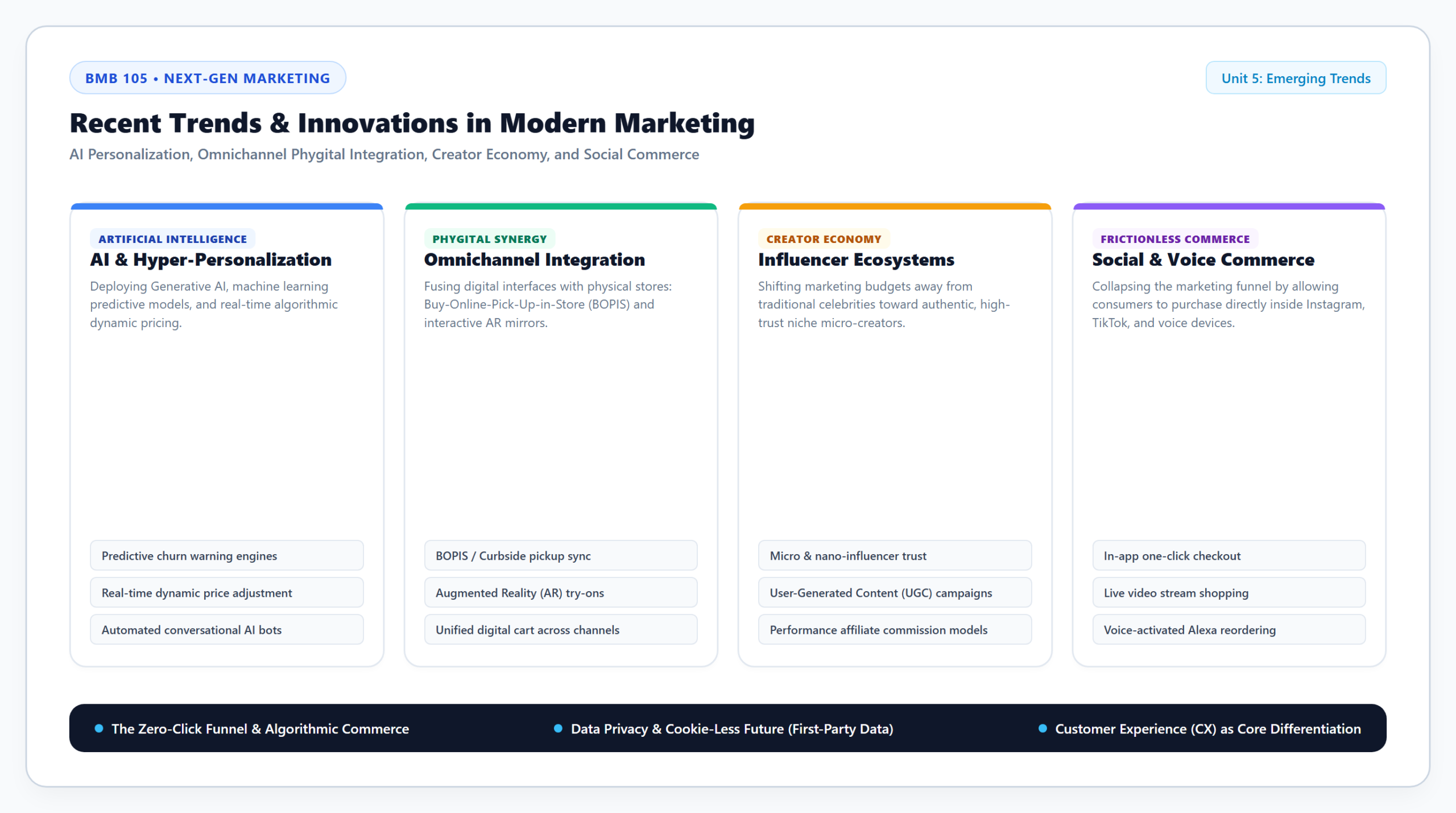
🧠 1. Core Concept & Business Meaning: Contemporary Marketing Innovations
Marketing has shifted from traditional transactional advertising (Marketing 1.0) and emotional positioning (Marketing 2.0/3.0) to Marketing 5.0: Technology for Humanity (Philip Kotler). Today’s marketing environment leverages advanced data architectures, algorithmic intelligence, and connected touchpoints to deliver tailored customer value at scale.
Rather than pushing standardized messages via unidirectional broadcast media (television, newspapers, outdoor billboards), contemporary enterprises utilize closed-loop digital feedback systems. Customer interactions across mobile applications, web portals, IoT devices, and physical smart stores continuously train machine learning models, allowing marketers to predict intent, personalize offerings in real time, and optimize conversion pathways dynamically.
⚙ 3. Key Dimensions & Strategic Mechanics of Marketing Innovation
Contemporary marketing leadership focuses on four major technological and strategic pillars:
AI applications have moved from peripheral experiments to mission-critical infrastructure:
- Predictive Lead Scoring & Churn Modeling: Machine learning algorithms evaluate hundreds of behavioural attributes to forecast customer drop-off before it happens.
- Algorithmic Dynamic Pricing: Adjusting prices in real time based on inventory levels, competitor rates, local demand surges, and consumer willingness to pay (e.g., Uber, Amazon, airline booking engines).
- Generative AI in Content Production: Generating personalized email copy, ad variations, and social media creative assets at near-zero marginal cost.
Consumers no longer shop across a single isolated channel. Omnichannel marketing synchronizes digital and physical channels so customers experience uninterrupted continuity:
- Buy Online, Pick Up in Store (BOPIS): Merging digital checkout convenience with physical store foot traffic.
- Endless Aisle: In-store tablet kiosks allowing customers to order out-of-stock items directly to their homes.
- Unified Customer Data Platforms (CDPs): Maintaining a single unified record of in-store transactions, app engagement, and customer support history.
Traditional celebrity endorsements are increasingly viewed with skepticism by Gen Z and millennial demographics. Brands have reallocated media budgets toward micro-influencers (10,000 to 100,000 followers) and nano-influencers (under 10,000 followers) who possess high niche topical credibility, genuine community trust, and significantly higher engagement rates per marketing dollar.
By enabling consumers to visualize products in their personal spaces before purchasing—such as testing lipstick shades on their face via mobile cameras (L’Oréal ModiFace) or projecting 3D furniture models into their living room (IKEA Place)—brands dramatically increase checkout confidence and slash product return rates by up to 30%.
📊 4. Comparative Synthesis Matrix: Traditional Marketing vs. Modern AI-Driven Marketing
The comparative table below outlines the structural shift between legacy traditional marketing and modern data-driven marketing:
| Strategic Dimension | Traditional Marketing | Modern AI-Driven Marketing |
|---|---|---|
| Communication Flow | One-way broadcast (TV, Print, Billboards). | Interactive, real-time closed-loop dialogue. |
| Audience Segmentation | Broad demographic groups (Age 25-40, Metro). | Hyper-personalized “Segment-of-One” micro-cohorts. |
| Campaign Cadence | Quarterly/annual campaigns with fixed creative. | Continuous A/B testing & real-time automated adjustments. |
| Measurement & Metrics | Gross Rating Points (GRP), recall surveys, delayed sales. | CAC, CLV, ROAS, click-through, attribution models. |
| Customer Relationship | Transactional; ends when retail sale completes. | Continuous lifecycle engagement & recurring subscriptions. |
💼 5. Real-World Corporate Case Studies
Spotify revolutionized music streaming by shifting from simple search directories to predictive algorithmic curation.
Its proprietary recommendation system analyzes individual listening patterns, skipping habits, and acoustic attributes to generate custom playlists like Discover Weekly and Release Radar. Furthermore, its annual viral campaign, Spotify Wrapped, transforms user behavioral data into personalized social media infographics, turning millions of users into organic brand advocates and driving record annual app downloads.
Indian beauty leader Nykaa transformed cosmetics retail by pioneering an integrated content-to-commerce engine.
Recognizing that beauty consumers require guidance and shade matching, Nykaa paired influencer video tutorials and beauty masterclasses directly with instant e-commerce purchasing. It expanded this with an omnichannel physical footprint (Nykaa Luxe and Nykaa On-Trend stores) featuring AR virtual makeover mirrors, allowing consumers to test thousands of lipstick and foundation shades digitally. This seamless blend of influencer content, digital AR try-ons, and physical fulfillment established Nykaa as India’s premier beauty destination.
Model Answer (40 words): Define it as the seamless integration of digital and physical touchpoints providing a unified customer experience; highlight improved retention and higher customer lifetime value.
Detail key operational areas: predictive customer churn, automated dynamic pricing, AI chatbots, and hyper-personalized content recommendation systems.
Structure your answer around the 4 key innovation pillars (AI & Predictive Analytics, Omnichannel Integration, Creator Economy, Immersive AR/VR). Contrast legacy marketing against modern data-driven ecosystems using the comparative matrix, and detail corporate case studies like Spotify and Nykaa.
Discussion & Questions
0 CommentsAcademic insights, questions, and conceptual clarifications from students & faculty.
No questions or comments yet
Have a doubt about this topic, an exam tip, or a conceptual perspective? Start the discussion below!
Leave a Comment / Ask a Question
Your email address will not be published. Required fields are marked *