
Relationship Marketing Vs. Relationship Management
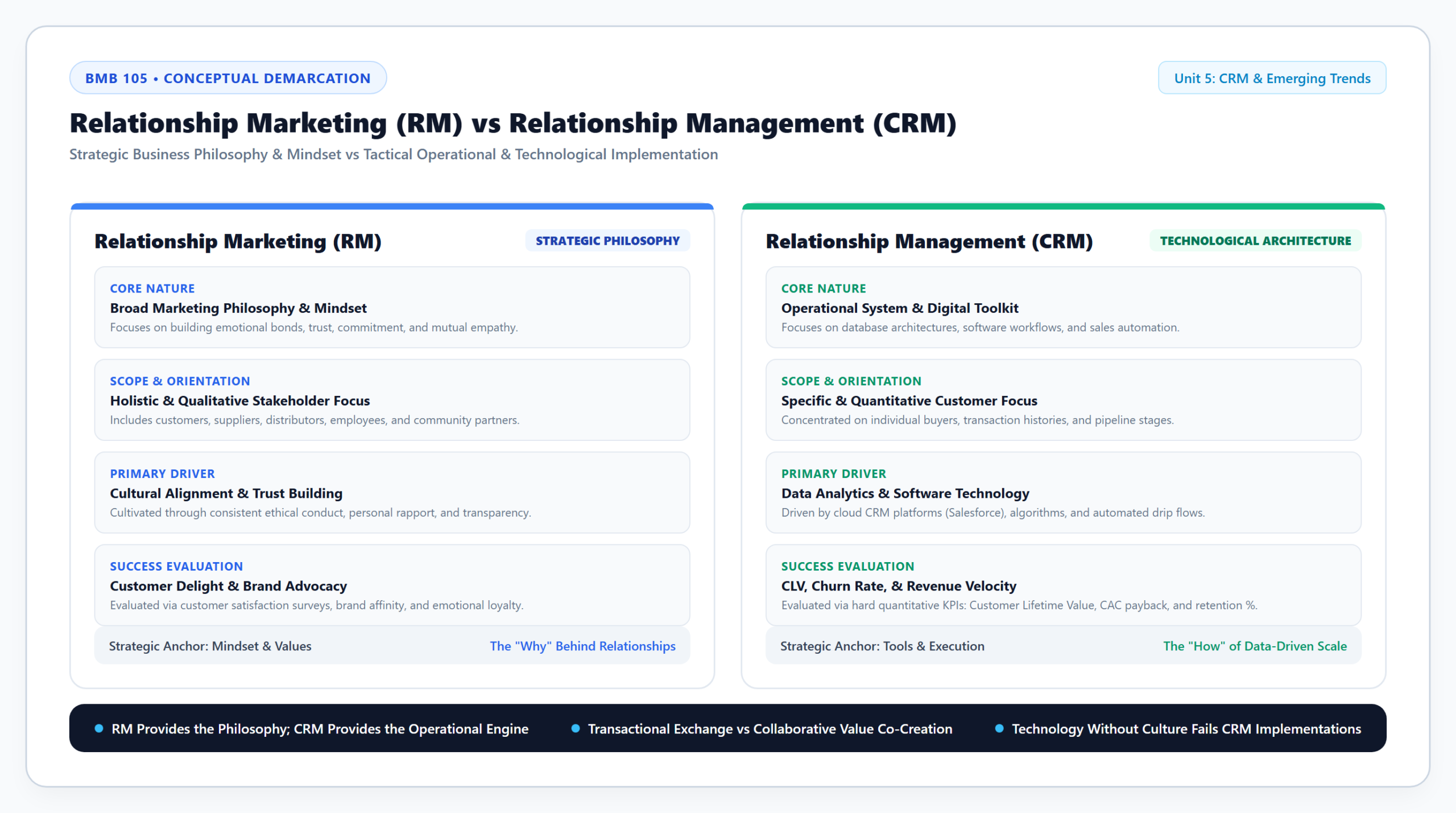
🧠 1. Core Concept & Business Meaning: RM vs CRM
Although often used interchangeably in casual business conversation, academic marketing literature and seasoned corporate leaders draw a clear boundary between Relationship Marketing (RM) and Customer Relationship Management (CRM).
Relationship Marketing (RM) is an overarching business philosophy first articulated by Leonard Berry in 1983. It represents a strategic mindset that shifts the entire organization away from discrete, adversarial transactions toward nurturing collaborative, trust-based relationships across a broad network of stakeholders (customers, channel partners, suppliers, and employees).
Customer Relationship Management (CRM), emerging in the late 1990s alongside enterprise database computing, is the practical, tactical, and technological apparatus used to operationalize Relationship Marketing. If Relationship Marketing is the philosophical architect defining the desired culture of customer loyalty, CRM is the engineering contractor deploying the databases, pipelines, and algorithms to execute that vision at scale.
⚙ 3. Key Dimensions & Strategic Mechanics: Comparing RM and CRM
Relationship Marketing adopts a holistic stakeholder perspective. It recognizes that maintaining strong customer loyalty is impossible if supplier relationships are combative or if employee turnover is severe. CRM adopts a customer-centric transactional focus, concentrating on capturing data points across customer touchpoints to streamline sales pipelines.
RM relies heavily on qualitative human dynamics: ethical integrity, executive leadership, shared values, transparent communication, and frontline empathy. CRM relies heavily on quantitative digital enablers: relational SQL databases, cloud computing, automated lead scoring, and predictive algorithms.
RM success is evaluated through qualitative sentiments: perceived customer delight, trust indices, brand affinity, and employee engagement scores. CRM success is audited via hard financial and operational KPIs: Customer Lifetime Value (CLV), Customer Acquisition Cost (CAC), churn rate percentage, and pipeline velocity.
Deploying CRM technology in an organization that lacks the Relationship Marketing mindset results in mechanical, spammy automation that alienates buyers. Conversely, practicing Relationship Marketing without modern CRM software limits an enterprise to small, artisanal scales. True market leadership occurs when RM philosophy guides CRM technological execution.
📊 4. Comparative Synthesis Matrix: Relationship Marketing (RM) vs CRM
| Dimension | Relationship Marketing (RM) | Customer Relationship Management (CRM) |
|---|---|---|
| Fundamental Nature | Broad strategic philosophy and cultural mindset | Operational system, software architecture, and process toolkit |
| Audience Scope | Broad stakeholders: Customers, suppliers, staff, community | Direct customers, prospects, and channel partners |
| Primary Enabler | Organizational culture, empathy, mutual trust, and ethics | Database software, cloud platforms (Salesforce), analytics |
| Measurement Paradigm | Qualitative: Customer delight, brand affinity, loyalty | Quantitative: CLV, churn rate, retention rate, conversion % |
| Strategic Question | “Why do we value customer relationships?” | “How do we capture data and manage customer touchpoints?” |
💼 5. Real-World Corporate Case Studies
The luxury hotel chain The Ritz-Carlton exemplifies the perfect synergy between RM philosophy and CRM technology.
Its cultural philosophy (RM) is famously captured in its motto: “We are Ladies and Gentlemen serving Ladies and Gentlemen,” granting every employee a $2,000 discretionary budget to resolve guest issues instantly without management approval. This culture is backed by Mystique, a proprietary CRM database tracking guest preferences (e. g. , extra foam pillows, hypoallergenic sheets, preferred morning tea). When a guest checks into any Ritz-Carlton property worldwide, their preferences are already fulfilled, creating extraordinary customer retention.
Harley-Davidson faced near-bankruptcy in the 1980s against Japanese motorcycle imports.
Rather than competing purely on technological features, Harley pioneered Relationship Marketing by establishing the Harley Owners Group (H. O. G. ). Executives and dealership owners regularly ride alongside customers at weekend motorcycle rallies, building deep subcultural bonds and emotional loyalty. This RM commitment—supported by modern CRM dealership management systems—allows Harley-Davidson to command industry-leading pricing premiums.
Model Answer (40 words): Marking Scheme: 3 marks for defining Relationship Marketing as a philosophy; 3 marks for defining CRM as an operational/technological system; 2 marks for structured comparison table; 2 marks for explaining why CRM fails without RM culture (software cannot replace genuine customer empathy).
Model Answer (40 words): Marking Scheme: 2 marks for stating that aggressive software marketing by enterprise vendors has overshadowed the fundamental organizational truth that CRM requires culture (people) and workflows (processes) to deliver value.
Marking Scheme: 2.5 marks for objectives (customer retention, trust building, mutual value co-creation); 2.5 marks for service organization benefits (intangible services require high trust, lower price sensitivity, and positive word-of-mouth).
Discussion & Questions
0 CommentsAcademic insights, questions, and conceptual clarifications from students & faculty.
No questions or comments yet
Have a doubt about this topic, an exam tip, or a conceptual perspective? Start the discussion below!
Leave a Comment / Ask a Question
Your email address will not be published. Required fields are marked *