
BPR Risk Assessment, Failure Mode and Effects Analysis (FMEA), and Enterprise Governance
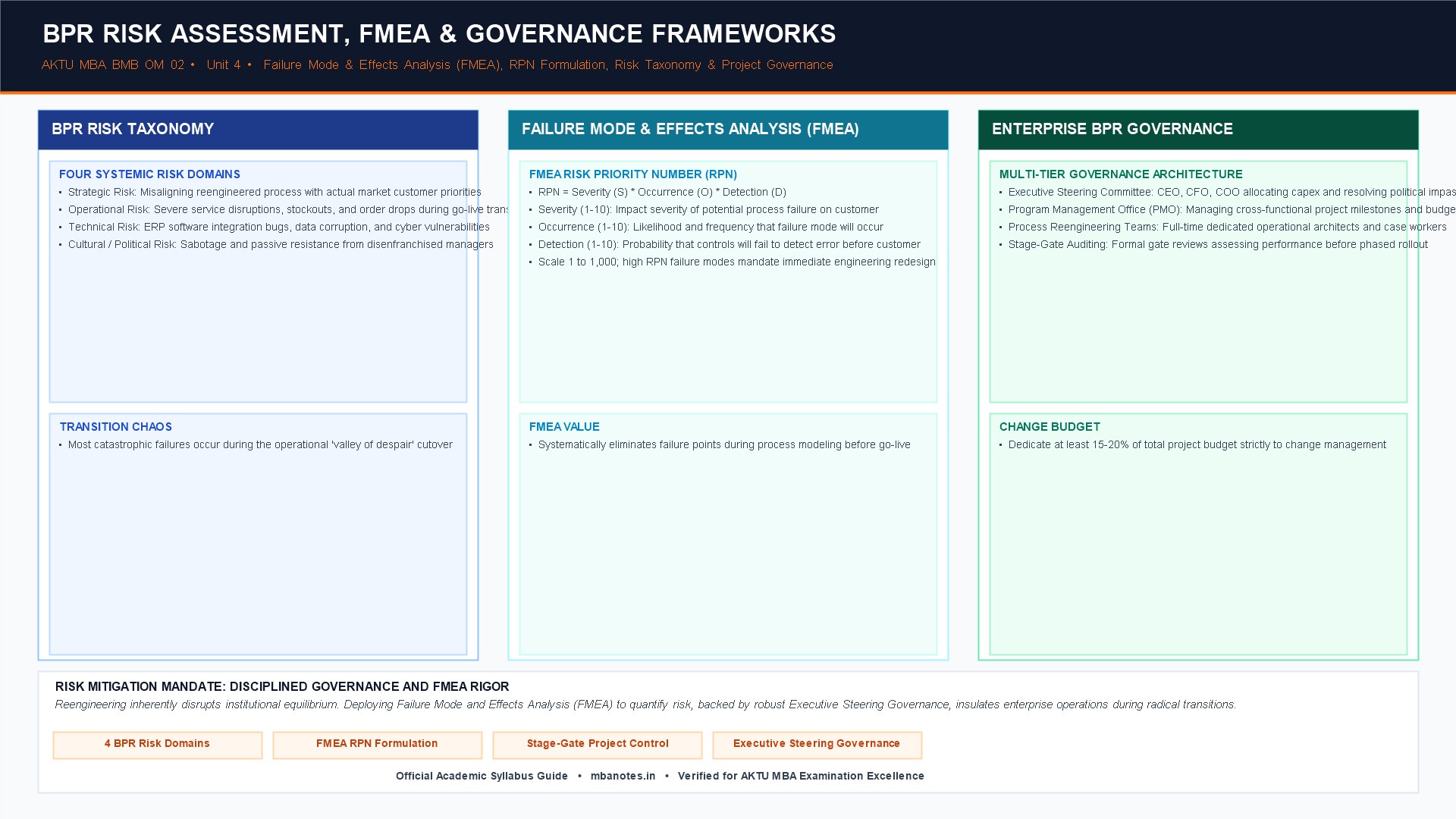
1. The Inherent Risk Architecture of Radical BPR
Because Business Process Reengineering involves radical clean-sheet redesign of core value streams, its risk profile is substantially higher than routine operational changes. When an enterprise rewires its entire order fulfillment or supply chain architecture, a misstep can disrupt production, alienate premier customers, and trigger crippling financial losses.
Risk management in BPR is not a defensive afterthought; it is an active engineering discipline integrated into every phase of the project lifecycle.
2. BPR Failure Mode Taxonomy: Technical, Social, and Strategic
1. Technical & Architecture Risks
Software bugs in new ERP/BPMS engines, legacy data migration corruption, network latency bottlenecks, and vendor platform lock-in.
2. Social & Cultural Risks
Passive-aggressive employee pushback, loss of key informal experts, union disputes, and widespread burnout from change fatigue.
3. Strategic & Governance Risks
Executive sponsor departure, misaligned corporate strategy, uncontrolled scope creep, and failure to establish post-cutover operational controls.
3. Failure Mode and Effects Analysis (FMEA) Methodology
Originally developed in the 1960s by aerospace reliability engineers, Process Failure Mode and Effects Analysis (PFMEA) is a structured qualitative and quantitative risk analysis tool adapted to BPR. PFMEA systematically identifies:
- Failure Mode: What could potentially go wrong in this redesigned process step?
- Failure Effect: What are the operational consequences on the customer or business?
- Failure Cause: What underlying weakness (software, training, policy) causes the failure?
- Current Controls: What mechanisms currently exist to prevent or catch this defect?
4. Risk Priority Number (RPN) Mathematical Formulation
The risk severity of each potential failure mode is quantified through the Risk Priority Number (RPN), calculated as the product of three ranking scales rated from 1 to 10:
RPN = ext{Severity (S)} imes ext{Occurrence (O)} imes ext{Detection (D)}
Scale: 1 (Lowest Risk) to 1000 (Maximum Critical Risk)
- Severity (S: 1-10): Assesses the gravity of the failure effect on customer satisfaction or legal compliance (1 = negligible nuisance; 10 = total catastrophic failure / regulatory shutdown).
- Occurrence (O: 1-10): Assesses the statistical probability or frequency of the cause occurring (1 = virtually impossible; 10 = almost inevitable).
- Detection (D: 1-10): Assesses the likelihood that current control mechanisms will catch the defect before reaching the customer (1 = guaranteed automatic detection; 10 = zero detection capability, completely hidden).
5. Worked Numerical Example: BPR Process FMEA
Problem Statement:
An e-commerce enterprise reengineers its Order Dispatch workflow from manual picking lists to automated automated robotic sortation. The risk team identifies two critical failure modes:
| Process Step | Potential Failure Mode | Severity (S) | Occurrence (O) | Detection (D) | Baseline RPN |
|---|---|---|---|---|---|
| Barcode Sorting | Barcode misread due to smudge; wrong item routed | 8 | 6 | 7 | RPN = 8 × 6 × 7 = 336 |
| Address Labeling | Label printer runs out of thermal ribbon; partial print | 7 | 4 | 3 | RPN = 7 × 4 × 3 = 84 |
Corrective Mitigation Action Plan:
Failure Mode 1 (Barcode Misread, RPN = 336) exceeds the enterprise critical action threshold of 150. The engineering team installs an automated dual-camera optical verification scanner with automatic rejection diverter.
Revised Severity (S) = 8 (Consequence unchanged)
Revised Occurrence (O) = 3 (High-resolution thermal laser printing)
Revised Detection (D) = 2 (Dual-camera vision scanner catches 99.8% of smudges)
Revised RPN = 8 imes 3 imes 2 = 48 (Slashing risk by 85.7%)
}$$Strategic Executive Summary: 3. BPR Risk Assessment, FMEA & Enterprise Governance
- Radical BPR carries high structural risk across technical, social, and strategic dimensions.
- Process FMEA provides an empirical framework to proactively isolate failure modes before go-live cutover.
- Risk Priority Number ($RPN = S imes O imes D$) quantitatively ranks failure modes to direct engineering resources.
- Executive Steering Committees utilize stage-gate reviews to ensure risk mitigation before authorizing capital release.
University Examination Question Bank & Model Solutions
Designed as per Dr. A.P.J. Abdul Kalam Technical University (AKTU) MBA Examination Pattern.
Part A: Conceptual 2-Mark Short Answer Questions
Q1 [2 Marks]: State the formula for calculating Risk Priority Number (RPN) in FMEA.
Ans: RPN = Severity (S) × Occurrence (O) × Detection (D), with each factor scored on a scale from 1 to 10.
Q2 [2 Marks]: What is the role of an Executive Steering Committee in BPR risk governance?
Ans: The Executive Steering Committee provides top-level project governance, resolves inter-departmental conflicts, approves stage-gate budget milestones, and monitors enterprise risk.
Q3 [2 Marks]: Why does improving the Detection score reduce RPN even if Severity remains constant?
Ans: Severity reflects customer harm if the defect escapes. By improving detection (e.g., automated Poka-Yoke sensors), defects are caught internally before ever reaching the customer.
Part B & C: Analytical 10-Mark Detailed Solutions & Numerical Blueprints
Question 1 [10/15 Marks]: Explain the methodology of Process Failure Mode and Effects Analysis (PFMEA) in business process reengineering. Detail the calculation and interpretation of RPN. (AKTU 10 Marks)
Model Examination Answer Blueprint:
- Introduction & Aerospace Origins: Frame PFMEA as a proactive risk mitigation framework ensuring TO-BE reliability.
- FMEA Core Components: Process Function, Potential Failure Mode, Potential Failure Effect, Severity (S), Potential Cause, Occurrence (O), Current Controls, Detection (D).
- RPN Mathematics: Detail $RPN = S \times O \times D$ on a 1-1000 scale. Define threshold cutoffs (e.g., RPN > 120 requires mandatory corrective action).
- Worked Practical Numerical: Present a clear table for an automated banking or supply chain process calculating baseline RPN and post-mitigation RPN.
- Governance Integration: Linking FMEA results to stage-gate project approvals.
Question 2 [10/15 Marks]: Classify the major risks associated with BPR projects across technical, organizational, and strategic dimensions. How should management mitigate them? (AKTU 10 Marks)
Model Examination Answer Blueprint:
- Taxonomy of BPR Risks:
- Technical: ERP implementation failure, software bugs, data loss, vendor lock-in.
- Organizational / Social: Cultural resistance, union disputes, loss of institutional knowledge, change fatigue.
- Strategic: Scope creep, executive champion departure, loss of focus on core customer value. - Mitigation Frameworks: Stage-gate reviews, robust change management (Kotter 8 steps), dual-run pilot rollouts, and executive steering committee oversight.
Frequently Asked Questions (Academic & Practitioner FAQ)
Q1. What is a "Stage-Gate" review process in BPR?
A Stage-Gate review is a formal project milestone where the executive steering committee audits deliverables, risks, and budget before authorizing funding for the next project phase.
Q2. Can Severity (S) ever be reduced in an FMEA?
Severity can only be reduced by fundamentally redesigning the process architecture so that even if the failure occurs, its consequence is harmless (e.g., adding an automatic physical bypass).
Discussion & Questions
0 CommentsAcademic insights, questions, and conceptual clarifications from students & faculty.
No questions or comments yet
Have a doubt about this topic, an exam tip, or a conceptual perspective? Start the discussion below!
Leave a Comment / Ask a Question
Your email address will not be published. Required fields are marked *