
Process Simulation Platforms and BPMS Workflow Engines in Business Process Reengineering
1. The Role of Simulation in Pre-Implementation BPR
Implementing a radically redesigned business process directly into live corporate operations without prior testing is an immense gamble. Unexpected bottlenecks, resource starvation, and queuing cascades can shut down corporate order fulfillment.
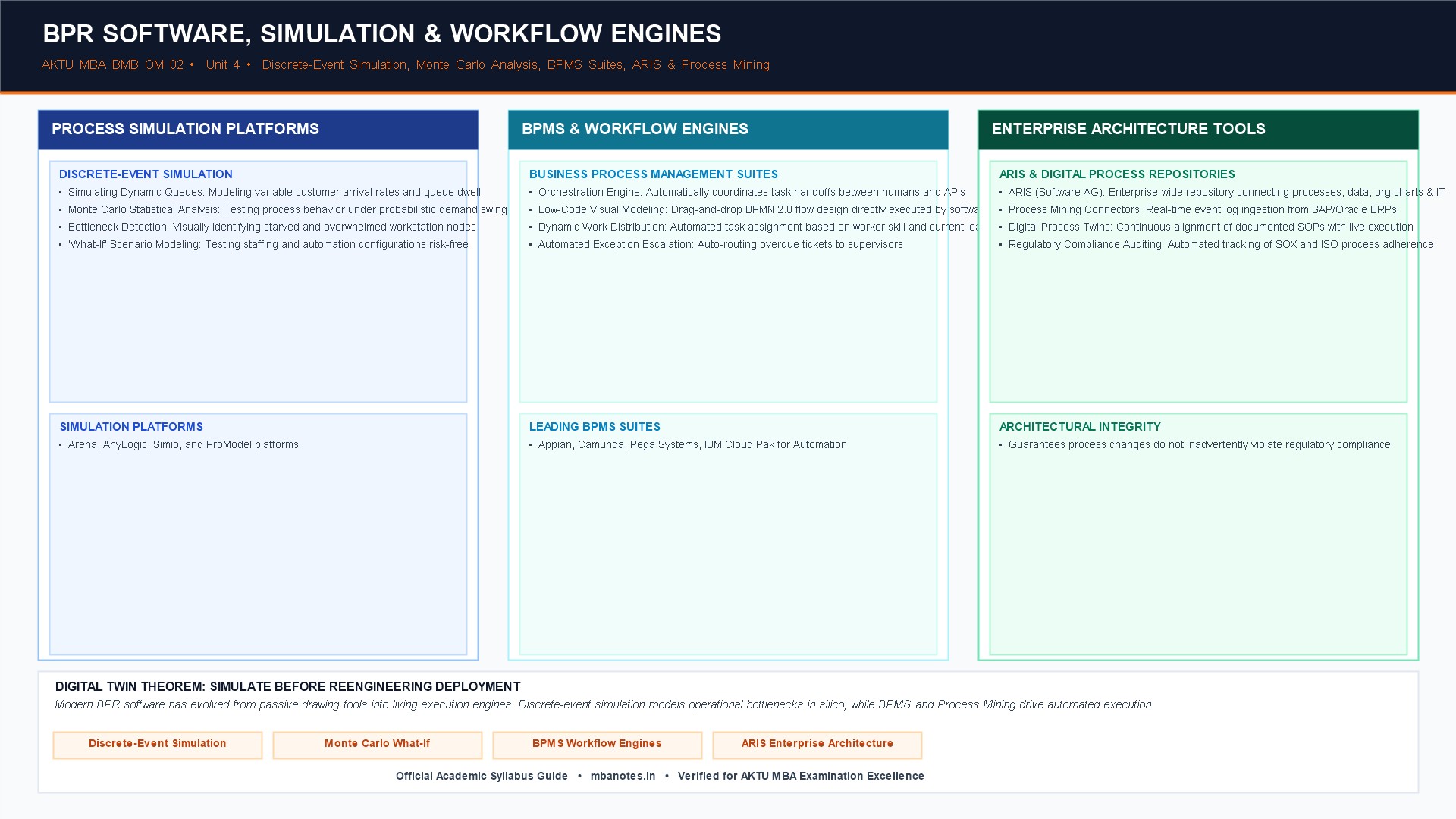
Business Process Simulation creates a dynamic, computer-based replica of the TO-BE operating model. By running thousands of simulated transactions under variable stochastic conditions, BPR architects stress-test assumptions, validate resource sizing, and uncover hidden bottlenecks in a risk-free virtual laboratory.
2. Discrete-Event Simulation (DES) & Stochastic Modeling
Static spreadsheet calculations assume deterministic averages (e.g., "every order takes exactly 15 minutes"). In reality, operational processes are characterized by stochastic variability: arrival rates fluctuate according to Poisson distributions, and processing times vary according to Erlang or log-normal distributions.
Discrete-Event Simulation (DES) models the operation of a system as a chronological sequence of distinct events (e.g., order arrival, start service, finish inspection). Coupled with Monte Carlo analysis, DES allows reengineering teams to answer critical "What-If" operational questions:
- What happens to customer queue times if order volume surges by 300% during Black Friday?
- How many cross-skilled case workers are required to guarantee a 99% SLA under peak demand?
- Where will the secondary bottleneck shift if we automate step 3 with straight-through processing?
3. BPMS Workflow Engines Architecture
A Business Process Management Suite (BPMS) is an enterprise software platform that enables organizations to model, automate, execute, monitor, and optimize cross-functional workflows. Modern leading BPMS engines include Camunda, Appian, Pegasystems, and IBM Cloud Pak.
1. Process Modeling & Execution Engine
Translates BPMN 2.0 visual diagrams directly into executable XML code. The workflow state engine orchestrates task assignments, timers, and automated gateway routing.
2. Business Rules Engine (BRE)
Decouples business decision logic (e.g., credit underwriting limits, pricing discounts) from core programming code, allowing managers to modify rules without IT developer intervention.
3. Enterprise Integration Adapters
Connects seamlessly to legacy ERP databases, CRM platforms, cloud APIs, and RPA bots, eliminating manual data re-keying across systems.
4. Business Activity Monitoring (BAM)
Provides real-time executive telemetry dashboards displaying live throughput rates, active WIP queue depths, and SLA threshold violations.
4. ARIS Framework & Enterprise Architecture Repositories
Developed by Professor August-Wilhelm Scheer, ARIS (Architecture of Integrated Information Systems) is a world-renowned framework for modeling enterprise process landscapes. ARIS breaks complex organizations into five integrated architectural views:
- Organization View: Hierarchies, organizational units, roles, and reporting relationships.
- Data View: Data models, entity-relationship diagrams, and master data structures.
- Function View: Functional decomposition, goals, and applications.
- Output View: Products, services, and financial deliverables.
- Control View: The central synthesizing core that integrates the other four views via Event-Driven Process Chains (EPC).
5. Digital Twin of an Organization (DTO)
The latest frontier in BPR simulation is the Digital Twin of an Organization (DTO). Pioneered by Gartner, a DTO is a dynamic, software-enabled virtual model of an entire enterprise that continuously ingests operational event data from live ERP, CRM, and IoT feeds.
A DTO allows executives to conduct continuous real-time experimentation: simulating the exact financial and lead time impacts of closing a warehouse, changing supplier lead times, or launching a new product line before making real-world capital commitments.
Strategic Executive Summary: 4. Process Simulation Platforms & BPMS Workflow Engines
- Discrete-Event Simulation (DES) stress-tests TO-BE process designs under stochastic variability before live deployment.
- BPMS platforms translate visual BPMN 2.0 workflows into directly executable enterprise software code.
- A Business Rules Engine (BRE) allows operational policy changes without requiring core software recoding.
- Digital Twins of an Organization (DTO) ingest live operational telemetry to enable continuous virtual reengineering.
University Examination Question Bank & Model Solutions
Designed as per Dr. A.P.J. Abdul Kalam Technical University (AKTU) MBA Examination Pattern.
Part A: Conceptual 2-Mark Short Answer Questions
Q1 [2 Marks]: What is Discrete-Event Simulation (DES)?
Ans: DES is a computational modeling technique that simulates the operation of a system as a chronological sequence of distinct stochastic events, capturing queue dynamics and resource bottlenecks.
Q2 [2 Marks]: Name four core architectural components of a modern BPMS.
Ans: 1. Process Modeling Engine, 2. Workflow Execution Engine, 3. Business Rules Engine (BRE), 4. Business Activity Monitoring (BAM) Dashboards.
Q3 [2 Marks]: What does DTO stand for in modern enterprise operations?
Ans: Digital Twin of an Organization.
Part B & C: Analytical 10-Mark Detailed Solutions & Numerical Blueprints
Question 1 [10/15 Marks]: Examine the architecture and strategic capabilities of Business Process Management Systems (BPMS). How do BPMS platforms bridge the gap between process design and execution? (AKTU 10 Marks)
Model Examination Answer Blueprint:
- Introduction: Define BPMS as software platforms that manage, execute, and monitor end-to-end business workflows.
- Core BPMS Architecture:
- Design Layer: BPMN 2.0 visual modeling with XML standardization.
- Execution Layer: Process orchestrator, state manager, task routing worklist.
- Decision Layer: Business Rules Engine (BRE) with DMN (Decision Model and Notation).
- Monitoring Layer: BAM dashboards, real-time KPI alerts, bottleneck heatmaps. - Bridging Design and Execution: How BPMS eliminates the traditional software development lag by allowing business analysts to design executable processes directly.
Question 2 [10/15 Marks]: Discuss the role of Discrete-Event Simulation (DES) in evaluating alternative TO-BE process architectures during BPR. Contrast static modeling with dynamic simulation. (AKTU 10 Marks)
Model Examination Answer Blueprint:
- Flaws of Static Modeling: Deterministic averages ignore arrival spikes, machine downtime, and queuing cascades (the flaw of averages).
- Dynamic Simulation Principles: Probability distributions (Poisson, Normal, Weibull), Monte Carlo iteration, resource contention, and queue accumulation.
- Strategic Decision Support:
- Evaluating required staffing levels across shifting demand patterns.
- Validating SLA compliance under peak stress scenarios.
- Calculating precise ROI before approving multi-million-dollar automation capital expenditures.
Frequently Asked Questions (Academic & Practitioner FAQ)
Q1. What is the difference between a BPMS and a traditional ERP system?
An ERP system is a transactional system of record focusing on data tables and ledgers. A BPMS is a process orchestration engine that coordinates human tasks and software calls across multiple systems of record.
Q2. What is Business Activity Monitoring (BAM)?
BAM is a real-time operational dashboard capability within BPMS that tracks live process KPIs (cycle times, queue depths, error rates) and triggers instant alerts when SLAs are breached.
Discussion & Questions
0 CommentsAcademic insights, questions, and conceptual clarifications from students & faculty.
No questions or comments yet
Have a doubt about this topic, an exam tip, or a conceptual perspective? Start the discussion below!
Leave a Comment / Ask a Question
Your email address will not be published. Required fields are marked *