
Sales Forecasting Methods: Qualitative and Quantitative Approaches, Demand Modeling and S&OP Integration
1. Conceptual Foundations and Strategic Role of Sales Forecasting
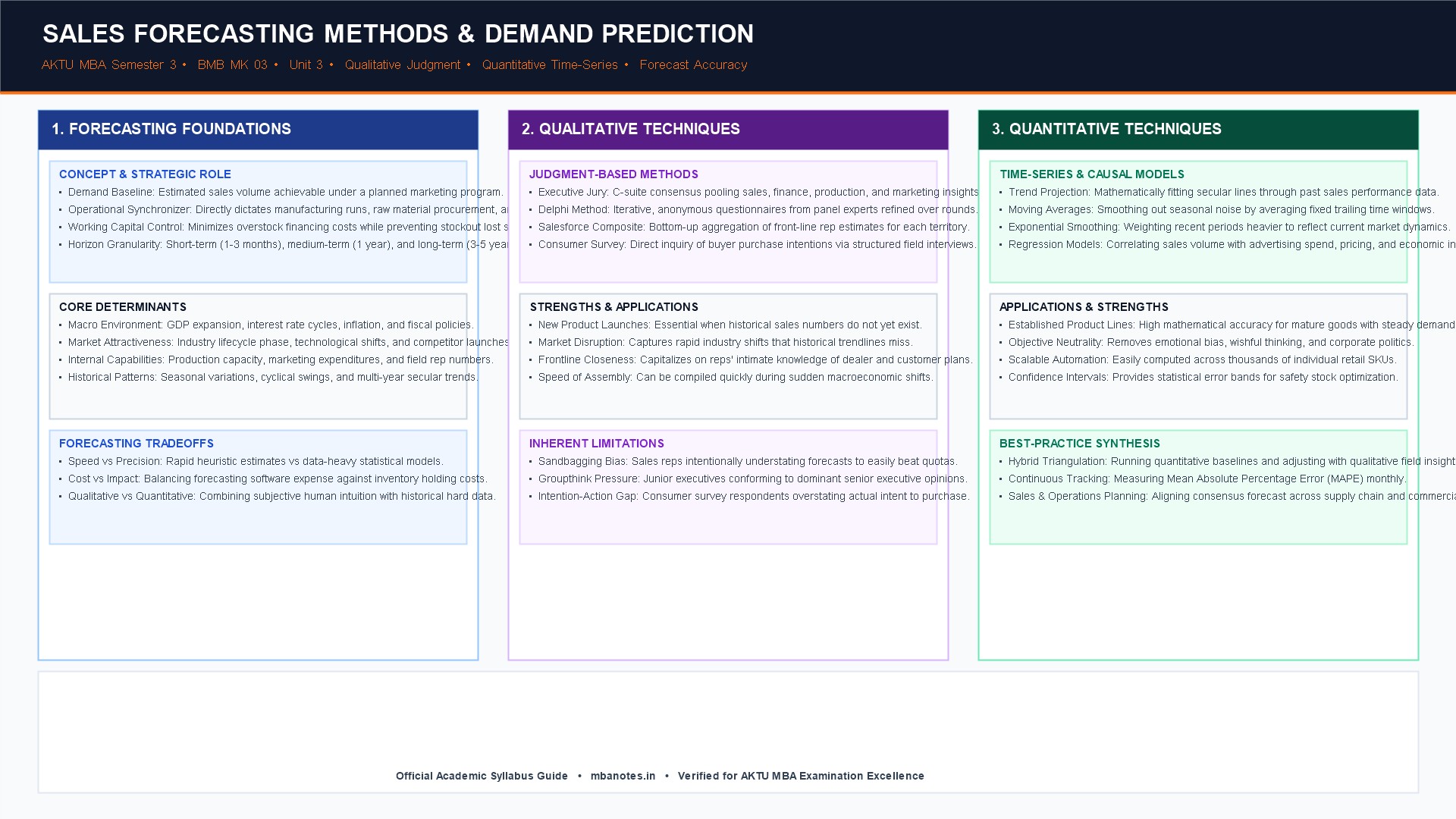
A sales forecast is an estimate of the expected monetary or unit sales that a company can realistically achieve within a specified future time period, for a designated product line or geographic territory, under a proposed marketing plan and an assumed set of macroeconomic conditions. Sales forecasting is the operational linchpin of the entire corporate enterprise. Every major operational commitment—from raw material purchase contracts, factory shift scheduling, and warehouse lease commitments to executive hiring and cash flow financing—stems directly from the sales forecast baseline.
The strategic functions governed by sales forecasting encompass:
- Controls Working Capital and Inventory Holding Costs: Underestimating demand leads to disastrous stockouts, factory idling, and lost customer goodwill; overestimating demand produces bloated warehouse inventories, expensive carrying costs, and distress markdown write-offs.
- Directs Manufacturing and Supply Chain Capacity: Allows operations directors to schedule production runs, organize machinery maintenance shutdowns, and negotiate bulk raw material discounts.
- Governs Human Resource Headcount Planning: Dictates whether the enterprise needs to recruit additional frontline sales engineers, field technicians, or customer support staff.
- Establishes Financial Budgeting Ceilings: Corporate cash flow projections, trade credit borrowings, and capital expenditure approvals are calibrated to expected cash inflows from forecasted sales.
2. Qualitative (Judgmental) Forecasting Methodologies
Qualitative forecasting techniques rely primarily on human judgment, expert intuition, and subjective assessment rather than historical numerical data. These methods are indispensable when launching radically new innovations with zero past sales history, entering unfamiliar geographic markets, or during severe macroeconomic disruptions where historical trendlines become useless.
The four primary qualitative forecasting methodologies encompass:
- Executive Opinion (Jury of Executive Opinion): A top-down approach where senior executives across Sales, Marketing, Finance, and Production pool their judgment to arrive at a consensus sales forecast.
- Strengths: Rapid execution, low administrative cost, incorporates executive wisdom and industry experience.
- Weaknesses: Highly vulnerable to corporate groupthink, political bias, and dominant senior personalities.
- The Delphi Method: An iterative, structured forecasting procedure developed by the RAND Corporation:
- A panel of internal and external industry experts independently answers written questionnaires regarding future demand.
- A neutral coordinator compiles responses, summarizes central tendencies, and returns the anonymized summary to the panel.
- Experts refine their estimates over 3 to 4 sequential rounds until statistical consensus emerges.
- Strengths: Complete anonymity eliminates peer pressure, seniority bias, and groupthink.
- Salesforce Composite (Grassroots Method): A bottom-up approach where each territory sales representative estimates future sales for their accounts; district managers aggregate these numbers, passing them upward to regional and national leadership.
- Strengths: Capitalizes on frontline reps' intimate knowledge of dealer inventories and customer expansion plans.
- Weaknesses: Reps routinely "sandbag" (intentionally underestimate forecasts) so they can easily exceed their resulting quotas and collect high commissions.
- Survey of Buyer Intentions: Direct inquiry of prospective buyers regarding their planned purchase volumes through structured questionnaires and focus groups. Highly effective for B2B industrial markets with small customer populations.
3. Quantitative (Mathematical & Causal) Forecasting Models
Quantitative forecasting models utilize historical numerical time-series data or mathematical causal relationships to project future demand. These models assume that past underlying patterns (trends, seasonality, cycles) will continue into the future.
The foundational quantitative forecasting techniques include:
- Trend Projection (Linear & Non-Linear Extrapolation): Fitting mathematical trendlines through past sales performance data over multi-year periods to project the baseline trajectory.
- Moving Averages: Smoothing out short-term random demand fluctuations by averaging historical sales across fixed trailing time windows (e.g., 3-month or 6-month trailing averages). As each new month's data arrives, the oldest month is dropped.
- Application: Highly effective for mature products exhibiting steady, stable demand without sharp seasonality.
- Exponential Smoothing: A sophisticated moving average technique that assigns exponentially decreasing weights to older historical periods, placing the highest mathematical weight on the most recent sales data to reflect current market realities.
- Causal / Econometric Regression Models: Mathematical models that correlate sales volume (the dependent variable) with one or more underlying causal factors (independent variables), such as national disposable income, advertising expenditures, product price changes, and housing starts.
4. Comparative Evaluation Matrix & S&OP Integration
World-class corporations do not rely solely on a single forecasting technique. Instead, they synthesize quantitative mathematical baselines with qualitative frontline insights inside a formalized Sales and Operations Planning (S&OP) governance cadence.
Sales & Operations Planning (S&OP) Consensus Framework
The Sales and Operations Planning (S&OP) process is a monthly executive governance discipline that brings commercial sales, brand marketing, factory operations, procurement, and finance together. S&OP reconciles divergent organizational perspectives—sales reps who want excess buffer inventory to avoid stockouts versus finance controllers who demand minimal working capital lockup. By developing a single "Consensus Forecast," the enterprise synchronizes field demand signals with manufacturing schedules.
| Methodology | Classification | Data Requirements | Primary Application | Key Limitation |
|---|---|---|---|---|
| Executive Jury | Qualitative | Zero historical data needed; executive wisdom. | Rapid strategic shifts, economic crises. | Subject to corporate politics and groupthink. |
| Delphi Method | Qualitative | Expert panel questionnaires and iterations. | Long-range technological disruptions (5-10 yrs). | Time-consuming; panel attrition over rounds. |
| Salesforce Composite | Qualitative | Frontline territory rep account projections. | Short-term quarterly commercial planning. | Rep sandbagging bias to lower quotas. |
| Moving Averages | Quantitative | Trailing numerical sales data (1-2 years). | Stable consumer staples, mature SKUs. | Lags sudden market upturns or downturns. |
| Causal Regression | Quantitative | Historical sales paired with economic variables. | Capital equipment, consumer durables, housing. | Complex modeling; requires macro index data. |
6. Corporate Case Vignette: Real-World Implementation
Whirlpool Corporation: Integrating CPFR & S&OP for Demand Forecasting Precision
Corporate Context & Challenge: Whirlpool, a global leader in home appliances (washing machines, refrigerators), faced extreme demand volatility. Retail partners like Sears, Home Depot, and Best Buy frequently experienced stockouts of hot-selling models during festive promotional periods, while unwanted appliance models cluttered regional warehouses, racking up millions in carrying costs. Whirlpool's commercial sales force operated on overly optimistic forecasts to protect dealer allocations, while factory production teams ran steady, flat manufacturing schedules that ignored retail promotions.
Strategic Intervention & Implementation: Whirlpool pioneered a comprehensive digital demand-forecasting overhaul centered on Collaborative Planning, Forecasting, and Replenishment (CPFR) and S&OP integration:
- POS Data Telemetry Ingestion: Whirlpool integrated real-time Point-of-Sale (POS) scanner data directly from retail partner cash registers into its demand forecasting algorithms, replacing monthly wholesale estimates with daily consumer purchase signals.
- Hybrid Algorithmic Modeling: Time-series exponential smoothing baselines were automatically adjusted by causal promotional models tracking consumer interest rates and regional housing starts.
- Disciplined Executive S&OP: Whirlpool instituted a mandatory monthly S&OP session where commercial sales heads, manufacturing plant leaders, and the CFO signed off on a single consensus production plan.
Strategic Outcome & Lessons Learned: Forecast accuracy improved by over 26%, finished goods warehouse inventory dropped by $100+ million, and retail fill rates surged to 96%. Whirlpool's success proves that forecasting excellence requires moving beyond isolated mathematical guessing to establish automated data integration and cross-functional S&OP consensus.
7. AKTU University Exam Practice Drill
AKTU Master Question Bank: Sales Forecasting Methods
Model answers prepared strictly according to AKTU evaluation rubrics and standard MBA marking schemes.
Explain the Delphi Method of sales forecasting in two concise points.
Model Answer:
- Iterative Anonymity: A panel of independent experts responds to sequential rounds of questionnaires anonymously, eliminating peer pressure, seniority bias, and groupthink.
- Facilitated Statistical Convergence: A neutral coordinator summarizes findings between rounds, allowing experts to refine their estimates until a reliable consensus forecast emerges.
Define Sales Forecasting. Differentiate between qualitative and quantitative forecasting methods with suitable examples. Discuss the role of Sales & Operations Planning (S&OP) in modern business.
Comprehensive University Framework:
1. Formal Definition: Sales forecasting is the systematic estimation of future sales volume (in currency or units) that an enterprise can achieve over a specified period under a proposed marketing strategy and an assumed macroeconomic environment.
2. Qualitative vs Quantitative Approaches:
- Qualitative Methods: Rely on human judgment, expert intuition, and subjective assessment. Essential when past sales data is unavailable (e.g., new product launches). Examples: Executive Opinion, Delphi Method, Salesforce Composite, Buyer Intention Surveys. Drawback: Vulnerable to cognitive bias and rep sandbagging.
- Quantitative Methods: Utilize historical numerical time-series and mathematical causal equations. Highly objective and scalable. Examples: Moving Averages, Exponential Smoothing, and Causal Linear Regression. Drawback: Assumes the future will mirror the past; fails during sudden market disruptions.
3. Role of Sales & Operations Planning (S&OP): S&OP is a monthly cross-functional business governance process that harmonizes commercial sales demand with manufacturing production, procurement, and financial capital. It resolves conflicts between commercial sales teams (who want excess inventory to prevent stockouts) and finance/operations (who demand minimal working capital and smooth manufacturing runs), establishing a unified "Consensus Forecast" for the enterprise.
Discussion & Questions
0 CommentsAcademic insights, questions, and conceptual clarifications from students & faculty.
No questions or comments yet
Have a doubt about this topic, an exam tip, or a conceptual perspective? Start the discussion below!
Leave a Comment / Ask a Question
Your email address will not be published. Required fields are marked *