

Big Data Warehousing, Cloud Architectures, and Ethical Issues in Data Mining (DPDP Compliance & Algorithmic Fairness)
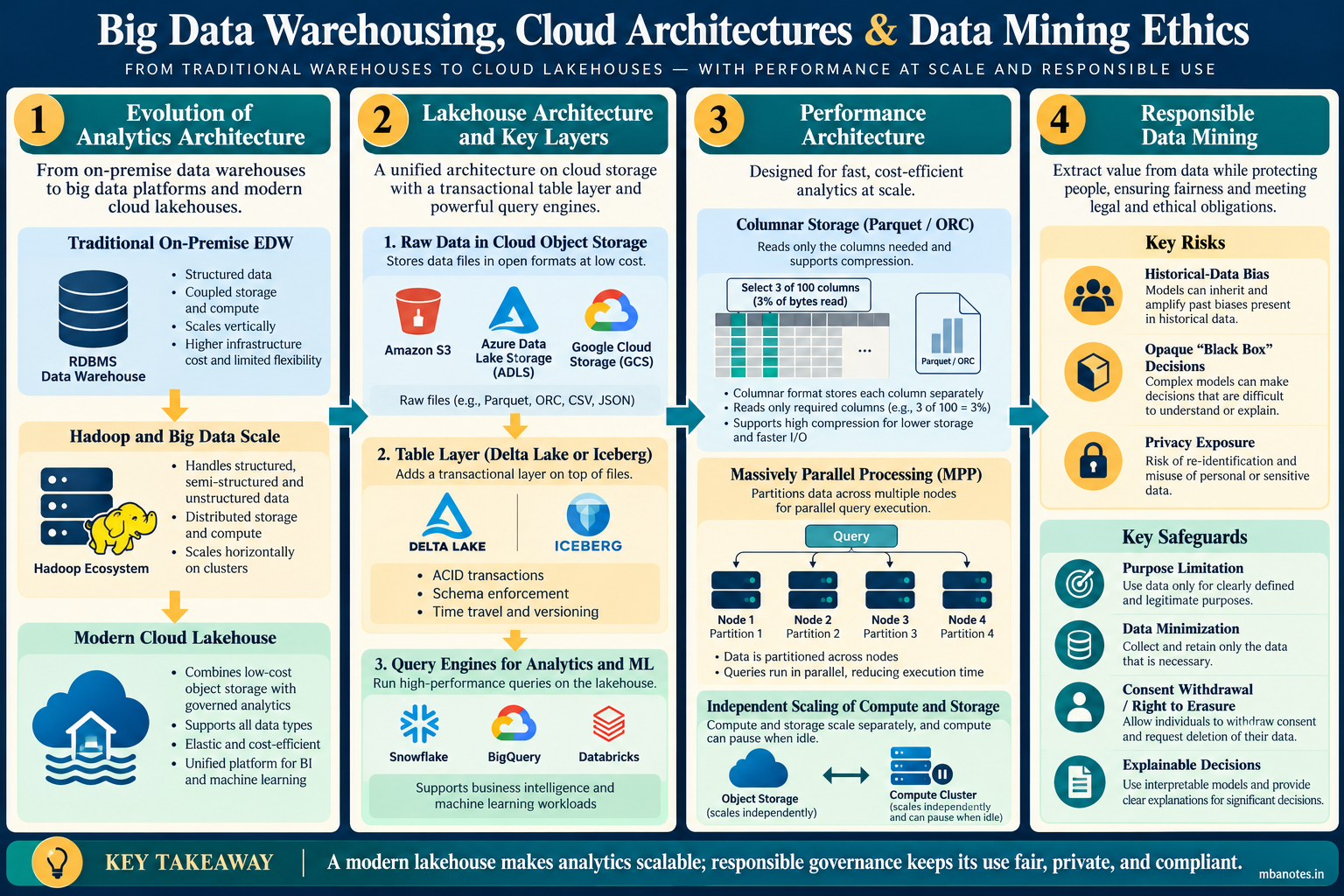
1. Limitations of Traditional Data Warehouses in the Big Data Era
Traditional on-premise Enterprise Data Warehouses (EDWs) were engineered for structured relational data generated in controlled corporate ERPs. However, the modern explosion of Big Data (characterized by the 5 Vs: Volume, Velocity, Variety, Veracity, and Value) overwhelmed legacy architectures:
- Traditional warehouses could not store or query semi-structured JSON logs or unstructured audio/video.
- Coupled storage and compute infrastructure required buying expensive proprietary appliance hardware whenever storage expanded, even if query compute needs remained flat.
- ETL batch loading windows collapsed as businesses demanded real-time streaming analytics rather than overnight batch updates.
2. The Modern Cloud Data Lakehouse Architecture
To unify the scale of cheap object storage with the governance of data warehouses, modern enterprises deploy the Data Lakehouse (pioneered by Databricks Delta Lake and Apache Iceberg):
- Bottom Storage Layer (Data Lake): Low-cost, highly durable public cloud object storage (Amazon S3, Azure Data Lake Storage, Google Cloud Storage) storing raw data in all formats.
- Structured Transactional Layer (Delta Lake / Iceberg): Adds ACID transactions, schema enforcement, time travel (data versioning), and metadata indexing on top of open object storage.
- High-Performance Analytical Engines: Decoupled SQL query engines (Snowflake, BigQuery, Databricks Photon) that query the unified lakehouse directly for BI dashboards and machine learning model training without duplicating data into proprietary warehouse silos.
3. Columnar Storage & Massively Parallel Processing (MPP)
Modern cloud warehouses achieve 100x query acceleration through two architectural innovations:
| Architectural Feature | Technical Mechanism | Analytical Performance Advantage |
|---|---|---|
| Columnar Storage (Parquet / ORC) | Stores data on disk by columns rather than by rows. | Queries analyzing 3 columns out of 100 read only 3% of disk bytes; enables 80% compression due to identical data types. |
| Massively Parallel Processing (MPP) | Partitions large fact tables across dozens of independent computing nodes. | Analytical aggregations execute simultaneously in parallel across multi-node clusters, slashing query time. |
| Decoupled Compute & Storage | Compute virtual warehouses scale up, down, or suspend automatically. | Zero compute costs when queries are inactive; massive multi-cluster compute on month-end financial closes. |
4. Ethical Dilemmas: Algorithmic Bias & The Black-Box Problem
The automated power of data mining presents significant ethical and societal perils:
- Algorithmic Bias & Discrimination: If historical training data reflects human societal discrimination, algorithms will encode and amplify that bias (e.g., credit scoring algorithms trained on historical lending data unfairly rejecting female or minority applicants).
- The "Black Box" Problem: Deep neural networks and ensemble models make highly accurate predictions but lack human interpretability. In sensitive domains (hiring, loan approvals, criminal justice), individuals have an ethical and legal right to know why an automated decision was made.
- Privacy Invasions: Mining un-anonymized data can reveal sensitive personal attributes (health conditions, political leanings) without explicit citizen knowledge.
5. Regulatory Compliance under India’s DPDP Act, 2023
The enactment of India’s Digital Personal Data Protection (DPDP) Act, 2023 imposes strict legal guardrails on enterprise data mining:
- Purpose Limitation: Personal consumer data collected for one purpose (e.g., e-commerce delivery) cannot be repurposed for training marketing data mining models without separate explicit consent.
- Data Minimization: Enterprises must only extract and retain attributes strictly necessary for the analytical task, discarding identifiers via differential privacy and cryptographic hashing.
- Right to Erasure & Withdrawn Consent: When a consumer revokes consent, data pipelines must remove their records from active training datasets.
- Non-Compliance Penalties: Financial penalties up to ₹250 Crores adjudicated by the Data Protection Board of India for failing to secure personal data against breaches.
University Examination Question Bank & Model Solutions
Designed as per Dr. A.P.J. Abdul Kalam Technical University (AKTU) MBA Examination Pattern.
Part A: Conceptual 2-Mark Short Answer Questions
Q1 [2 Marks]: Define the core operational scope of Big Data, Cloud & Mining Ethics in enterprise systems.
Ans: It represents a key frontier analytics and data architecture paradigm governing how unstructured textual records, web structures, enterprise CRM/fraud workflows, or modern cloud data lakehouses are deployed responsibly.
Q2 [2 Marks]: What is the significance of Architectural Evolution in modern data intelligence?
Ans: It establishes the formal mechanisms—such as NLP vectorization, web graph algorithms, real-time RFM scoring, or decoupled cloud lakehouse storage—that unlock commercial value from complex data.
Part B & C: Analytical 10-Mark Detailed Solutions & Technical Frameworks
Question 1
Model Examination Answer Blueprint:
Strategic Executive Summary: 20. Big Data, Cloud & Mining Ethics
- Unstructured Text Monetization: Converting raw customer reviews and support tickets into quantifiable TF-IDF vectors and sentiment polarity scores.
- Web Intelligence: Deploying Web Structure (PageRank) and Web Usage (Clickstream) analytics to optimize search rankings and e-commerce conversion funnels.
- Closed-Loop Enterprise Analytics: Embedding real-time churn forecasting and fraud isolation models directly into CRM and payment processing pipelines.
- Modern Cloud Lakehouse Governance: Decoupling compute and storage on open Parquet formats while maintaining strict DPDP Act privacy compliance.
Frequently Asked Questions (Academic & Technical FAQ)
Q1. What makes Big Data, Cloud & Mining Ethics critical for modern enterprise managers?
It equips business leaders to capitalize on modern unstructured text, web interactions, and cloud data platforms while rigorously insulating the firm against algorithmic bias and legal data privacy penalties.
Q2. How do practitioners apply these principles in corporate environments?
Data engineers build automated TF-IDF and sentiment NLP pipelines, analyze server clickstream logs, train RFM customer models, and deploy Snowflake or Databricks Lakehouse clusters with role-based access controls.
Q3. What are the most frequent examination questions asked from this topic in AKTU?
AKTU examinations frequently require explaining the text mining NLP pipeline and calculating TF-IDF, comparing Web Content vs Structure vs Usage mining, detailing the PageRank algorithm, explaining Analytical CRM and RFM segmentation, detailing modern Data Lakehouse architectures, and discussing ethical issues and DPDP Act compliance.
Discussion & Questions
0 CommentsAcademic insights, questions, and conceptual clarifications from students & faculty.
No questions or comments yet
Have a doubt about this topic, an exam tip, or a conceptual perspective? Start the discussion below!
Leave a Comment / Ask a Question
Your email address will not be published. Required fields are marked *