
Enterprise Data Mining Applications: Analytical CRM, Financial Fraud Detection, and Retail Analytics
1. The Paradigm of Enterprise Data Mining
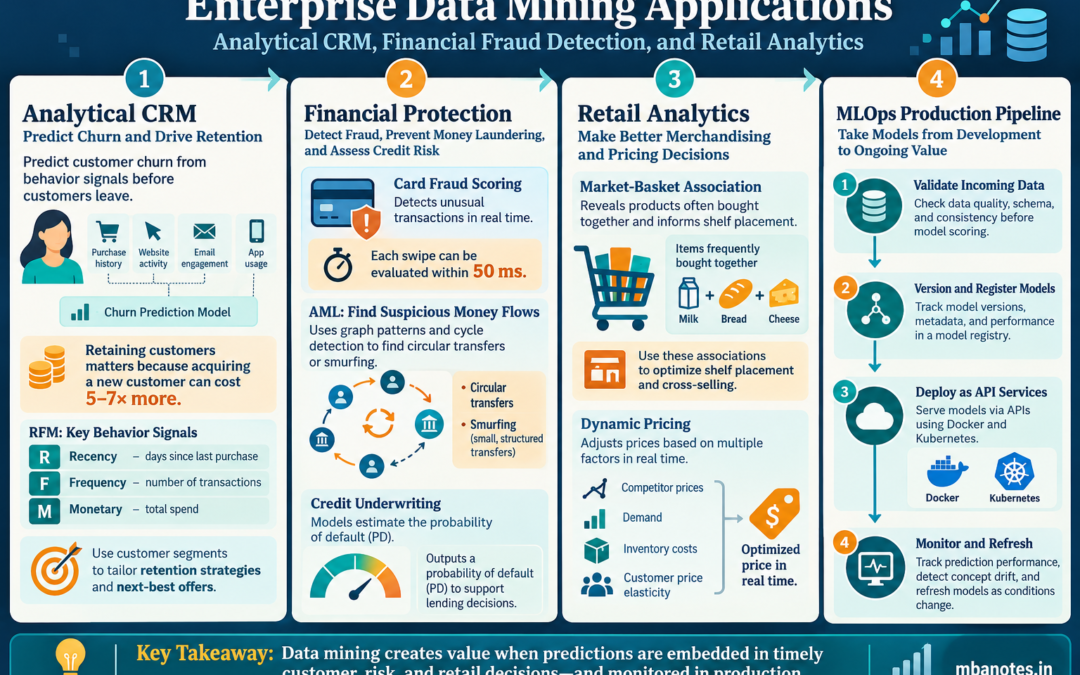
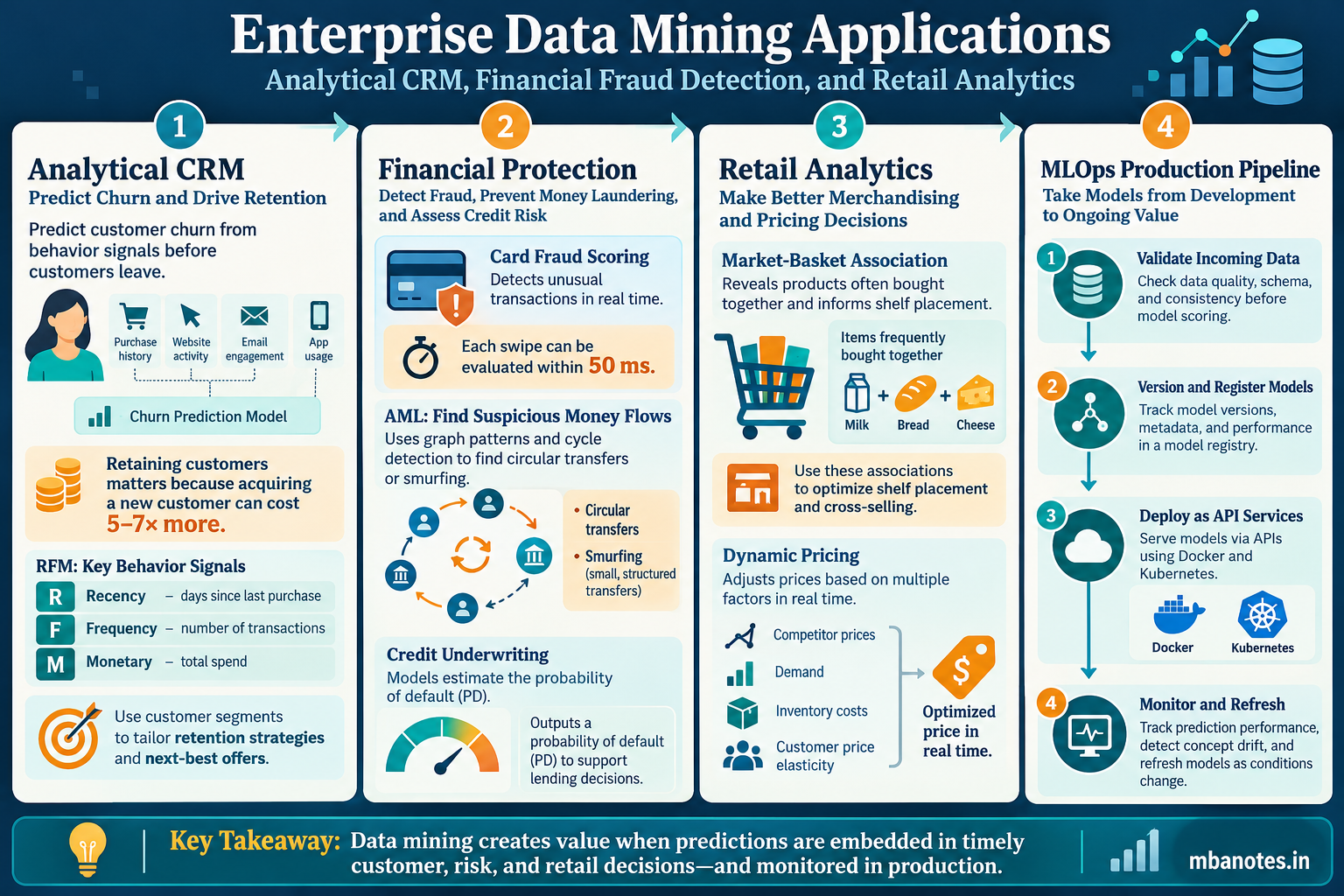
Data mining delivers its ultimate commercial value when embedded directly into enterprise operational workflows. Modern corporations no longer view data mining as an academic retrospective exercise; instead, automated predictive scoring models are integrated into customer relationship management (CRM) systems, credit approval decision engines, and real-time payment gateways to drive profitability, suppress risk, and retain valuable customers.
2. Analytical CRM: Churn Prediction & RFM Customer Segmentation
Customer Relationship Management is bifurcated into Operational CRM (automating sales and support touchpoints) and Analytical CRM (mining customer data to maximize Customer Lifetime Value - CLV):
- Customer Churn Modeling: Acquiring a new customer costs 5 to 7 times more than retaining an existing one. Classification algorithms (Random Forests, XGBoost) analyze customer telemetry (declining app logins, support tickets, payment frequency) to calculate a Churn Probability Score. High-risk customers are automatically routed to proactive retention campaigns before defection occurs.
- RFM Customer Segmentation: Scores customers across three behavioral dimensions:
- Recency (R): Days elapsed since last transaction. (Recent buyers are most responsive to new offers).
- Frequency (F): Total number of transactions within a defined window. (Indicates customer loyalty).
- Monetary (M): Total aggregate expenditure. (Identifies high-value revenue drivers).
- Next Best Offer (NBO): Collaborative filtering and association rules suggest optimal cross-sell and up-sell products during live customer support calls.
3. Financial Fraud Detection & Algorithmic Credit Scoring
Financial institutions leverage data mining to protect capital across multiple domains:
| Financial Domain | Algorithmic Technique | Operational Fraud Mitigation Mechanism |
|---|---|---|
| Credit Card Fraud Scoring | Isolation Forests, Autoencoders, Supervised Gradient Boosting | Evaluates every swipe within 50 milliseconds; flags anomalous geographic velocity (swipes in Delhi and London within 1 hour). |
| Anti-Money Laundering (AML) | Graph Neural Networks (GNN) & Cycle Detection | Identifies circular wire transfers and smurfing (structuring large deposits into small transactions to evade reporting). |
| Credit Risk Underwriting | Logistic Regression, Decision Trees, Support Vector Machines | Scores loan applicants against multi-attribute credit bureau histories to predict probability of default (PD). |
4. Retail Analytics: Planogram Optimization & Dynamic Pricing
In physical supermarkets and digital marketplaces, data mining optimizes retail margins:
- Planogram Shelf Space Optimization: Association rule mining identifies item affinities. Retailers strategically position high-affinity companion products adjacent to each other (e.g., chips placed next to dips) or place high-margin impulse items near staple goods.
- Dynamic Pricing Algorithms: Machine learning models continuously calibrate product prices based on real-time competitor prices, local demand spikes, inventory holding costs, and customer price elasticity.
5. Enterprise Architecture for Production Model Deployment
Operationalizing data mining requires an automated MLOps pipeline: continuous data validation, model versioning (MLflow), automated model registry, API microservice deployment (Docker/Kubernetes), and real-time concept drift monitoring to detect when changing market environments degrade model predictive accuracy.
University Examination Question Bank & Model Solutions
Designed as per Dr. A.P.J. Abdul Kalam Technical University (AKTU) MBA Examination Pattern.
Part A: Conceptual 2-Mark Short Answer Questions
Q1 [2 Marks]: Define the core operational scope of Enterprise Data Mining Applications in enterprise systems.
Ans: It represents a key frontier analytics and data architecture paradigm governing how unstructured textual records, web structures, enterprise CRM/fraud workflows, or modern cloud data lakehouses are deployed responsibly.
Q2 [2 Marks]: What is the significance of Analytical CRM in modern data intelligence?
Ans: It establishes the formal mechanisms—such as NLP vectorization, web graph algorithms, real-time RFM scoring, or decoupled cloud lakehouse storage—that unlock commercial value from complex data.
Part B & C: Analytical 10-Mark Detailed Solutions & Technical Frameworks
Question 1
Model Examination Answer Blueprint:
Strategic Executive Summary: 19. Enterprise Data Mining Applications
- Unstructured Text Monetization: Converting raw customer reviews and support tickets into quantifiable TF-IDF vectors and sentiment polarity scores.
- Web Intelligence: Deploying Web Structure (PageRank) and Web Usage (Clickstream) analytics to optimize search rankings and e-commerce conversion funnels.
- Closed-Loop Enterprise Analytics: Embedding real-time churn forecasting and fraud isolation models directly into CRM and payment processing pipelines.
- Modern Cloud Lakehouse Governance: Decoupling compute and storage on open Parquet formats while maintaining strict DPDP Act privacy compliance.
Frequently Asked Questions (Academic & Technical FAQ)
Q1. What makes Enterprise Data Mining Applications critical for modern enterprise managers?
It equips business leaders to capitalize on modern unstructured text, web interactions, and cloud data platforms while rigorously insulating the firm against algorithmic bias and legal data privacy penalties.
Q2. How do practitioners apply these principles in corporate environments?
Data engineers build automated TF-IDF and sentiment NLP pipelines, analyze server clickstream logs, train RFM customer models, and deploy Snowflake or Databricks Lakehouse clusters with role-based access controls.
Q3. What are the most frequent examination questions asked from this topic in AKTU?
AKTU examinations frequently require explaining the text mining NLP pipeline and calculating TF-IDF, comparing Web Content vs Structure vs Usage mining, detailing the PageRank algorithm, explaining Analytical CRM and RFM segmentation, detailing modern Data Lakehouse architectures, and discussing ethical issues and DPDP Act compliance.
Discussion & Questions
0 CommentsAcademic insights, questions, and conceptual clarifications from students & faculty.
No questions or comments yet
Have a doubt about this topic, an exam tip, or a conceptual perspective? Start the discussion below!
Leave a Comment / Ask a Question
Your email address will not be published. Required fields are marked *