
International Financial Architecture & Trade Promotion: The IMF, World Bank, EXIM Bank of India, and ECGC Operations
1. The Bretton Woods Conference & Post-War Financial Architecture
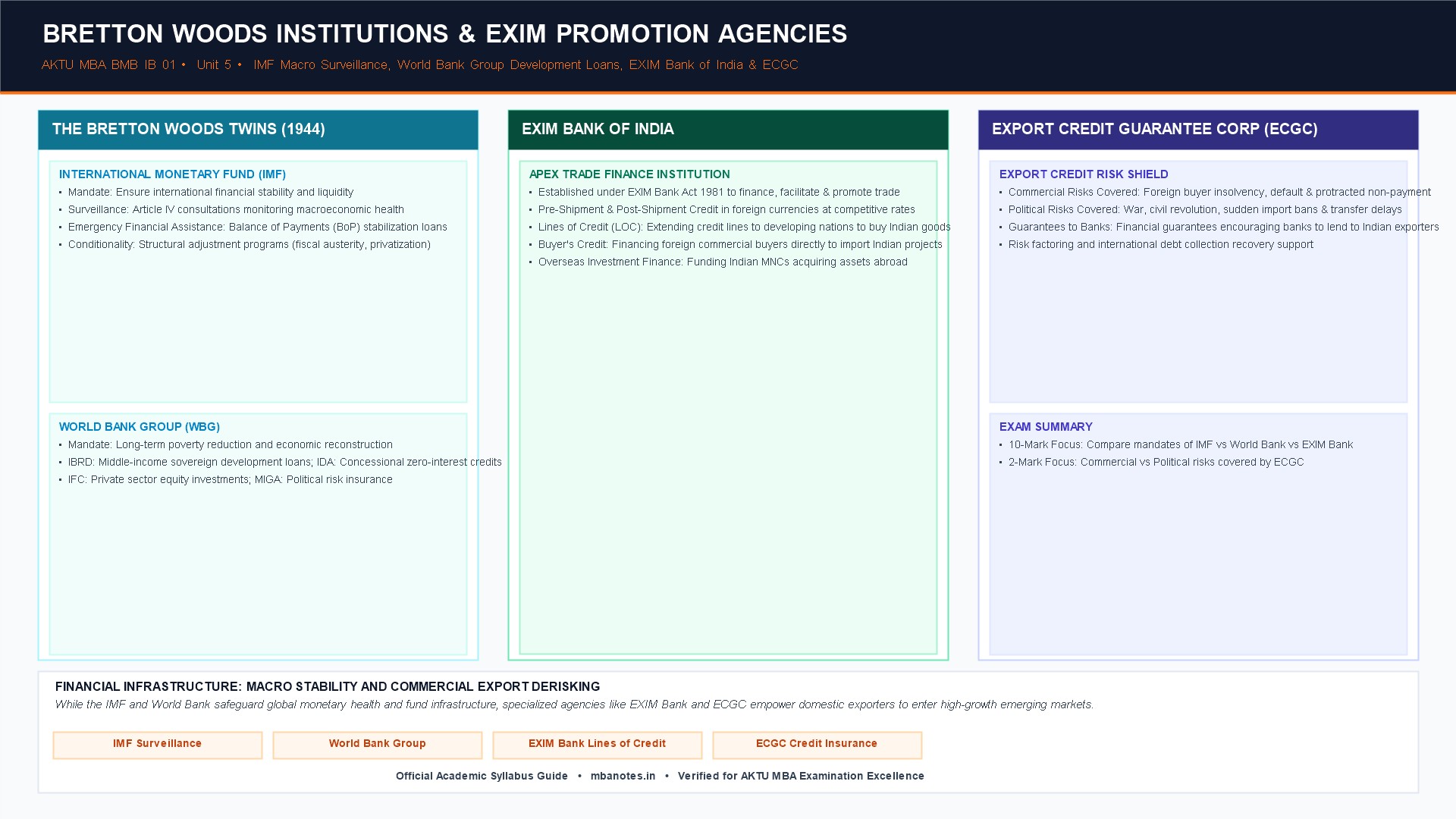
In July 1944, delegates from 44 allied nations convened at Bretton Woods, New Hampshire, to design a resilient international monetary architecture that would avoid the disastrous competitive devaluations and trade wars of the 1930s. The conference established the Bretton Woods Twins: the International Monetary Fund (IMF) to maintain global exchange rate stability and short-term liquidity, and the International Bank for Reconstruction and Development (IBRD), now the core of the World Bank Group, to finance post-war physical reconstruction and long-term economic development.
2. International Monetary Fund (IMF): Objectives & Facilities
Headquartered in Washington, D.C., the IMF functions as the global macroeconomic watchdog and financial lender of last resort for sovereign nations facing balance of payments (BOP) crises:
- Surveillance & Policy Consultations: Conducting Article IV annual macroeconomic consultations with member states to evaluate fiscal, monetary, and exchange rate health.
- BOP Crisis Lending: Providing credit facilities to countries depleted of foreign exchange reserves to restore balance of payments viability.
- Conditionality Programs: IMF loans are tied to structural adjustment policies, requiring recipient governments to reduce fiscal deficits, liberalize trade, privatize state assets, and stabilize inflation.
- Special Drawing Rights (SDRs): An international reserve asset created in 1969 to supplement member countries' official reserves. The value of an SDR is calculated based on a weighted currency basket: US Dollar, Euro, Chinese Renminbi, Japanese Yen, and British Pound.
3. World Bank Group (IBRD & IDA): Development Finance
The World Bank Group specializes in long-term developmental finance aimed at poverty eradication and sustainable infrastructure development:
IBRD (International Bank for Reconstruction & Development)
Lends to middle-income and creditworthy low-income governments at commercial or near-commercial interest rates with maturities ranging from 15 to 30 years to finance power plants, transit corridors, and green energy infrastructure.
IDA (International Development Association)
Provides zero-interest or ultra-low interest concessional loans (credits) and direct grants with 30–40 year repayment tenures and 5–10 year grace periods to the world's 75 poorest nations.
4. Export-Import Bank of India (EXIM Bank): Mandate & Financing
Established in 1982 under the Export-Import Bank of India Act, the EXIM Bank serves as the apex financial institution coordinating and delivering trade finance to Indian exporters and overseas buyers:
- Lines of Credit (LOCs): Concessional credit extended to foreign sovereign governments or commercial banks to finance the import of Indian capital equipment, engineering goods, and consulting services.
- Buyer's Credit & Supplier's Credit: Financial advances granted directly to overseas importers to facilitate high-value capital equipment purchases from Indian manufacturers.
- Pre-Shipment & Post-Shipment Finance: Working capital lending in foreign currencies (USD, EUR) to cover procurement, processing, manufacturing, and export receivables.
- Export Product Development Lending: Capital loans supporting Indian firms investing in R&D, international tooling, global certifications, and offshore marketing infrastructure.
5. Export Credit Guarantee Corporation (ECGC): Risk Underwriting
Operated under the Ministry of Commerce & Industry, ECGC Limited provides credit risk insurance covers protecting Indian exporters and commercial banks against overseas non-payment:
Core Risks Underwritten by ECGC
1) Commercial Risks (Covered up to 90%): Insolvency of the foreign buyer, protracted buyer default (non-payment after 4 months of due date), and buyer refusal to accept goods without legitimate contractual breach.
2) Political Risks (Covered up to 90–95%): Foreign currency exchange transfer delays imposed by host governments, war, civil insurrection, expropriation, import licensing cancellations, and trade embargoes.
3) Bank Guarantees: Financial guarantees issued to commercial banks protecting them against default on working capital advances extended to exporters.
University Examination Question Bank & Model Solutions
Designed as per Dr. A.P.J. Abdul Kalam Technical University (AKTU) MBA Examination Pattern.
Part A: Conceptual 2-Mark Short Answer Questions
Q1 [2 Marks]: What was the primary objective of the Bretton Woods Conference?
Ans: The Bretton Woods Conference (1944) aimed to reconstruct post-war global economic stability, avoid competitive currency devaluations, and establish multilateral institutions (the IMF and World Bank) to provide international liquidity and development capital.
Q2 [2 Marks]: What are Special Drawing Rights (SDRs)?
Ans: SDRs are an artificial international reserve asset created by the IMF in 1969 to supplement member countries' official reserves. Its value is determined based on a weighted currency basket consisting of USD, EUR, CNY, JPY, and GBP.
Q3 [2 Marks]: What is the core function of the Export Credit Guarantee Corporation (ECGC)?
Ans: ECGC provides credit risk insurance to Indian exporters and financial institutions to protect them against non-payment risks arising from foreign commercial insolvency, buyer defaults, and foreign political disruptions.
Part B & C: Analytical 10-Mark Detailed Solutions & Strategic Frameworks
Question 1 [10/15 Marks]: Critically evaluate the contrasting mandates, lending mechanisms, and structural adjustment policies of the IMF and the World Bank Group.
Model Examination Answer Blueprint:
Question 2 [10/15 Marks]: Discuss the institutional role of EXIM Bank of India and ECGC in promoting and derisking Indian international trade.
Model Examination Answer Blueprint:
Strategic Executive Summary: 3. Bretton Woods, IMF, World Bank & EXIM Agencies
- [object Object]
- [object Object]
- [object Object]
- [object Object]
- [object Object]
Frequently Asked Questions (Academic & Practitioner FAQ)
Q1. What is IMF Conditionality and why is it debated?
IMF conditionality refers to economic policy requirements (e.g., cutting government subsidies, reducing fiscal deficits, privatizing state enterprises) imposed on borrowing nations. Critics argue these austerity measures can induce domestic recessions and disproportionately affect low-income citizens.
Q2. How does an EXIM Bank Line of Credit (LOC) benefit Indian manufacturers?
When EXIM Bank extends an LOC to a foreign sovereign government, that government uses the funds to procure engineering goods, locomotives, or telecom equipment directly from Indian manufacturers, who receive prompt, risk-free payment in India.
Q3. Does ECGC cover currency devaluation risks?
No, ECGC policies do not insure exporters against normal foreign currency depreciation or market exchange rate fluctuations, which must be hedged through commercial banking forward contracts or currency derivatives.
Discussion & Questions
0 CommentsAcademic insights, questions, and conceptual clarifications from students & faculty.
No questions or comments yet
Have a doubt about this topic, an exam tip, or a conceptual perspective? Start the discussion below!
Leave a Comment / Ask a Question
Your email address will not be published. Required fields are marked *