
Multilateral Trade Institutions: The Evolution of GATT into the WTO, Core Principles, and Dispute Settlement Mechanisms
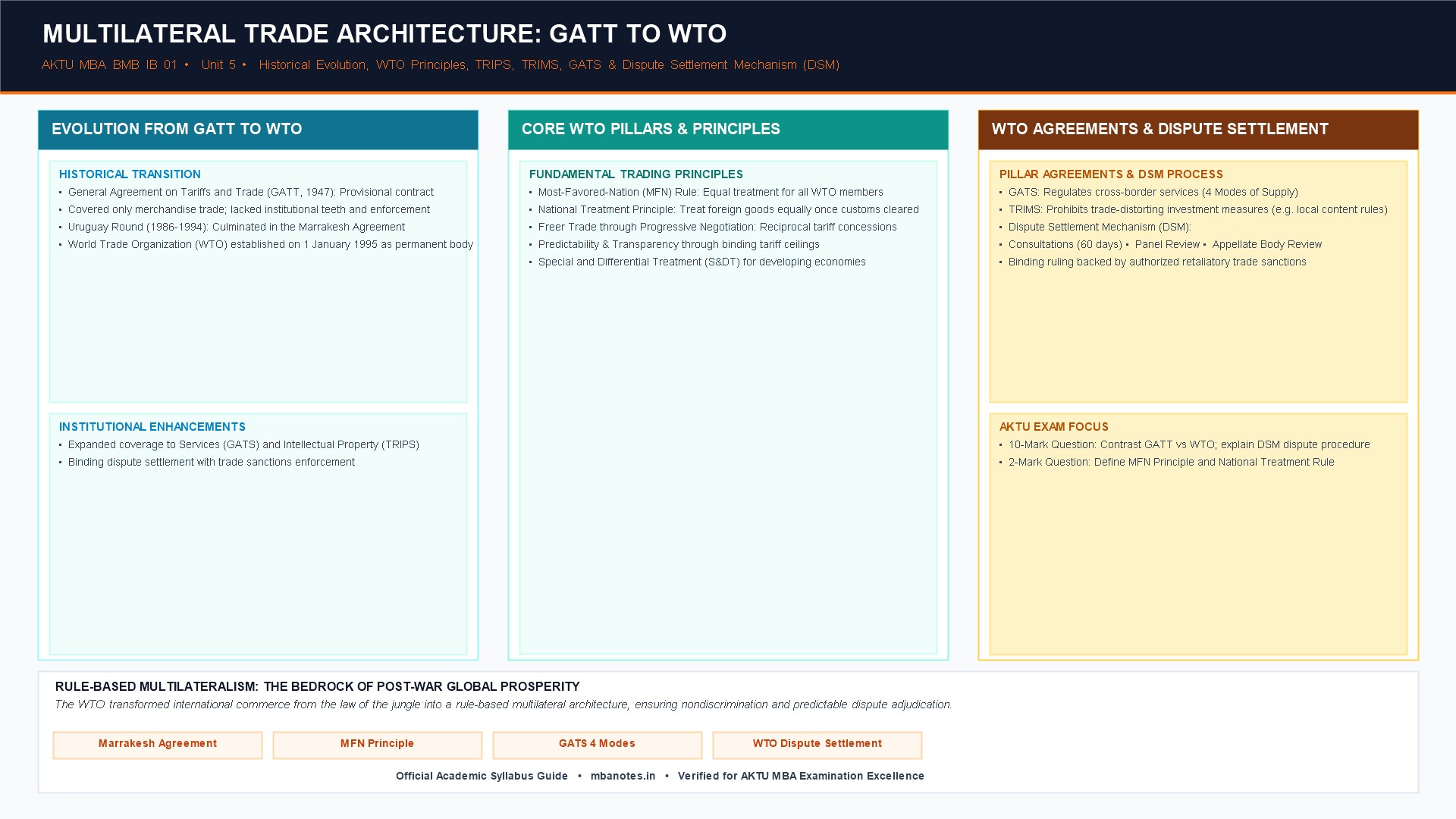
1. Historical Evolution: GATT 1947 to WTO 1995
The post-WWII multilateral trading order originated with the General Agreement on Tariffs and Trade (GATT) signed in 1947 by 23 nations in Geneva. GATT functioned as a provisional treaty focused exclusively on reducing industrial tariffs through progressive negotiating rounds (e.g., Kennedy Round, Tokyo Round).
However, GATT suffered from structural deficiencies: it lacked legal personality, excluded trade in agriculture and services, ignored intellectual property, and possessed a weak dispute mechanism requiring consensus to adopt panel reports. The eight-year Uruguay Round (1986–1994) culminated in the Marrakesh Agreement, officially establishing the World Trade Organization (WTO) on January 1, 1995, as a permanent global institution governing international commerce.
2. Foundational Principles of the WTO Multilateral System
All WTO multilateral agreements are grounded in core economic and legal principles designed to guarantee predictability, non-discrimination, and fairness in global trade:
Most-Favored-Nation (MFN) Treatment (GATT Article I)
Any commercial advantage, tariff concession, or privilege granted by one member state to any product originating in or destined for any other country must be accorded immediately and unconditionally to the like product of all other WTO members. Exceptions include Regional Free Trade Agreements (Article XXIV) and Generalized System of Preferences (GSP).
National Treatment Principle (GATT Article III)
Once imported foreign goods have cleared customs and paid standard border tariffs, they must be treated no less favorably than internally produced domestic goods regarding internal taxes, regulations, and distribution mandates.
- Freer Trade Through Negotiation: Binding tariff commitments (bound rates) that prevent unilateral tariff spikes.
- Predictability & Transparency: Publishing trade regulations openly and submitting trade regimes to periodic Trade Policy Review Mechanisms (TPRM).
- Promoting Fair Competition: Discouraging unfair practices such as export dumping and predatory government subsidies through Anti-Dumping and Countervailing duty frameworks.
- Special & Differential (S&D) Treatment: Granting developing and least-developed nations extended transition periods, tariff concessions, and technical assistance.
3. Major WTO Covered Agreements (TRIPS, TRIMS, GATS)
The WTO expanded global governance far beyond traditional manufactured goods into services, investment, and intangible assets:
- GATS (General Agreement on Trade in Services): Covers international trade in services across four modes of supply: Mode 1 (Cross-border supply, e.g., software exports), Mode 2 (Consumption abroad, e.g., medical tourism), Mode 3 (Commercial presence, e.g., foreign bank branches), and Mode 4 (Presence of natural persons, e.g., IT consultants traveling overseas).
- TRIMS (Trade-Related Investment Measures): Prohibits host-nation investment measures that distort trade, such as domestic local content requirements (mandating firms source parts locally) and trade-balancing requirements.
- TRIPS (Trade-Related Aspects of Intellectual Property Rights): Establishes universal minimum standards for the protection and enforcement of patents, trademarks, copyrights, industrial designs, and trade secrets worldwide.
- AoA (Agreement on Agriculture): Disciplines agricultural distortion across three pillars: Market Access (tariffication of quotas), Domestic Support (Amber, Blue, and Green box subsidies), and Export Subsidies.
4. The WTO Dispute Settlement Mechanism (DSM) Workflow
The Dispute Settlement Mechanism (DSM), administered by the Dispute Settlement Body (DSB), is regarded as the "crown jewel" of the WTO due to its binding legal authority and compulsory jurisdiction:
Sequential Dispute Settlement Stages
1) Stage 1: Bilateral Consultations (60 Days): The disputing parties attempt to negotiate a mutually satisfactory bilateral resolution.
2) Stage 2: Panel Establishment & Adjudication (6–9 Months): If consultations fail, an independent three-member ad-hoc panel reviews legal briefs and issues an official report.
3) Stage 3: Adoption of Panel Report (Reverse Consensus): The panel report is automatically adopted unless all WTO members unanimously vote to reject it (reverse consensus rule).
4) Stage 4: Appellate Review (60–90 Days): Parties can appeal points of law to the permanent seven-member Appellate Body.
5) Stage 5: Implementation & Retaliation: The losing party must conform its laws. If it fails, the DSB authorizes the injured nation to impose retaliatory trade sanctions.
5. Contemporary Challenges & Developing Nation Dynamics (Doha Agenda)
Launched in 2001, the Doha Development Agenda (DDA) sought to place developing nations' priorities at the heart of global trade. However, negotiations stalled due to deep North-South impasses over agricultural subsidies in wealthy nations versus tariff cuts on industrial goods in emerging economies. Modern WTO challenges include the paralysis of the Appellate Body, the rise of unilateral tariffs, and the growing tension between state-led capitalism and free-market disciplines.
University Examination Question Bank & Model Solutions
Designed as per Dr. A.P.J. Abdul Kalam Technical University (AKTU) MBA Examination Pattern.
Part A: Conceptual 2-Mark Short Answer Questions
Q1 [2 Marks]: What is the Most-Favored-Nation (MFN) principle?
Ans: The MFN principle (GATT Article I) requires that any trade privilege, duty concession, or advantage granted by a WTO member to any nation must be extended immediately and unconditionally to all other WTO member countries.
Q2 [2 Marks]: Explain the National Treatment principle.
Ans: National Treatment (GATT Article III) mandates that once foreign goods have passed customs and paid import tariffs, they must receive treatment no less favorable than domestic goods regarding internal taxes, sales laws, and distribution regulations.
Q3 [2 Marks]: Name the four modes of service supply under GATS.
Ans: Mode 1: Cross-border supply (e.g., software exports); Mode 2: Consumption abroad (e.g., international tourism); Mode 3: Commercial presence (e.g., setting up a foreign bank branch); Mode 4: Presence of natural persons (e.g., overseas business consultants).
Part B & C: Analytical 10-Mark Detailed Solutions & Strategic Frameworks
Question 1 [10/15 Marks]: Trace the evolution of GATT into the World Trade Organization (WTO). Contrast GATT with the WTO in terms of institutional structure, scope, and dispute resolution.
Model Examination Answer Blueprint:
Question 2 [10/15 Marks]: Detail the functioning of the WTO Dispute Settlement Mechanism (DSM). Why is the reverse consensus rule critical to its authority?
Model Examination Answer Blueprint:
Strategic Executive Summary: 2. Multilateral Architecture: GATT, WTO & DSM
- [object Object]
- [object Object]
- [object Object]
- [object Object]
- [object Object]
Frequently Asked Questions (Academic & Practitioner FAQ)
Q1. What is the 'Reverse Consensus' rule in the WTO Dispute Settlement Body?
Under reverse consensus, a WTO dispute panel or appellate report is automatically adopted unless all member countries unanimously decide by consensus to reject it, preventing a losing nation from single-handedly vetoing an adverse legal ruling.
Q2. How does the WTO define Export Dumping?
Dumping occurs when an enterprise exports a product to an overseas market at an export price lower than its normal value (the price charged in the exporter's home domestic market or below its cost of production), causing injury to the importing nation's domestic industry.
Q3. What are Bound Tariff Rates under WTO commitments?
Bound tariff rates are maximum customs duty ceilings agreed upon by a member state during WTO trade rounds. A nation cannot raise its applied tariff rate above the bound rate without offering compensation to affected trading partners.
Discussion & Questions
0 CommentsAcademic insights, questions, and conceptual clarifications from students & faculty.
No questions or comments yet
Have a doubt about this topic, an exam tip, or a conceptual perspective? Start the discussion below!
Leave a Comment / Ask a Question
Your email address will not be published. Required fields are marked *