
Characteristics & Classification of Services: IHIP Framework, Service Process Matrix & Delivery Systems
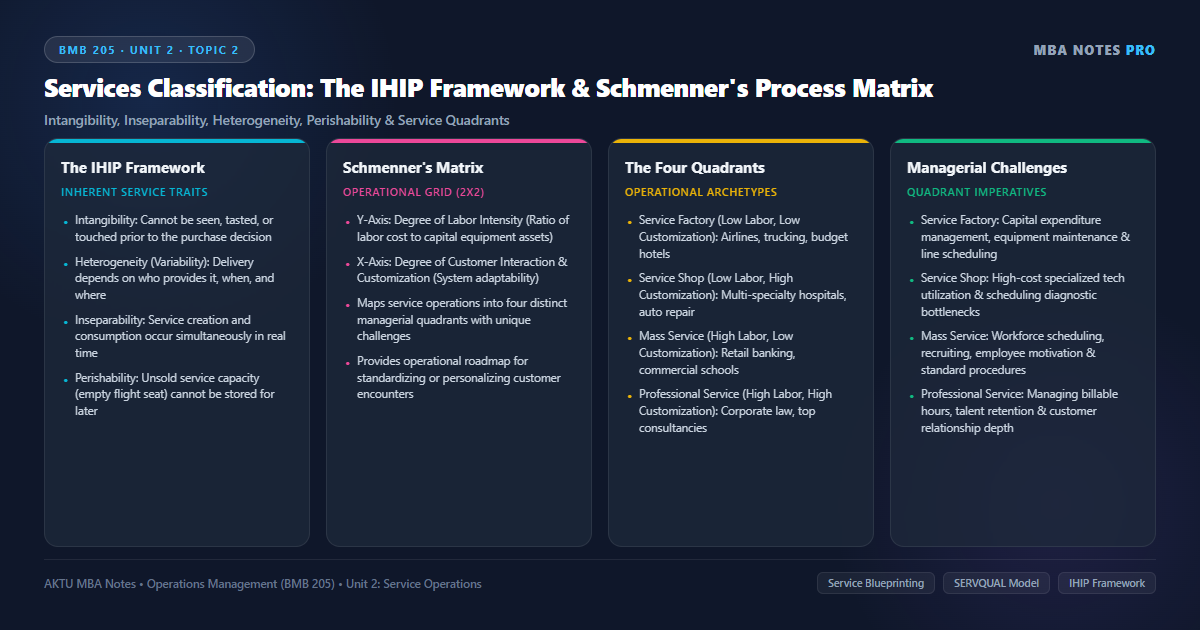
1. The Inherent Characteristics of Services: The IHIP Framework
The academic foundation of service operations management is anchored in the seminal IHIP Framework, which codifies the four essential characteristics that distinguish services from physical manufactured goods:
- 1. I — INTANGIBILITY: Services are performances, experiences, or intellectual outputs rather than physical objects. A customer cannot touch, test-drive, or physically inspect a software audit or life insurance policy prior to purchase.
Operational Implication: Customers experience high perceived purchase risk. Operations must create Tangible Evidence (modern physical offices, branded uniform attire, professional documentation, certificates) to signal credibility. - 2. H — HETEROGENEITY (Variability): Because services rely heavily on human labor and direct customer interaction, no two service deliveries are ever identical. The quality of a haircut or college lecture varies depending on who delivers it, their fatigue level, and the customer’s mood.
Operational Implication: Standardized quality control requires strict Standard Operating Procedures (SOPs), extensive employee training, scripts, and automated service technologies (e.g., net banking, self-checkout kiosks). - 3. I — INSEPARABILITY (Simultaneity): Unlike manufactured goods that are produced in a factory, shipped to a warehouse, and consumed months later, services are produced and consumed concurrently. The patient must be present while the dentist performs a root canal.
Operational Implication: The customer is physically present inside the service delivery factory, acting as a co-producer. Operations must manage customer behavior, waiting lines, and frontstage aesthetics. - 4. P — PERISHABILITY: Service capacity is completely time-perishable. An empty seat on an IndiGo flight from Delhi to Mumbai at 8:00 AM cannot be saved, stored, or resold on Wednesday afternoon.
Operational Implication: SCM inventory buffering is impossible. Operations must aggressively balance capacity and demand through dynamic pricing, overbooking models, reservation systems, and part-time flexible staffing.
2. Roger Schmenner’s Service Process Matrix: Architectural 2×2 Taxonomy
Proposed by Harvard operations scholar Roger W. Schmenner, the Service Process Matrix classifies service organizations into four distinct quadrants based on two structural operational dimensions:
High Labor Intensity (> 1.5) indicates people-dependent businesses; Low Labor Intensity (< 0.5) indicates capital-intensive, machine-driven operations.
The Four Quadrants of Schmenner’s Matrix:
| Quadrant Archetype | Labor Intensity & Interaction | Representative Enterprises | Primary Operations Management Focus |
|---|---|---|---|
| 1. Service Factory | Low Labor Intensity Low Customization / Interaction | Commercial Airlines (IndiGo), Freight Trucking (VRL Logistics), Budget Hotels (Ginger), Theme Parks (Wonderla). | High capital expenditure management, preventive equipment maintenance, flight scheduling, yield management, and maximizing asset capacity utilization. |
| 2. Service Shop | Low Labor Intensity High Customization / Interaction | Multi-Specialty Hospitals (Apollo, Fortis), Specialized Auto Diagnostic Garages, High-End Tailoring. | Scheduling scarce capital equipment (MRI/CT scanners, operating theaters), managing specialized diagnostic technicians, and maintaining clinical quality standards. |
| 3. Mass Service | High Labor Intensity Low Customization / Interaction | Commercial Retail Banks (SBI, HDFC branch banking), Supermarkets (DMart), Wholesaling, Public Secondary Schools. | Managing large branch workforce, rigorous employee recruitment, standardizing operating procedures, visual merchandising, and managing queue waiting lines. |
| 4. Professional Service | High Labor Intensity High Customization / Interaction | Corporate Law Firms (Shardul Amarchand), Management Consulting (McKinsey, BCG), Architectural Firms, Chartered Accountants. | Managing elite professional talent, preventing billable hour burnout, managing high client expectations, and ensuring confidentiality and fiduciary compliance. |
3. Alternative Service Classification Models: Lovelock & Bowen Frameworks
Beyond Schmenner’s matrix, service operations theorists have developed alternative multi-dimensional classification taxonomies:
A. Christopher Lovelock’s Nature of Service Act (2×2 Matrix):
- 1. Tangible Actions Directed at People’s Bodies: Healthcare, passenger transportation, beauty salons, fitness centers. Customer must physically enter the service facility.
- 2. Tangible Actions Directed at Physical Goods/Possessions: Freight shipping, equipment repair, laundry, warehousing. Physical asset enters system; customer can remain absent.
- 3. Intangible Actions Directed at People’s Minds: Education, broadcasting, religious services, entertainment cinema. Changes customer mental state or knowledge.
- 4. Intangible Actions Directed at Intangible Assets / Information: Banking, legal advice, investment banking, software coding, data processing. Information-based; delivery can occur anywhere digitally.
B. Nature of Delivery: Discrete Transactions vs Continuous Relationships:
- Continuous Delivery with Formal Membership: Insurance policies, mobile postpaid plans, banking accounts. High customer retention data enabling predictive capacity forecasting.
- Discrete Transactions with Zero Membership: Toll booth transit, fast food drive-throughs, cinema ticket purchases. High demand volatility; operations must respond in real time.
4. Strategic Repositioning Across the Service Matrix: Automation & Decoupling
In modern service management, organizations actively manipulate their position on Schmenner’s matrix through technology and structural decoupling:
Strategic Repositioning Vectors:
- Shifting Mass Service to Service Factory via Digitalization: Retail banking historically operated as a high-labor, brick-and-mortar Mass Service. By introducing ATMs, mobile banking apps, and UPI, banks dramatically reduced labor intensity, transforming basic banking into a high-volume, automated Service Factory.
- Service Decoupling (Richard Chase Model): Separating the high-contact front office (where customer customization and relationship empathy dominate) from the low-contact back office (which is run like an automated, standardized manufacturing plant). For example, a commercial bank handles loan consultations face-to-face in the branch, while credit scoring and underwriting algorithms run in a centralized back-office server farm.
- Productization of Professional Services: Consultancies and law firms convert customized advisory work into standardized SaaS software platforms and diagnostic templates, expanding scalability and lowering client costs.
Corporate Case Vignette: Narayana Health’s ‘Health Factory’ Model of High-Volume Cardiac Care
Founded by renowned cardiac surgeon Dr. Devi Shetty, Narayana Health (NH) revolutionized healthcare operations by deliberately shifting cardiac surgery from a high-cost Service Shop into an ultra-efficient Service Factory:
- The Operational Dilemma: Traditional open-heart surgery in private hospitals was prohibitively expensive ($6,000 to $10,000), characterized by low surgeon utilization and fragmented scheduling.
- Assembly-Line Specialization & Asset Sweating: Dr. Shetty implemented a focused hospital model where surgical operating suites run 16 hours daily. Surgeons perform 4 to 6 open-heart surgeries daily (compared to 1 to 2 in conventional hospitals), developing extraordinary surgical velocity and microscopic complication rates through high-volume repetition.
- Standardized Procurement & Equipment Sweating: Medical devices, artificial heart valves, and coronary stents are negotiated in massive bulk contracts directly from manufacturers at 60% discounts. Diagnostic equipment (CT/MRI) operates around the clock to amortize fixed capital depreciation.
- Measurable Impact: Narayana Health performs high-quality coronary artery bypass graft (CABG) surgery for under $1,500 (one-fifth of Indian private competitors and one-thirtieth of US hospital costs) with clinical mortality rates (1.2%) that beat average hospital benchmarks in North America.
Managerial Takeaway: By applying Service Factory mass-volume discipline to specialized healthcare, operations managers can democratize life-saving services while sustaining financial profitability.
AKTU University Examination Questions: Classification & Characteristics of Services
Section A (2 Marks Conceptual Questions):
Q1: What does the acronym IHIP stand for in Service Operations? (2 Marks)
Q2: Distinguish between a ‘Service Factory’ and a ‘Professional Service’ in Schmenner’s Matrix. (2 Marks)
Section B / C (10 Marks Detailed Analytical Question):
Q: Explain Roger Schmenner’s Service Process Matrix in detail with a neat 2×2 diagram. Describe the operational characteristics, representative industries, and managerial challenges of each of the four quadrants. How can a bank reposition itself from Mass Service to Service Factory? (10 Marks)
1. Conceptual Foundation of Classification: Explain why classifying services is essential for operations design and capacity planning.
2. The IHIP Framework: Detail Intangibility, Heterogeneity, Inseparability, and Perishability with operational implications.
3. Schmenner’s 2×2 Service Process Matrix: Draw 2×2 grid showing Y-axis (Labor Intensity) and X-axis (Degree of Interaction & Customization).
4. Quadrant Analysis: Detail all 4 quadrants:
• Service Factory: Airlines, budget hotels (focus on capex, maintenance, line scheduling).
• Service Shop: Hospitals, auto repair (focus on scheduling bottleneck equipment and specialists).
• Mass Service: Retail banking, supermarkets (focus on staffing, SOPs, training).
• Professional Service: Law firms, consultancies (focus on billable hours, relationship depth).
5. Strategic Repositioning & Decoupling: Explain how digital automation (ATMs, UPI, net banking) enabled retail banks to transition repetitive transactions from Mass Service to an automated Service Factory. Explain front-office vs back-office decoupling.
6. Corporate Case Reference: Cite Narayana Health’s ‘Health Factory’ model in cardiac surgery.
Discussion & Questions
0 CommentsAcademic insights, questions, and conceptual clarifications from students & faculty.
No questions or comments yet
Have a doubt about this topic, an exam tip, or a conceptual perspective? Start the discussion below!
Leave a Comment / Ask a Question
Your email address will not be published. Required fields are marked *