
Direct Marketing: Meaning, Features, Functions
🧠 1. Core Concept & Business Meaning of Direct Marketing
Traditional mass marketing operates on broad broadcast principles: companies place commercials on television or billboards hoping that unseen consumers will eventually walk into physical retail stores to buy. In sharp contrast, Direct Marketing establishes an immediate, direct channel of communication and commerce between the producer and individual consumers, completely eliminating retail middlemen.
According to the Direct Marketing Association (DMA): “Direct Marketing is an interactive system of marketing which uses one or more advertising media to effect a measurable response and/or transaction at any location.”
⚙ 3. Key Dimensions & Strategic Mechanics of Direct Marketing
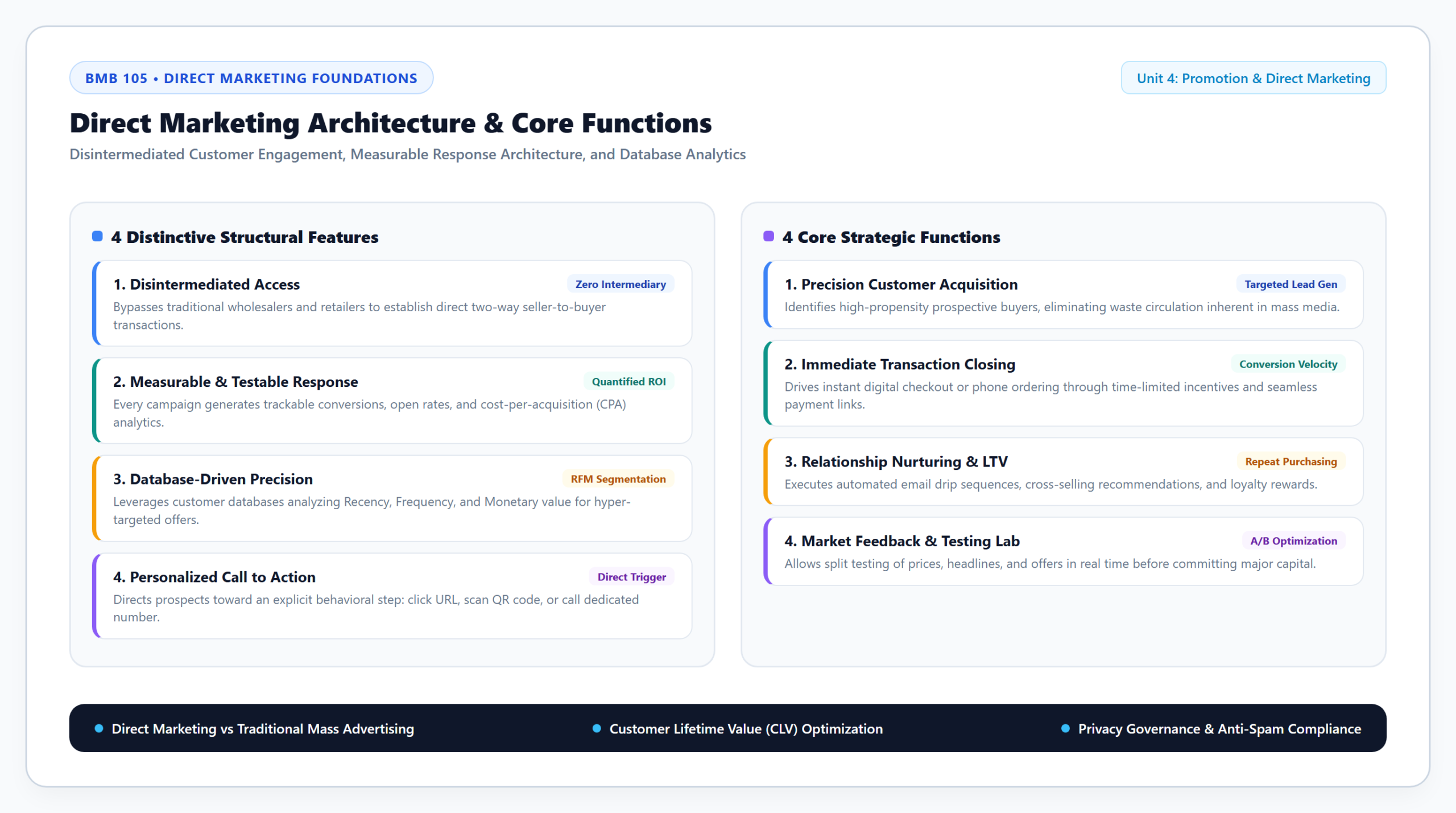
- Disintermediation: Removes wholesalers, distributors, and physical retail stores, allowing producers to control customer experience and capture retail margin spreads.
- Measurable Response: Eliminates guesswork. Marketers measure exact cost per lead (CPL), conversion rate, cost per acquisition (CPA), and return on ad spend (ROAS).
- Database-Driven Architecture: Operates using rich customer databases tracking purchase history, demographic variables, and psychographic preferences via RFM segmentation (Recency, Frequency, Monetary).
- Interactive Two-Way Relationship: Consumers interact directly with the brand via email replies, direct phone lines, chatbots, and customized landing pages.
- Precision Customer Acquisition: Reaching narrowly targeted prospective segments with tailored messages, eliminating the wasteful ad circulation of mass media.
- Immediate Sales Conversion: Driving fast transactional checkout through time-limited offers, direct-order URLs, and one-click digital payment gateways.
- Customer Retention & Lifetime Value (LTV): Building long-term relationships through personalized cross-sell recommendations, loyalty rewards, and automated replenishment reminders.
- Market Testing Laboratory: Providing an agile platform for testing new product concepts, pricing sensitivity, and advertising headlines via A/B split tests before launching full-scale manufacturing.
📊 4. Comparative Synthesis Matrix: Direct Marketing vs Traditional Mass Marketing
| Dimension | Direct Marketing | Traditional Mass Marketing |
|---|---|---|
| Channel Structure | Disintermediated: Direct Producer-to-Consumer | Multi-tier: Producer -> Wholesaler -> Retailer -> Shopper |
| Audience Targeting | Individualized, database-segmented, hyper-targeted | Broad mass market, high waste circulation |
| Response Measurability | Direct, immediate, mathematically trackable (CPA, ROI) | Indirect, delayed, estimated via sample surveys |
| Customer Knowledge | High; company owns first-party customer purchase history | Low; retailer owns consumer interface and checkout data |
| Call to Action | Specific immediate response: order, call, click URL | General awareness and positive brand image building |
💼 5. Real-World Corporate Case Studies
Michael Dell revolutionized the global personal computer industry by creating the “Direct Model.
” While traditional competitors like IBM, HP, and Compaq sold standardized computers through dealer channels, Dell took orders directly from customers via telephone and its pioneering website. Dell built computers only after payment was received, slashing component inventory holding costs to virtually zero. By eliminating retailer markups and gathering direct customer feedback, Dell became the world’s most profitable PC manufacturer throughout the 1990s.
Amazon represents the pinnacle of modern database-driven direct marketing.
Through its proprietary collaborative filtering algorithms, Amazon analyzes billions of user clicks, searches, and past purchases. When a customer visits Amazon or opens an automated email recommendation, the catalog displayed is uniquely personalized. Amazon’s direct-to-consumer relationship—bolstered by Prime subscription delivery—generates unparalleled conversion rates and massive customer lifetime value.
Model Answer (40 words): Marking Scheme: 2 marks for standard definition (DMA); 4 marks for detailing 4 distinguishing features (disintermediation, measurable response, database-driven, CTA); 4 marks for explaining key functions (acquisition, conversion, retention, market testing).
Model Answer (40 words): Marking Scheme: 2 marks each for 5 distinct parameters: Intermediary structure, audience targeting, measurability of ROI, ownership of customer data, and primary communication objective.
Model Answer (40 words): Marking Scheme: 2 marks for defining RFM: Recency (how recently a customer purchased), Frequency (how often they buy), and Monetary value (how much money they spend), used to identify the most valuable customer segments.
Discussion & Questions
0 CommentsAcademic insights, questions, and conceptual clarifications from students & faculty.
No questions or comments yet
Have a doubt about this topic, an exam tip, or a conceptual perspective? Start the discussion below!
Leave a Comment / Ask a Question
Your email address will not be published. Required fields are marked *