
Tools and Techniques of Sales Promotion
🧠 1. Core Concept & Business Meaning of Sales Promotion Tools
Selecting the appropriate sales promotion technique requires matching marketing goals with consumer behavioral psychology. A firm introducing a radical new consumer staple needs a technique that overcomes fear of the unknown (such as free sampling), whereas an established brand defending against aggressive low-cost entrants requires tools that reward ongoing loyalty (such as continuity programs or multi-pack volume deals).
Modern sales promotion has evolved beyond printed paper vouchers into dynamic digital couponing, instant UPI cash-backs, geolocation-triggered mobile offers, and interactive in-store digital kiosks.
⚙ 3. Key Dimensions & Strategic Mechanics of Promotional Tools
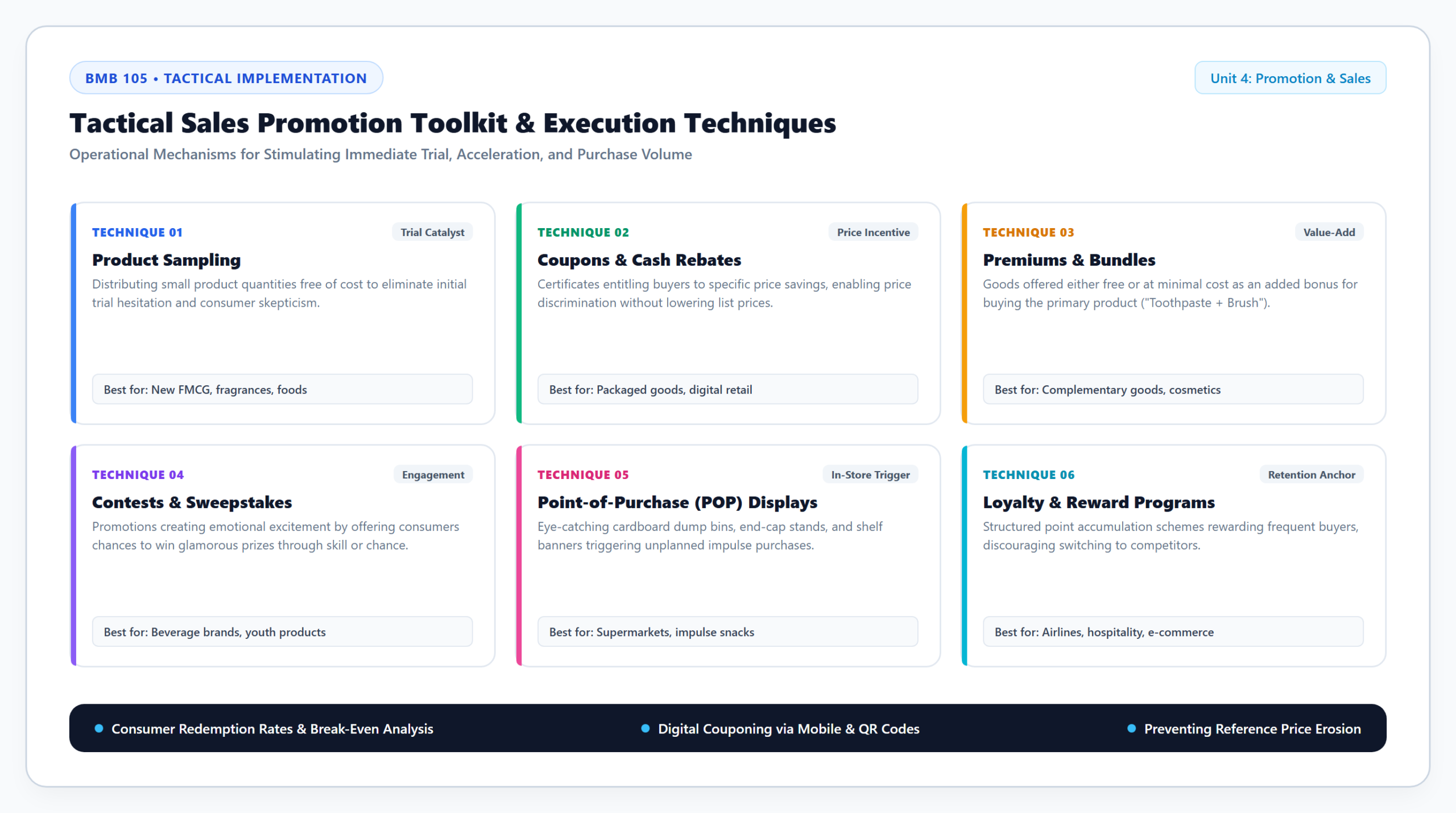
Delivering a trial portion of the actual product free of charge. Most effective when: the product’s superiority can be judged immediately upon use (e.g., taste, fragrance, texture), the unit production cost is relatively small, and the category exhibits high repeat purchase potential.
Coupons are certificates offering a stated financial discount upon checkout. They permit price discrimination: price-sensitive shoppers invest time clipping or searching for promo codes, while convenience-oriented, price-insensitive shoppers pay full price. Rebates, on the other hand, provide cash refunds directly from the manufacturer after the consumer submits proof of purchase.
Tangible merchandise offered free or at deep discount as a bonus for purchasing a product. Classified into:
- In/On-Package Premiums: Gifts attached directly to the product packaging (e.g., a free toy inside a cereal box).
- Free-in-the-Mail Premiums: Sent to consumers upon mailing in proofs of purchase.
- Self-Liquidating Premiums: Merchandise sold at a price covering the manufacturer’s cost of purchasing and shipping the premium.
Cardboard floor stands, shelf-talkers, end-cap banners, and dump bins installed inside retail environments. Research indicates that over 70% of supermarket purchasing decisions are made at the shelf; effective POP displays act as silent salespersons triggering unplanned impulse purchases.
Promotional games designed to generate excitement. A contest requires participants to demonstrate analytical skill, creativity, or knowledge (e.g., writing a slogan or submitting a recipe), whereas a sweepstakes simply requires submitting personal contact details, with winners chosen strictly by random draw.
📊 4. Comparative Synthesis Matrix: Sales Promotion Techniques
| Promotion Technique | Core Mechanism | Primary Advantage | Key Limitation | Ideal Product Domain |
|---|---|---|---|---|
| Sampling | Free trial units | Highest trial conversion rate | Very high cost per contact | Food, perfume, cosmetics |
| Coupons / Rebates | Discount certificate | Selective price discrimination | Fraudulent redemptions, low redemption % | Packaged goods, e-commerce |
| Premiums | Free / discounted gift | Adds tangible perceived value | Consumers may buy only for the gift | Breakfast cereals, personal care |
| POP Displays | In-store fixtures & bins | Triggers unplanned impulse buys | Retailers may refuse or discard stands | Snacks, batteries, magazines |
| Contests / Sweepstakes | Skill / chance games | Builds consumer buzz & contact lists | Does not generate repeat purchase habit | Soft drinks, sports apparel |
💼 5. Real-World Corporate Case Studies
McDonald’s legendary Monopoly promotional campaign is one of the most successful sweepstakes in global business history.
Customers receive game stamps with meal purchases corresponding to properties on a classic Monopoly board. Collecting rare combinations unlocks cash, cars, and holidays, while instant-win tokens provide free fries and burgers. The promotion systematically drives visit frequency and ticket sizes as customers strive to complete property sets, creating multi-week sales spikes worldwide.
Starbucks transformed traditional paper punch cards into the world’s most lucrative digital loyalty program.
Through the Starbucks mobile app, members earn “Stars” for every dollar spent, unlocking free drinks, customized syrups, and birthday rewards. The technique incentivizes prepaid card loads (granting Starbucks billions in interest-free working capital) while giving Starbucks granular predictive analytics to send personalized promotions, keeping customer retention above 80%.
Model Answer (40 words): Marking Scheme: 2 marks for introduction and classification; 6 marks for explaining 6 key techniques (Sampling, Coupons, Premiums, POP, Contests, Loyalty); 2 marks for real-world corporate examples.
Model Answer (40 words): Marking Scheme: 1 mark for definition of POP display fixture; 1 mark for highlighting its vital role in triggering unplanned impulse purchases where shoppers make split-second checkout choices.
Marking Scheme: 2.5 marks for Contests (evaluated on skill, intellectual effort, or creativity); 2.5 marks for Sweepstakes (evaluated purely on luck/random draw, legally requiring no mandatory purchase in many jurisdictions).
Discussion & Questions
0 CommentsAcademic insights, questions, and conceptual clarifications from students & faculty.
No questions or comments yet
Have a doubt about this topic, an exam tip, or a conceptual perspective? Start the discussion below!
Leave a Comment / Ask a Question
Your email address will not be published. Required fields are marked *