
Types, and Functions of Public Relations
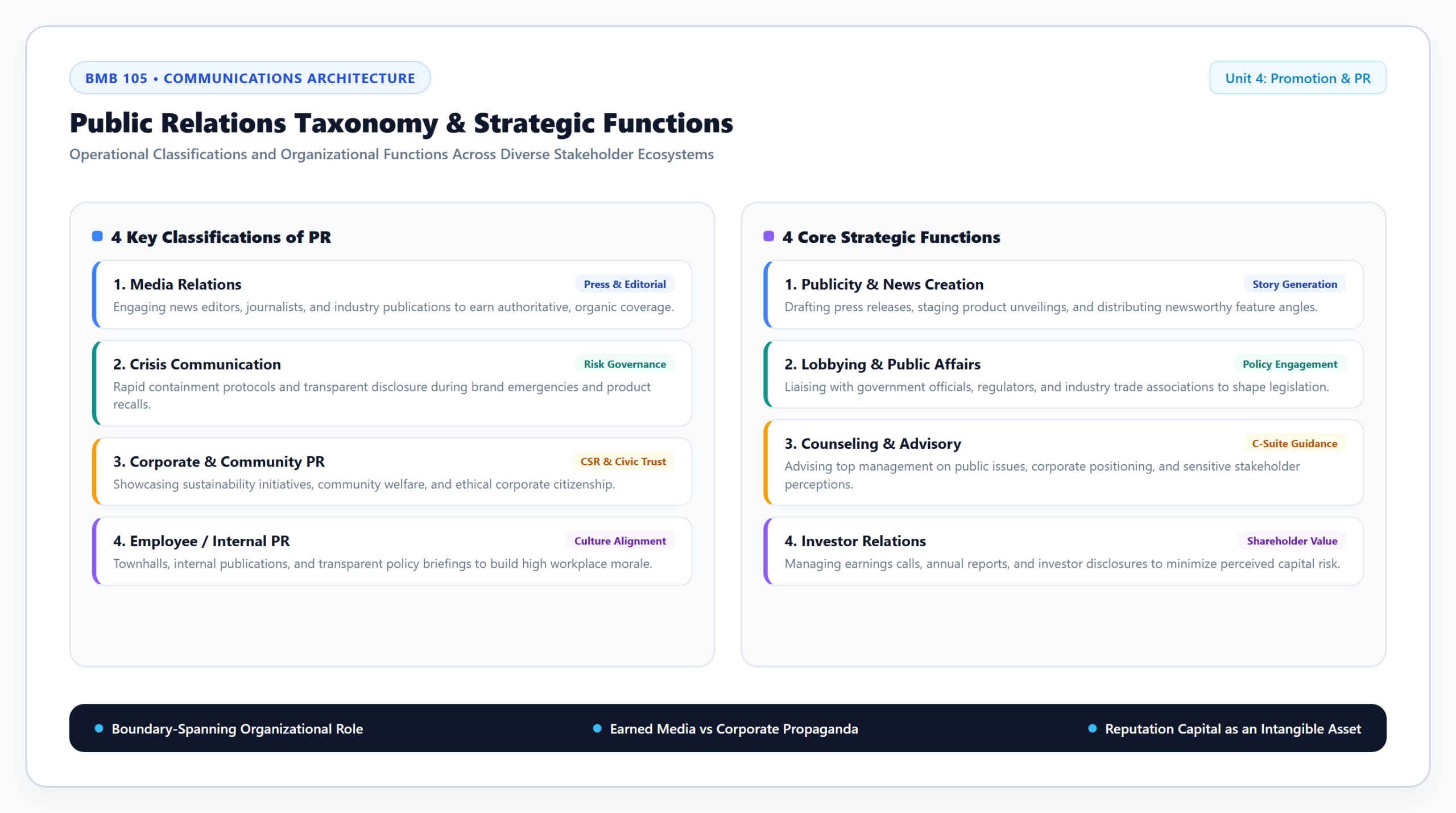
🧠 1. Core Concept & Business Meaning of PR Types & Functions
Public Relations is not a monolithic activity; it is a multi-dimensional strategic management capability that spans multiple internal and external interfaces. Organizations operate within complex social ecosystems where they must simultaneously communicate with skeptical consumers, vigilant regulators, demanding shareholders, and unionized employees.
Understanding the Types of PR enables firms to deploy specialized communication tools tailored to specific audience dynamics, while analyzing PR Functions clarifies the operational workflows through which public goodwill and institutional legitimacy are maintained.
⚙ 3. Key Dimensions & Strategic Mechanics: PR Types and Core Functions
- Media Relations: Building sustained, professional relationships with journalists, editors, and broadcasters. Involves distributing press releases, hosting press conferences, and pitching exclusive editorial angles to secure unpaid organic coverage.
- Crisis PR & Reputation Management: Developing 24/7 emergency response protocols, identifying pre-crisis vulnerabilities, establishing designated media spokespersons, and executing transparent disclosure during organizational crises.
- Corporate & Community PR: Designing corporate social responsibility (CSR) initiatives, environmental sustainability programs, and local community outreach to secure the firm’s societal license to operate.
- Employee (Internal) PR: Creating transparent internal communication channels (townhalls, employee intranets, corporate newsletters) to align workforce culture with corporate mission and boost morale.
- Press Agentry & Publicity Creation: Staging corporate events, sponsorships, and product launches designed to attract widespread editorial attention without paid advertising slots.
- Public Affairs & Lobbying: Collaborating with industry bodies (e.g., CII, FICCI) and government legislators to guide regulatory policy, taxation reforms, and trade agreements.
- Executive Counseling: Serving as the moral and strategic compass for C-suite executives, advising them on public sentiment, cultural sensitivities, and communication fallout before corporate decisions are announced.
- Investor Relations: Publishing transparent financial disclosures, coordinating quarterly earnings releases, and organizing annual general meetings (AGMs) to sustain investor confidence.
📊 4. Comparative Synthesis Matrix: Core PR Functions Across Stakeholders
| PR Function | Primary Target Public | Primary Deliverables | Key Performance Indicator |
|---|---|---|---|
| Publicity Generation | General public & prospective buyers | Press releases, media kits, press conferences | Earned media value (EMV) & share of voice |
| Public Affairs / Lobbying | Government agencies & regulators | Policy whitepapers, parliamentary testimonies | Favorable policy outcomes & regulatory compliance |
| Executive Counseling | Board of directors & CEO | Reputation impact audits, speechwriting, media training | Executive approval ratings & brand perception score |
| Investor Relations | Institutional funds, retail shareholders | Annual reports, earnings presentations, AGM logistics | Stock valuation stability & analyst consensus trust |
💼 5. Real-World Corporate Case Studies
In May 2015, Indian food safety regulators reported elevated lead levels in Maggi noodles, resulting in a nationwide ban.
Nestlé’s initial silent, legalistic response severely eroded brand trust. Recognizing the failure of its initial approach, Nestlé deployed new leadership under Suresh Narayanan, who executed a masterclass in Crisis and Media PR. Nestlé destroyed 38,000 tonnes of noodles transparently, launched the #WeMissYouToo emotional storytelling campaign across digital media, held open press conferences sharing laboratory test certifications, and partnered with e-commerce portals for midnight re-launch bookings. Within 9 months, Maggi regained over 60% market share.
Infosys set the gold standard for Investor Relations PR in emerging markets.
Long before mandatory corporate governance regulations were enacted, Infosys voluntarily adopted US GAAP accounting standards, reported compliance with the Cadbury Committee guidelines, and published comprehensive annual reports detailing executive compensation, client concentration, and risk disclosures. This radical transparency earned Infosys an extraordinary valuation premium and made it the first Indian company listed on NASDAQ.
Model Answer (40 words): Marking Scheme: 4 marks for detailing the 4 major PR types (Media, Crisis, Corporate, Employee); 4 marks for explaining core functions (Publicity, Lobbying, Counseling, Investor Relations); 2 marks for relevant corporate case study.
Model Answer (40 words): Marking Scheme: 2 marks for defining lobbying as the specialized public affairs function of interacting with legislators and government officials to provide technical data and influence legislation in favor of corporate and industry growth.
Marking Scheme: 3 marks for defining Crisis PR and pre-crisis preparedness; 4 marks for outlining step-by-step recall communication protocols (rapid acknowledgement, spokesperson assignment, multi-channel updates); 3 marks for citing Johnson & Johnson (Tylenol) or Nestlé (Maggi).
Discussion & Questions
0 CommentsAcademic insights, questions, and conceptual clarifications from students & faculty.
No questions or comments yet
Have a doubt about this topic, an exam tip, or a conceptual perspective? Start the discussion below!
Leave a Comment / Ask a Question
Your email address will not be published. Required fields are marked *