
Environmental Scanning: Macro PESTLE Framework, Porter's Five Forces and Strategic Scenario Planning
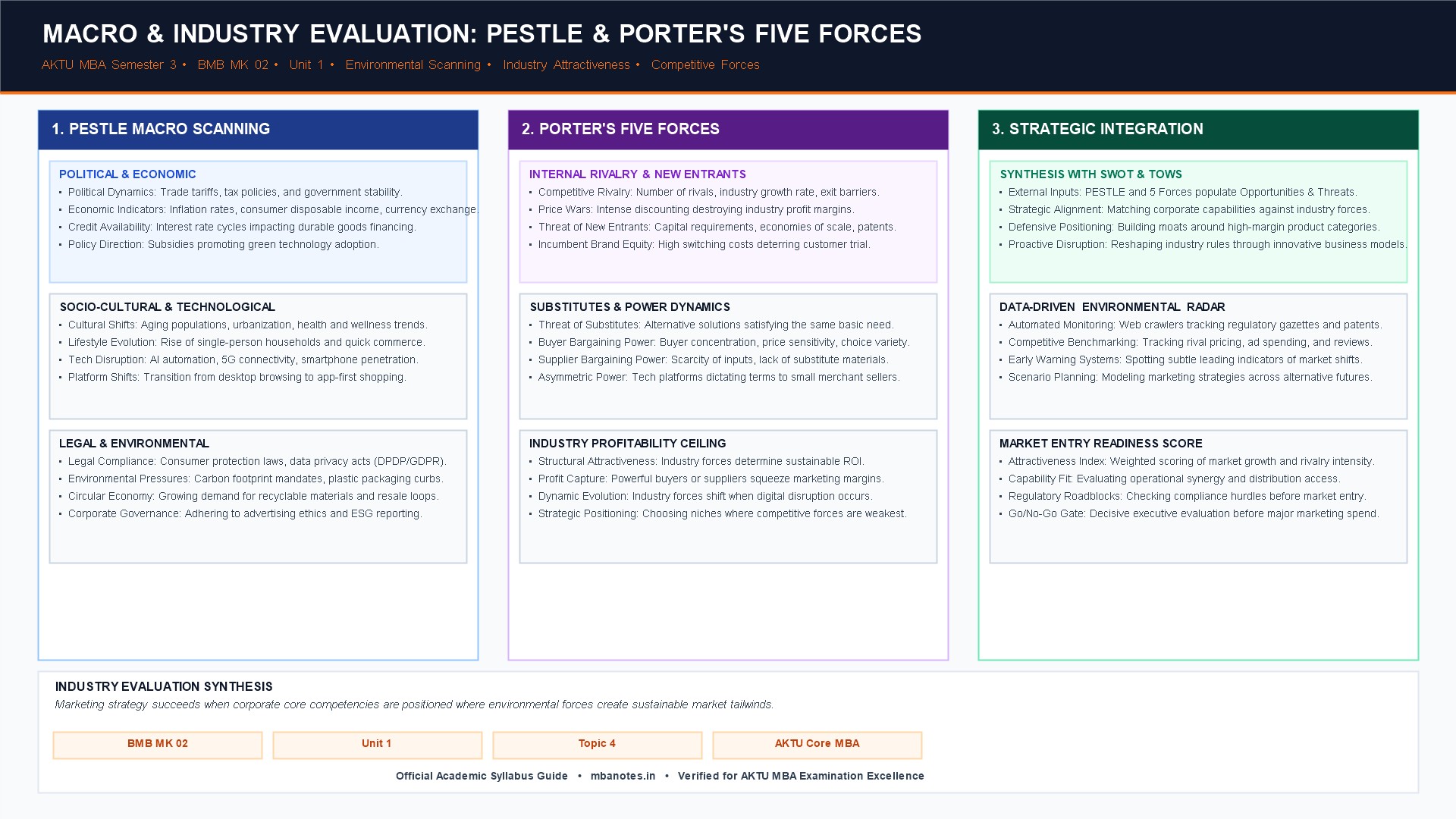
1. Macro-Environmental Scanning and the PESTLE Analytical Taxonomy
Organizations do not operate in a vacuum; they exist within an expansive, dynamic external environment. Environmental scanning is the systematic monitoring, evaluation, and dissemination of information from the external and internal environments to key people within the organization. While the internal environment dictates organizational strengths and weaknesses, the macro-environment presents overarching opportunities and existential threats that management cannot directly control, but must proactively adapt to.
The PESTLE analytical taxonomy categorizes macro-environmental forces into six interconnected structural pillars:
- Political Factors: Government policies, taxation regimes, political stability, trade restrictions, and geopolitical alliances that influence business operations and cross-border trade flows.
- Economic Factors: Macroeconomic indicators such as GDP growth rates, interest rates, exchange rate fluctuations, inflation benchmarks, and disposable consumer income levels that dictate customer purchasing power.
- Social & Cultural Factors: Demographic shifts, population aging, urban migration patterns, changing consumer lifestyle values, health awareness, and cultural norms that redefine consumer demand profiles.
- Technological Factors: R&D incentives, artificial intelligence breakthroughs, automation adoption, digital connectivity speeds (5G/6G), and patent protections that obsolete existing business models while creating entirely new markets.
- Legal & Regulatory Factors: Employment laws, consumer protection acts, antitrust regulations, health and safety mandates, and data protection legislation (such as GDPR or India's DPDP Act) requiring strict corporate compliance.
- Environmental & Ecological Factors: Climate change risks, carbon emissions targets, sustainability mandates, renewable energy transitions, and resource scarcity that compel brands to adopt circular, eco-friendly practices.
- Dynamic Interconnectivity: The PESTLE dimensions do not operate in isolation; technological advancements often trigger new legal regulations, which in turn reshape social expectations and economic viability.
2. Industry Competitiveness: Porter's Five Forces Framework and Market Dynamics
While PESTLE analyzes the broad macroeconomic climate, Harvard Business School Professor Michael Porter's Five Forces model zeroes in on the immediate micro-industry environment. Porter established that the collective strength of these five competitive forces determines the ultimate profit potential and long-term attractiveness of an industry.
- Threat of New Entrants: Evaluates how easy or difficult it is for new competitors to enter the industry. High barriers to entry—such as massive capital requirements, strong brand loyalty, economies of scale, and proprietary patents—protect existing incumbent profit margins.
- Bargaining Power of Buyers: Measures the leverage customers possess to negotiate lower prices or demand higher service levels. Buyer power is high when customers purchase in large volumes, products are standardized commodities, and buyer switching costs are virtually zero.
- Bargaining Power of Suppliers: Assesses the ability of suppliers to dictate prices, restrict input supply, or compromise material quality. Supplier power surges when inputs are concentrated among a few monopolistic suppliers, switching costs are prohibitive, and no viable substitute materials exist.
- Threat of Substitute Products or Services: Analyzes the availability of alternative products outside the immediate category that perform the same fundamental functional job (e.g., high-speed rail acting as a substitute for domestic short-haul flights).
- Rivalry Among Existing Competitors: The intensity of direct competition among current industry players. Rivalry turns cutthroat when numerous equally balanced competitors operate in a slow-growth industry characterized by high fixed exit barriers.
- Industry Attractiveness Determinant: When all five forces are intensely hostile, industry returns drop toward the cost of capital (e.g., commercial airlines). When forces are mild, sustainable above-average economic profits flourish (e.g., enterprise enterprise software).
3. Strategic Integration: Scenario Planning, Early Warning Systems and Agility
Conducting environmental scanning without translating findings into executive action produces passive academic reports. Best-in-class strategic marketing integrates environmental scanning with scenario planning and early warning detection to build institutional agility.
- Scenario Planning & Future Stress-Testing: Rather than relying on a single, brittle linear forecast, scenario planners construct multiple plausible future market scenarios (e.g., rapid regulatory decarbonization vs prolonged fossil reliance) to stress-test corporate marketing strategies.
- Early Warning System (EWS) Telemetry: Establishing automated analytical listening posts that track 'weak signals' across scientific patent filings, regulatory committee debates, and niche fringe social conversations before they emerge as disruptive industry forces.
- Cross-Impact Matrix Analysis: Modeling how simultaneous shifts across multiple environmental variables compound each other, revealing hidden vulnerabilities in the supply chain or distribution network.
- Dynamic Resource Flexibility: Designing modular product architectures, variable cost structures, and flexible supplier contracts that permit rapid strategic pivots when environmental conditions shift abruptly.
- SWOT Synthesis Alignment: Environmental scanning directly populates the external Opportunities and Threats quadrants of a corporate SWOT matrix, ensuring internal strengths are deployed against real-world external tailwinds.
- Continuous Scanning Rhythm: Environmental scanning must operate as an ongoing, institutionalized executive radar rather than an ad-hoc panic reaction triggered only after an unexpected crisis strikes.
4. Comparative Framework: PESTLE Macro Analysis vs Porter's Five Forces
The comparative matrix below delineates the structural, operational, and tactical distinctions between broad PESTLE macro-environmental analysis and Porter's micro-industry competitive model.
Analytical Boundary: Macro Environment vs Micro Industry
Strategic ModelingPESTLE scans the broad macroeconomic weather system affecting all businesses across society, while Porter's Five Forces examines the immediate competitive battlefield and industry profit structures.
| Evaluation Dimension | PESTLE Macro Analysis | Porter's Five Forces Model |
|---|---|---|
| Analytical Scope | Macro-environmental landscape encompassing society, politics, and technology. | Micro-industry market structure and immediate value-chain dynamics. |
| Locus of Impact | Affects all industries and organizations across an entire national or global economy. | Specific to a single defined industry, sector, or competitive market arena. |
| Controllability | Virtually uncontrollable by individual firms; requires organizational adaptation. | Partially influenceable through strategic positioning, mergers, and scale barriers. |
| Primary Analytical Focus | Long-term societal shifts, regulatory evolutions, and technological waves. | Power balance between buyers, suppliers, rivals, entrants, and substitutes. |
| Primary Strategic Question | 'What major external environmental forces will reshape our future market landscape?' | 'How attractive is this specific industry, and how can we protect our margins?' |
| Actionable Output | Strategic scenario development, risk mitigation, and long-term innovation roadmaps. | Competitive positioning, pricing power defense, and barrier-to-entry construction. |
6. Corporate Case Vignette: Reliance Jio & Disruptive Environmental Scanning
Enterprise Application: How Reliance Jio Mastered PESTLE & Industry Forces
Telecommunications & Digital ServicesThe Strategic Challenge: In 2015, the Indian telecom sector was dominated by entrenched incumbent operators (Airtel, Vodafone, Idea) offering expensive, metered 2G and 3G voice and data services. Conventional market logic assumed entering such a capital-intensive sector against established rivals was commercial suicide.
The Environmental Scanning Masterstroke: Reliance leadership identified massive converging macro tailwinds via PESTLE analysis: government Digital India initiatives (Political), surging smartphone affordability (Economic), widespread hunger for video content (Social), and the emergence of pure IP-based LTE 4G technology (Technological). Analyzing Porter's Five Forces, Jio recognized that legacy incumbents were trapped in heavy debt with outdated 2G/3G infrastructure. Jio leapfrogged them by constructing an all-IP greenfield 4G optical fiber network, eliminating voice carriage costs entirely, and launching with free voice and ultra-cheap data tariffs.
The Commercial Result: Within four years, Jio acquired over 400 million subscribers, forced an unprecedented consolidation across the telecom sector, drove data consumption in India to the highest in the world, and transformed Reliance into an unrivaled digital ecosystem powerhouse valued at over $100 billion.
7. AKTU University Exam Practice Drill: Solved Questions
University Examination Review: Model Solutions
AKTU MBA PatternQ1: What is the primary difference between a competitor and a substitute in Porter's Five Forces model?
Answer: A direct competitor operates within the exact same industry product category delivering a similar solution (e.g., Pepsi vs Coca-Cola). A substitute belongs to an entirely different industry category but satisfies the identical underlying consumer need or functional job-to-be-done (e.g., packaged mineral water, fresh coconut water, or tea serving as substitutes for carbonated sodas).
Q2: Detail the PESTLE framework and Porter's Five Forces model. Explain how environmental scanning and scenario planning help marketing managers build agile strategies in turbulent markets.
Answer Structure Guide:
- Introduction & Definition: Define environmental scanning as the continuous monitoring and analysis of external forces to identify emerging opportunities and existential threats.
- Detailed PESTLE Taxonomy: Systematically explain each of the six dimensions (Political, Economic, Social, Technological, Legal, Environmental) with clear corporate examples.
- Porter's Five Forces Framework:
- Threat of New Entrants (capital requirements, economies of scale).
- Bargaining Power of Buyers (volume concentration, switching costs).
- Bargaining Power of Suppliers (monopoly inputs, scarcity).
- Threat of Substitutes (cross-elasticity, functional alternatives).
- Rivalry Among Existing Competitors (exit barriers, industry growth).
- Comparative Integration: Differentiate macro-environmental scanning (PESTLE) from micro-industry structural analysis (Porter), highlighting how macro forces shape micro power dynamics.
- Scenario Planning & Strategic Agility: Explain how developing alternative future scenarios stress-tests strategies, minimizes blind spots, and deploys early warning telemetry to enable rapid corporate pivots.
- Conclusion: Conclude with the insight that organizations that master environmental scanning turn external volatility from an existential threat into an engine of competitive advantage.
Discussion & Questions
0 CommentsAcademic insights, questions, and conceptual clarifications from students & faculty.
No questions or comments yet
Have a doubt about this topic, an exam tip, or a conceptual perspective? Start the discussion below!
Leave a Comment / Ask a Question
Your email address will not be published. Required fields are marked *