
Functional Strategies and Sourcing Decisions: Outsourcing and Offshoring Dynamics
1. Foundations of Functional Strategy: Departmental Alignment & Synergies
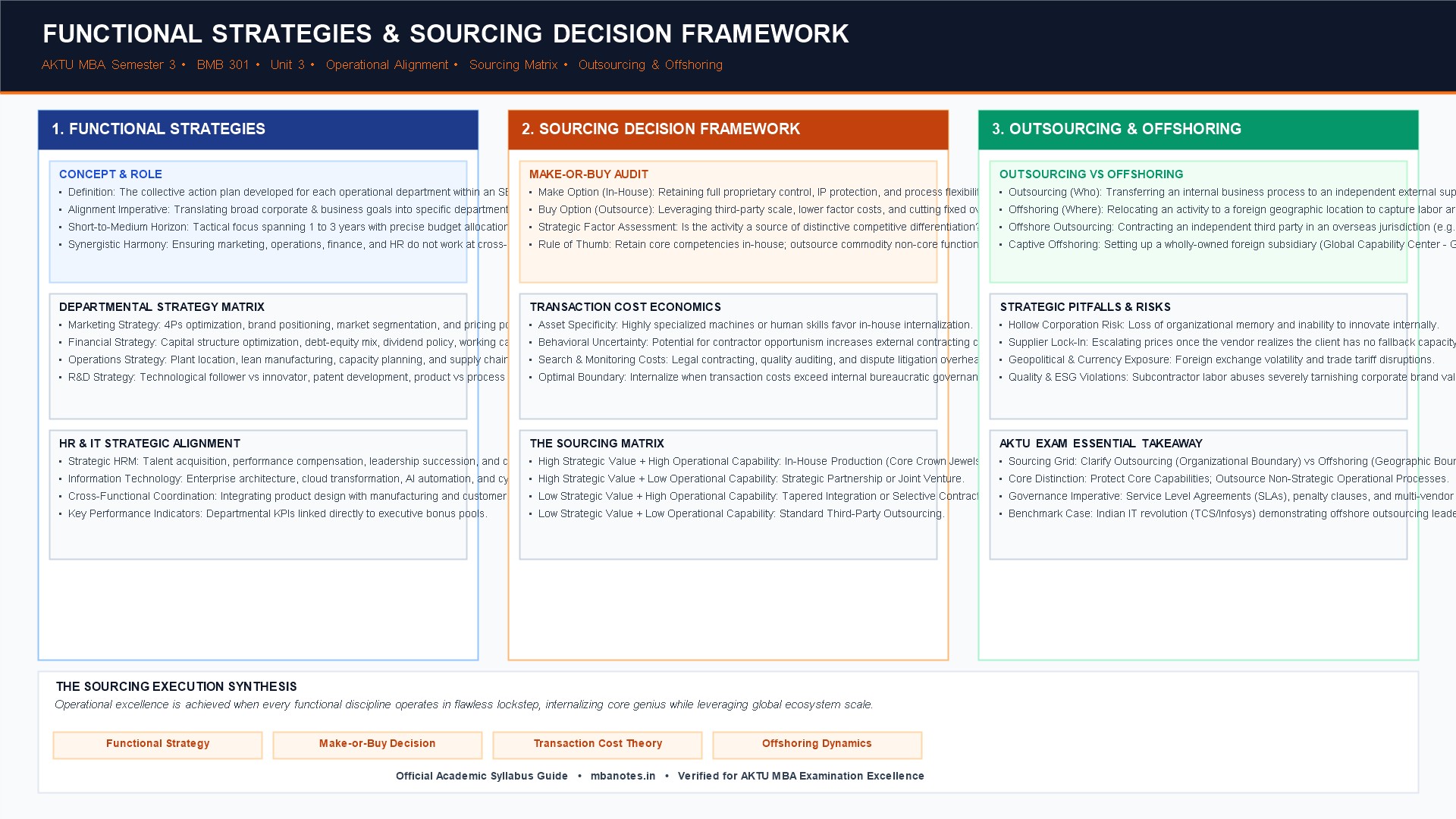
A brilliant corporate vision and a compelling business-level strategy remain sterile abstractions without precise operational execution. Functional Strategy represents the operational blueprint formulated for each distinct functional department—Marketing, Operations, Finance, Research and Development (R&D), Human Resource Management (HRM), and Information Technology (IT)—within an organization or Strategic Business Unit (SBU).
Operating on a tactical, short-to-medium-term time horizon (typically 1 to 3 years), functional strategies have two primary responsibilities:
- Vertical Alignment: Ensuring every functional program directly reinforces and implements the broader competitive posture (Cost Leadership, Differentiation, or Focus) chosen by the SBU.
- Horizontal Integration: Ensuring diverse functional departments operate in collaborative harmony rather than functioning as hostile corporate fiefdoms pursuing contradictory objectives.
The Strategic Alignment Imperative
If a firm chooses a Cost Leadership Strategy at the business level, its functional strategies must reflect uncompromising frugality and standardization:
- Operations: Relentless pursuit of scale economies, high capacity utilization, automated assembly, and strict scrap-rate containment.
- Marketing: Straightforward volume advertising, minimal customized promotion, and direct channel distribution.
- Finance: Low debt-service costs, rapid asset turnover metrics, and rigorous variance monitoring.
- HRM: Compensation linked directly to operational productivity metrics, process efficiency, and cost reduction suggestions.
Conversely, if the business-level posture is Differentiation, functional strategies invert: Operations prioritizes customized flexibility and zero-defect engineering; Marketing invests heavily in brand storytelling and sensory packaging; R&D receives generous exploratory funding; and HR recruits creative mavericks compensated through innovation bonuses.
2. Departmental Strategies: Marketing, Operations, Finance, R&D & HR
Key Functional Disciplines & Their Strategic Focus
- Marketing Strategy: Focuses on pricing, market segmentation, product positioning, and promotion. Key decisions include choosing between market penetration pricing (setting low introductory prices to capture mass volume) and skimming pricing (setting high prices to recover R&D investments from early adopters); determining distribution intensity (intensive, selective, or exclusive franchising); and managing customer lifetime value (CLV) via digital engagement.
- Financial Strategy: Governs the acquisition, preservation, and allocation of capital resources. Strategic decisions encompass establishing optimal capital structure (balancing low-cost debt against equity dilution); working capital management; dividend payout policies (retaining earnings for high-growth reinvestment vs distributing stable dividends to reassure institutional investors); and managing foreign exchange volatility through currency hedging.
- Operations & Supply Chain Strategy: Determines how products and services are physically manufactured, assembled, and delivered. Core choices include facility location (proximity to raw materials vs major consumer consumption centers); capacity planning (lead strategy: adding capacity ahead of demand vs lag strategy: waiting until capacity is strained); modular design; and deploying Total Quality Management (TQM) and Just-in-Time (JIT) inventory systems.
- Research & Development (R&D) Strategy: Determines whether the enterprise positions itself as a technological technological pioneer (first-mover advantage, patent thickets, high R&D risk) or a technological follower (reverse engineering, fast following, optimizing processes to lower costs). It also balances product R&D (inventing new customer-facing products) with process R&D (improving shop-floor production efficiency).
- Strategic Human Resource Management (SHRM): Views workforce talent as the primary driver of sustainable competitive advantage. Encompasses selective talent acquisition, leadership succession planning, performance-linked equity incentives, and nurturing a collaborative, high-performance corporate culture aligned with ethical governance.
- Information Technology (IT) Strategy: Aligns digital infrastructure with strategic objectives through enterprise ERP architecture, automated CRM customer analytics, cloud migrations, predictive AI workflows, and robust cyber-security perimeter defenses.
3. The Sourcing Decision: Outsourcing vs Offshoring Mechanics & Governance
One of the most consequential decisions facing modern functional leaders is the Sourcing Decision—often termed the Make-or-Buy Decision. In a hyper-specialized global economy, no company can maintain world-class capability across every operational node. Executive leaders must critically evaluate which activities belong inside the organizational boundary and which should be entrusted to external market specialists.
Clarifying the Terminological Distinction: Outsourcing vs Offshoring
Management students and corporate observers frequently conflate outsourcing and offshoring. They represent two fundamentally different strategic vectors:
- Outsourcing (The "Who" Vector — Ownership Boundary): Outsourcing involves transferring a business process or functional activity previously conducted in-house to an independent external third-party supplier. The critical variable is organizational ownership. If a Mumbai bank hires an independent Indian accounting firm to audit its books, it has outsourced domestically.
- Offshoring (The "Where" Vector — Geographic Boundary): Offshoring involves relocating a business process or operational facility across national borders to a foreign country. The critical variable is geography. If an American corporation establishes its own wholly-owned software research center in Bengaluru, India, it has offshored, but it has not outsourced (this is known as Captive Offshoring or a Global Capability Center - GCC).
- Offshore Outsourcing: The intersection of both vectors. An enterprise contracts an independent third-party vendor located in an overseas jurisdiction to perform an operational activity (e.g., a British bank contracting Tata Consultancy Services in Pune to manage its global cloud infrastructure).
The Strategic Make-or-Buy Evaluation Logic
- Rule 1 — Protect Core Competencies: Any activity that directly produces the firm's distinctive competitive advantage, involves proprietary trade secrets, or drives brand differentiation must remain in-house (e.g., Apple designs its A-series and M-series chips in-house).
- Rule 2 — Outsource Commodity Non-Core Activities: Functional tasks that are standardized, non-differentiating, and easily benchmarked across the marketplace (e.g., payroll processing, facility catering, legal document proofreading, logistics fleet maintenance) should be outsourced to capture vendor scale economies.
Strategic Pitfalls and Risks of Over-Outsourcing
- The "Hollow Corporation" Vulnerability: When an enterprise aggressively outsources its engineering, design, and manufacturing capabilities, it risks losing its core technical intuition. Over time, the firm becomes an empty marketing shell unable to innovate, completely dependent on external suppliers.
- The Supplier Lock-In Trap: Once internal capabilities and tooling are disbanded, the external contractor possesses immense bargaining power. The vendor can gradually escalate service fees, reduce responsiveness, or deliver sub-par quality, knowing the client cannot easily bring operations back in-house.
- Loss of Intellectual Property (IP): Outsourcing sensitive manufacturing or coding to third parties creates the risk of reverse engineering and IP leakage, inadvertently training future global competitors.
- Geopolitical, Currency & ESG Exposures: Offshore operations face foreign currency fluctuations, sudden trade embargoes, cross-border tariff disputes, and subcontractor labor or environmental violations that can permanently damage the parent company's brand reputation.
4. Core Theoretical Framework: Transaction Cost Economics & Sourcing Matrix
Oliver Williamson's Transaction Cost Economics (TCE) (1975, 1985)
Nobel Laureate Oliver Williamson established that firms and markets are alternative governance mechanisms. Deciding whether to "Make" (internal firm hierarchy) or "Buy" (external market contracting) depends on minimizing total costs: the direct production cost plus the indirect Transaction Costs of searching, negotiating, monitoring, and enforcing contracts.
Asset Specificity
When an activity requires highly customized machinery, software, or specialized human knowledge that cannot be redeployed, transaction costs soar, strongly favoring internal hierarchy (Make).
Behavioral Opportunism
Assuming external contractors act with 'guile' and seek self-interest whenever contractual loopholes arise. Higher opportunism risks require expensive legal monitoring, favoring internalization.
Bounded Rationality
Human executives cannot foresee every future contingency. In highly turbulent or complex environments, writing complete contracts is impossible, favoring internal management agility.
Governance Equilibrium
Internalize activities (Make) when market transaction costs exceed internal bureaucratic overhead; outsource to the market (Buy) when standardization keeps transaction costs minimal.
Comprehensive Comparison: Sourcing Governance Configurations
| Strategic Dimension | Domestic In-House (Make) | Domestic Outsourcing (Buy) | Captive Offshoring (GCC) | Offshore Outsourcing |
|---|---|---|---|---|
| Ownership Boundary | Internal: Wholly owned within corporate parent. | External: Independent third-party vendor. | Internal: 100% owned foreign corporate subsidiary. | External: Independent overseas contractor. |
| Geographic Location | Domestic: Within the home nation. | Domestic: Within the home nation. | International: In a low-cost or talent-rich foreign nation. | International: In a foreign offshore location. |
| Primary Strategic Driver | Maximum control, IP protection, and strategic secrecy. | Vendor scale economies, operational focus on core skills. | Labor cost arbitrage while maintaining strict internal IP control. | Maximum operational cost reduction and variable flexibility. |
| Level of Control | Highest: Full executive and operational management. | Moderate: Controlled via Service Level Agreements (SLAs). | High: Corporate parent culture and security governance. | Lowest: Governed exclusively by cross-border contracts. |
| Transaction Costs | Zero external contracting costs; high internal overhead. | Moderate: Domestic legal contracting and audit costs. | Moderate: International compliance and expatriate oversight. | Highest: Complex international dispute arbitration, currency risks. |
| Real-World Benchmark | ISRO building rocket cryogenic engines internally. | HDFC Bank outsourcing branch security to SIS India. | J.P. Morgan Global Capability Center (GCC) in Bengaluru. | Nike contracting footwear manufacturing in Vietnam. |
6. Corporate Case Vignette: The Indian IT & GCC Paradigm (TCS & Infosys)
Tata Consultancy Services & Infosys: Driving the Global Sourcing Revolution
The dramatic expansion of the Indian Information Technology sector over the past four decades is the world's most compelling manifestation of Offshore Outsourcing and strategic sourcing evolution. In the late 1990s, Fortune 500 corporations in North America and Western Europe confronted high domestic software programming costs and severe talent shortages, amplified by the impending Y2K computing milestone.
Pioneered by Tata Consultancy Services (TCS) and Infosys, Indian IT enterprises engineered the Global Delivery Model (GDM). GDM divided complex software lifecycles into discrete operational components: high-level business requirement analysis was conducted on-site at the client's American or European headquarters, while code writing, automated unit testing, database maintenance, and bug fixing were offshored to state-of-the-art software technology parks in Bengaluru, Hyderabad, and Chennai.
7. AKTU University Exam Drill: Questions & Model Answers
AKTU MBA Semester Exam: Model Questions & High-Score Answers
Q1: Clearly distinguish between Outsourcing and Offshoring.
Model Answer: Outsourcing relates to the organizational ownership boundary: transferring an internal business activity to an independent external third-party supplier, regardless of geography. Offshoring relates to the geographic boundary: relocating an operational process or facility to a foreign country across national borders, regardless of whether it is operated as a wholly-owned subsidiary (captive) or managed by a third party.
Q2: What is 'Asset Specificity' in Transaction Cost Economics?
Model Answer: In Oliver Williamson's Transaction Cost Economics, Asset Specificity refers to the degree to which an investment in specialized physical machinery, site location, or human skill is dedicated to a specific transaction and cannot be redeployed to alternative uses without a substantial loss in economic value. High asset specificity creates severe opportunism risks, strongly favoring doing the activity in-house (Make).
Q3: What are Functional Strategies? Explain how they align with business-level positioning, and critically evaluate the Make-or-Buy sourcing decision using Transaction Cost Economics.
Model Answer Structure & Key Arguments:
- Introduction & Definition of Functional Strategy: Define functional strategy as the operational blueprint developed for each departmental discipline (Marketing, Operations, Finance, R&D, HR) to execute the overarching business-level strategy over a 1 to 3 year tactical horizon.
- Vertical & Horizontal Strategic Alignment:
- Vertical Alignment: Demonstrate how functional disciplines align with generic business strategies. In Cost Leadership, Operations focuses on high capacity and standardization while Marketing utilizes volume distribution; in Differentiation, R&D focuses on breakthrough invention and Operations on flexible customization.
- Horizontal Harmony: Coordinating cross-functional interactions to eliminate departmental silos and ensure operations, finance, and marketing pursue unified goals.
- The Sourcing Decision Framework (Make-or-Buy):
- Core vs Non-Core Competency Rule: Protect internal crown jewels and proprietary intellectual property in-house; outsource standardized, non-differentiating operational tasks to market specialists.
- Outsourcing vs Offshoring Taxonomy: Draw the 2x2 grid delineating Domestic In-House, Domestic Outsourcing, Captive Offshoring (GCC), and Offshore Outsourcing.
- Oliver Williamson's Transaction Cost Economics (TCE):
- Explain the balance between internal bureaucratic production costs and external market transaction costs (search, bargaining, contracting, monitoring, and dispute litigation).
- Detail the three behavioral and environmental drivers: Asset Specificity (physical, site, human), Behavioral Opportunism (acting with guile), and Bounded Rationality.
- Conclude that when asset specificity and opportunism are high, internal hierarchy (Make) is the optimal governance choice.
- Strategic Risks of Over-Outsourcing: Detail the Hollow Corporation phenomenon, loss of organizational memory, supplier lock-in traps, and global ESG/geopolitical vulnerabilities.
- Corporate Indian Benchmark: Conclude by examining how TCS and Infosys leveraged the Global Delivery Model to pioneer global offshore outsourcing, followed by the contemporary evolution of 1,600+ Global Capability Centers (GCCs) in India.
Discussion & Questions
0 CommentsAcademic insights, questions, and conceptual clarifications from students & faculty.
No questions or comments yet
Have a doubt about this topic, an exam tip, or a conceptual perspective? Start the discussion below!
Leave a Comment / Ask a Question
Your email address will not be published. Required fields are marked *