
Strategy: Meaning, Nature, Scope, Importance, and Strategic Intent
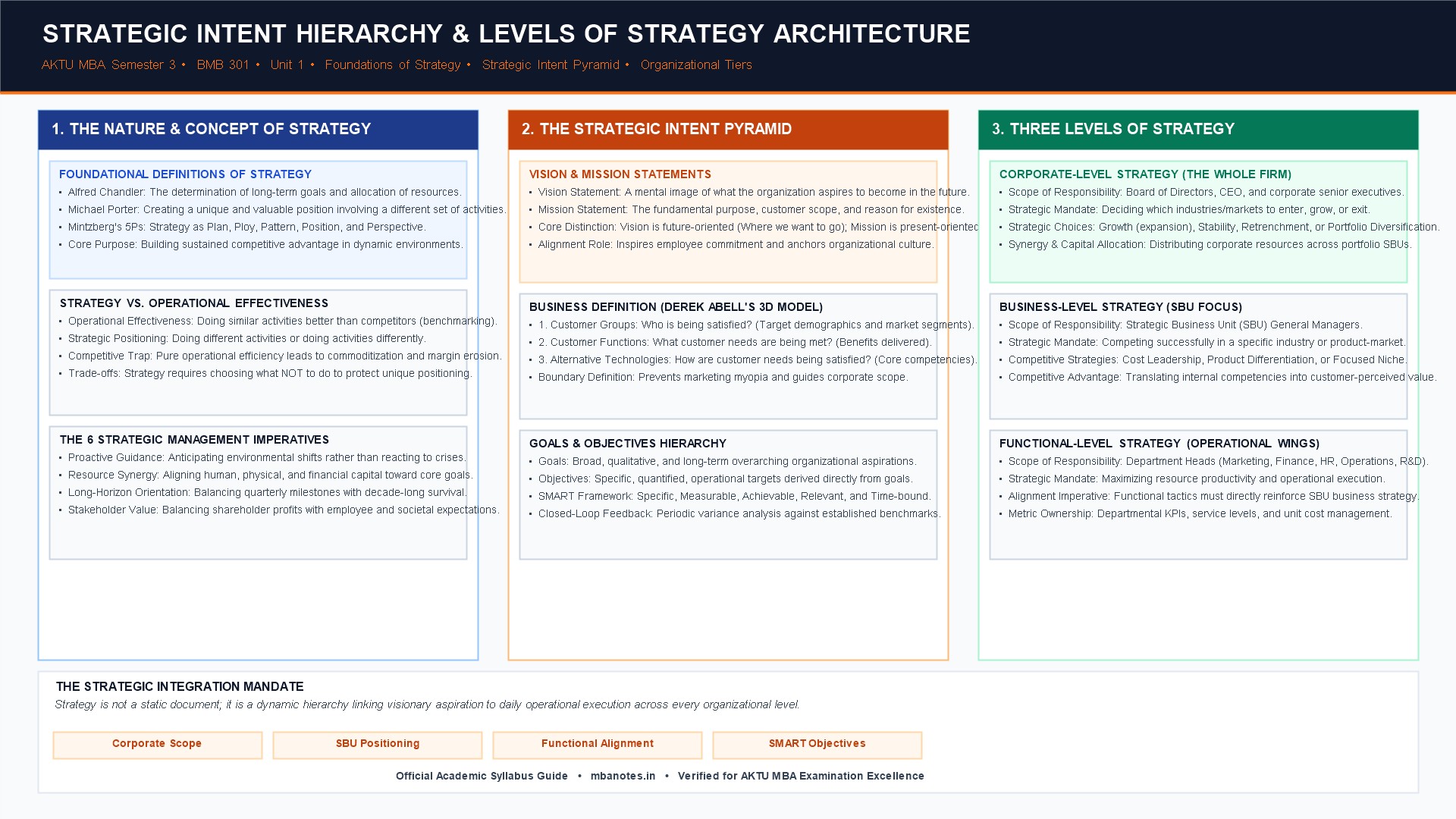
1. Concept, Nature & Scope of Strategy in Business Policy
The word strategy originates from the ancient Greek term strategos, meaning "generalship" or the art of the military commander. In management science, strategy emerged from the field of Business Policy, transitioning from historical budgeting and operational control into an integrative discipline focused on firm survival, market positioning, and sustainable wealth creation under environmental turbulence.
Academic Definitions of Strategy
- Alfred Chandler (1962): "The determination of the basic long-term goals and objectives of an enterprise, and the adoption of courses of action and the allocation of resources necessary for carrying out these goals." Chandler established the foundational axiom: Structure follows Strategy.
- Michael Porter (1996): "Strategy is the creation of a unique and valuable position, involving a different set of activities... Strategy is making trade-offs in competing. The essence of strategy is choosing what not to do."
- Igor Ansoff (1965): Viewed strategy as the "common thread" running through an enterprise's activities and product-market entries, defining the essential nature of the business the firm seeks to establish.
Henry Mintzberg's 5Ps of Strategy Framework
To eliminate narrow textbook preconceptions, management theorist Henry Mintzberg formulated the celebrated 5Ps Framework, establishing that strategy cannot be restricted to a single written binder:
- 1. Strategy as a Plan: An intentionally crafted, forward-looking course of action designed prior to execution to achieve explicit organizational milestones.
- 2. Strategy as a Ploy: A specific tactical maneuver or competitive feint intended to outwit, deter, or mislead a competitor (e.g., announcing capacity expansion to discourage rival entry).
- 3. Strategy as a Pattern: A stream of consistent organizational actions over time, regardless of whether those actions were deliberately planned in advance or emerged organically.
- 4. Strategy as a Position: The specific domain, market niche, or competitive space an enterprise occupies in its external economic environment (e.g., low-cost leader vs. ultra-luxury provider).
- 5. Strategy as a Perspective: The enterprise's fundamental character, culture, and ingrained collective worldview—its distinctive way of perceiving the commercial world.
Operational Effectiveness vs. Strategic Positioning
Michael Porter warned managers against confusing Operational Effectiveness (OE) with Strategy:
- Operational Effectiveness: Performing similar operational activities better, faster, or with less scrap than competitors. Techniques like Total Quality Management (TQM), benchmarking, and re-engineering improve OE, but they are easily copied, resulting in competitive convergence and price wars.
- Strategic Positioning: Performing different activities from rivals, or performing similar activities in different ways, to deliver a distinctive blend of customer value.
- The Trade-Off Rule: Sustainable advantage requires intentional trade-offs. A budget airline (like IndiGo) cannot simultaneously offer complimentary hot meals, luxury lounges, and complex interline luggage transfers without destroying its low-cost operating model.
6 Organizational Drivers of Strategic Management
- 1. Navigating Environmental Volatility: Equips leadership to anticipate technological disruptions, geopolitical shifts, and changing consumer lifestyles rather than reacting blindly.
- 2. Systematic Resource Allocation: Directs scarce corporate capital, managerial talent, and engineering capabilities toward high-yield growth avenues instead of subsidizing dying legacy units.
- 3. Cohesive Enterprise Direction: Provides a unified navigational compass that aligns diverse, geographically dispersed departments toward a singular overarching corporate mission.
- 4. Building Defensible Moats: Identifies and cultivates distinct core competencies that erect high barriers to entry against domestic and international rivals.
- 5. Enhancing Financial Performance: Empirical research consistently demonstrates that organizations practicing disciplined strategic planning achieve superior Return on Invested Capital (ROIC).
- 6. Organizational Longevity & Survival: Prepares enterprises to reinvent their business models proactively before obsolescence and market irrelevance set in.
2. The Strategic Intent Hierarchy: Vision, Mission, Abell's Model & Objectives
Strategic Intent, a concept popularized by Gary Hamel and C.K. Prahalad, represents an ambitious and compelling organizational stretch—an overarching obsession with winning that sustains executive energy across multi-year horizons. Strategic intent is formally structured into a top-down hierarchy:
1. Vision Statement (The Horizon Blueprint)
- Core Definition: An inspiring, future-oriented mental image articulating what the enterprise aspires to become over the next 10 to 20 years.
- Key Characteristics: Graphic, forward-looking, directional, focused, flexible, and feasible yet highly challenging (e.g., Ford's historical vision: "A horse-less carriage in every American driveway").
- Managerial Value: Provides emotional inspiration, fosters shared organizational identity, and prevents strategic drift during market downturns.
2. Mission Statement (The Fundamental Purpose)
- Core Definition: A formal declaration of the organization's core purpose, customer scope, philosophical values, and present operational identity.
- Distinction from Vision: While Vision answers "Where do we want to go in the distant future?", Mission answers "Who are we, whom do we serve, what value do we deliver, and why do we exist today?"
- Key Components of a Robust Mission: Target customers, core products/services, geographic domain, proprietary technology, commitment to economic survival, corporate philosophy, self-concept, and public/environmental image.
3. Business Definition: Derek Abell's 3-Dimensional Model
Defining a business merely by the physical product it manufactures (e.g., "We make railway tracks") leads directly to Marketing Myopia (Theodore Levitt). Strategist Derek Abell established that a business must be defined along three distinct dimensions:
- 1. Customer Groups (Who is being satisfied?): Identifies the specific consumer demographics, industrial sectors, or geographic segments served by the firm.
- 2. Customer Functions (What need is being satisfied?): Details the functional benefits, emotional desires, or utility delivered to the target buyers.
- 3. Alternative Technologies (How are customer needs being satisfied?): Identifies the technological processes, engineering techniques, or service methodologies used to satisfy those needs.
- Strategic Utility: Enables leadership to recognize substitute products early (e.g., airlines recognizing high-speed rail as an alternative technology satisfying intercity transit functions).
4. Goals vs. Objectives: The Operational Bridge
- Organizational Goals: Broad, qualitative, multi-year strategic aspirations that establish general organizational direction (e.g., "To become the benchmark for customer service in Indian civil aviation").
- Strategic Objectives: Specific, quantifiable, short-to-medium-term operational targets derived directly from overarching goals (e.g., "Achieve an on-time arrival rate of 92.5% and reduce baggage mishandling below 1.2 per 1,000 passengers by Q4 2027").
- The SMART Criteria: For objectives to drive organizational accountability, they must be Specific (unambiguous), Measurable (quantifiable metrics), Achievable (realistic stretch), Relevant (aligned with mission), and Time-bound (explicit deadline).
3. The Three Levels of Strategy: Corporate, Business (SBU) & Functional
In multi-business, diversified modern corporations, strategic management operates simultaneously across three distinct hierarchical tiers:
1. Corporate-Level Strategy (The Enterprise Scope)
- Key Decision-Makers: Board of Directors, Chief Executive Officer (CEO), Chief Strategy Officer, and Corporate Executive Committee.
- Primary Strategic Question: "What businesses and industries should we be in, and how should corporate headquarters manage the portfolio?"
- Core Responsibilities:
- Allocating financial, human, and technological capital across competing business units.
- Deciding corporate directional posture: Growth (expansion), Stability, or Retrenchment (divestiture/turnaround).
- Managing Mergers, Acquisitions, Joint Ventures, and Strategic Alliances.
- Harvesting corporate synergy (making the value of the portfolio greater than the sum of its independent parts).
2. Business-Level Strategy (SBU Competitive Positioning)
- Key Decision-Makers: Strategic Business Unit (SBU) General Managers, Division Presidents, and Brand Leaders.
- Primary Strategic Question: "How do we compete successfully and win against rivals within our specific industry or product-market?"
- Core Responsibilities:
- Formulating competitive positioning using Porter's Generic Strategies (Cost Leadership, Differentiation, or Focus).
- Translating internal core competencies into unique customer value propositions.
- Anticipating and neutralizing competitor moves, price cuts, and new product introductions.
- Aligning functional departments within the SBU toward market-share and margin objectives.
3. Functional-Level Strategy (Operational Execution Wings)
- Key Decision-Makers: Department Heads (Chief Marketing Officer, Chief Financial Officer, VP of Supply Chain, Head of HR, R&D Director).
- Primary Strategic Question: "How can departmental workflows, capabilities, and resources maximize operational productivity to support the SBU strategy?"
- Core Responsibilities:
- Marketing Strategy: Pricing architecture, brand positioning, distribution channels, and promotional mix.
- Operations & Supply Chain: Plant capacity, lean manufacturing, procurement optimization, and quality assurance.
- Financial Strategy: Working capital management, capital structure, debt-equity mix, and cash flow liquidity.
- Human Resource Strategy: Talent acquisition, performance appraisal, executive compensation, and culture building.
- R&D / Technology Strategy: Product innovation cycles, intellectual property patents, and digital transformation.
4. Core Theoretical Framework: Ansoff's Paradigm & Planning Comparison
Igor Ansoff's Strategic Success Paradigm
Father of Strategic Management Igor Ansoff established that organizational financial success is not accidental. A firm achieves peak Return on Investment when its strategic aggressiveness matches the turbulence of its environment, supported by internal organizational capability:
Environmental Turbulence Level
The speed, novelty, and unpredictability of external market, competitive, regulatory, and technological changes (ranging from repetitive/stable to discontinuous/turbulent).
Strategic Aggressiveness
The degree of change and innovation the firm introduces through its strategic posture (reactive, defensive, analytical, or proactively entrepreneurial).
Organizational Capability
The responsiveness of the firm's leadership, structure, culture, information systems, and competencies to execute chosen strategies under environmental stress.
Strategic Alignment Axiom
Return on Investment is maximized when Strategic Aggressiveness matches Environmental Turbulence, and both are backed by commensurate Organizational Capability.
To excel in university examinations, students must understand the crucial historical distinction between Strategic Planning and Corporate Planning:
| Comparison Dimension | Corporate Planning (Traditional) | Strategic Planning (Modern) |
|---|---|---|
| Foundational Assumption | The future will be an incremental extrapolation of past trends. | The future will be discontinuous, uncertain, and disruptive. |
| Primary Focus | Internal budgeting, capacity expansion, and resource allocation. | External market positioning, competitive moats, and strategic fit. |
| Time Horizon | Fixed medium-term calendars (e.g., 3-year or 5-year capital budgets). | Fluid, continuous, and dynamic horizon adapted to market shifts. |
| Leadership Involvement | Staff specialists and corporate financial planning departments. | Top line executives, Board of Directors, and cross-functional teams. |
| Handling Uncertainty | Tries to forecast single point estimates; suppresses ambiguity. | Deploys scenario planning, stress testing, and real options logic. |
| Organizational Impact | Rigid functional compliance; often degenerates into paperwork. | Agile strategic flexibility, proactive innovation, and competitive resilience. |
6. Corporate Case Vignette: Titan Company's Multi-Tier Strategic Alignment
Titan Company Limited: Translating Strategic Intent into Multi-Category Dominance
Founded in 1984 as a joint venture between the Tata Group and TIDCO, Titan Company Limited transformed India's horological industry by introducing quartz technology when mechanical winding watches held 90% market share. By articulating a clear strategic intent—"To bring pride, glamour, and trust to accessories and lifestyle shopping in India"—Titan built an enduring corporate blueprint.
At the Corporate Level, Titan made bold directional diversification decisions, entering jewelry (Tanishq), eyewear (Titan Eyeplus), youth lifestyle (Fastrack), and traditional Indian ethnic wear (Taneira). Rather than operating as an uncoordinated conglomerate, corporate headquarters provided treasury strength, shared brand equity, and strict ethical governance while granting operational autonomy to independent Strategic Business Units (SBUs).
At the Business Level (SBU), Tanishq executed a brilliant Differentiation Strategy in an unorganized Indian jewelry market plagued by gold impurity. Tanishq introduced Karatmeter purity testing, state-of-the-art retail showrooms, and transparent pricing, converting suspicious consumers into loyal advocates. Concurrently, Fastrack executed a Focus Differentiation Strategy tailored strictly to youth fashion.
At the Functional Level, supply chain engineers established vertically integrated jewelry manufacturing in Hosur, marketing built emotionally resonant brand campaigns, and retail operations standardized high-touch customer experiences. By maintaining strict vertical alignment from visionary intent down to functional execution, Titan achieved an annualized ROE exceeding 28% and an enterprise market capitalization surpassing ₹3 Lakh Crore, establishing a textbook benchmark for Indian strategic management.
7. AKTU University Exam Drill: Questions & Model Answers
AKTU MBA Semester Examination Question Bank
Q1. Define Mintzberg's 5Ps of Strategy. [AKTU 2021, 2023]
Model Answer: Henry Mintzberg defined strategy through five interrelated perspectives: (1) Plan (deliberate course of action), (2) Ploy (tactical maneuver to outwit rivals), (3) Pattern (consistent behavioral stream over time), (4) Position (market domain occupied in the environment), and (5) Perspective (fundamental organizational culture and worldview).
Q2. Differentiate between Vision and Mission statements. [AKTU 2020, 2024]
Model Answer: A Vision Statement is future-oriented, outlining an inspiring long-term mental picture of what the enterprise aspires to become over a 10 to 20 year horizon ("Where do we want to go?"). A Mission Statement is present-oriented, defining the core purpose, target customer groups, technological domain, and fundamental reason for organizational existence today ("Who are we and why do we exist?").
Q3. What are the three dimensions of Derek Abell's Business Definition model? [AKTU 2022, 2025]
Model Answer: Derek Abell defined a business along three interactive axes: (1) Customer Groups (Who is being satisfied? - target segments), (2) Customer Functions (What customer need is being satisfied? - benefits delivered), and (3) Alternative Technologies (How are customer needs being satisfied? - production and service competencies).
Q4. Critically analyze the hierarchy of Strategic Intent from Vision to SMART Objectives. Explain how multi-business organizations align Corporate, Business, and Functional level strategies with suitable corporate examples. [AKTU 2021, 2023, 2025]
Comprehensive Model Essay:
1. Introduction to Strategic Intent
Strategic intent represents an ambitious, compelling, and enduring organizational stretch that channels enterprise energy toward market leadership. Formulated by Gary Hamel and C.K. Prahalad, it implies an active management process that includes focusing organizational attention on the essence of winning, motivating employees through shared purpose, and sustaining operational commitment over extended horizons.
2. The Hierarchical Progression of Strategic Intent
Strategic intent functions as an inverted funnel, translating broad philosophical dreams into precise, actionable operational metrics:
- Vision: The apex of the pyramid. Provides emotional inspiration and broad direction (e.g., Tata Group's commitment to leadership with trust).
- Mission: Codifies corporate identity, operational boundaries, and societal value propositions.
- Business Definition (Abell's Model): Systematically demarcates commercial scope across customer groups, customer functions, and alternative technologies, preventing product obsolescence and marketing myopia.
- Overarching Goals: Broad qualitative milestones (e.g., expanding nationwide distribution).
- SMART Objectives: Specific, measurable, achievable, relevant, and time-bound targets (e.g., "Attain 22% market share in the premium consumer electronics segment across North India by March 2027") that serve as benchmarks for executive accountability.
3. Tri-Level Strategy Alignment in Multi-Business Firms
In modern diversified enterprises, strategic coherence requires vertical integration across three hierarchical tiers:
- Corporate-Level Strategy: Focuses on corporate portfolio management, industry selection, and resource synergy. For example, Reliance Industries Limited (RIL) uses corporate cash flows generated from its traditional oil-to-chemicals (O2C) division to fund massive capital expenditures in digital services (Jio) and retail (Reliance Retail).
- Business-Level (SBU) Strategy: Focuses on competitive positioning within a specific industry. Within Reliance, Jio adopted an aggressive Cost Leadership and platform ecosystem strategy to disrupt telecom incumbents, whereas Reliance Trends focuses on affordable fashion retail.
- Functional-Level Strategy: Translates SBU mandates into daily operational excellence. In Jio, the technology function rapidly rolled out standalone 5G networks, the marketing function designed disruptive bundled subscription plans, and the HR function upskilled thousands of network engineers.
4. Exam Takeaway & Managerial Synthesis
A strategy fails when there is a disconnect between tiers. If corporate headquarters demands high margins while an SBU attempts cost leadership without functional supply chain cost controls, the firm experiences strategic paralysis. True competitive advantage emerges when visionary intent flows downward smoothly into daily operational metrics across every functional wing.
Discussion & Questions
0 CommentsAcademic insights, questions, and conceptual clarifications from students & faculty.
No questions or comments yet
Have a doubt about this topic, an exam tip, or a conceptual perspective? Start the discussion below!
Leave a Comment / Ask a Question
Your email address will not be published. Required fields are marked *