
Industrial Organization (I/O) View and Structure-Conduct-Performance (SCP) Framework
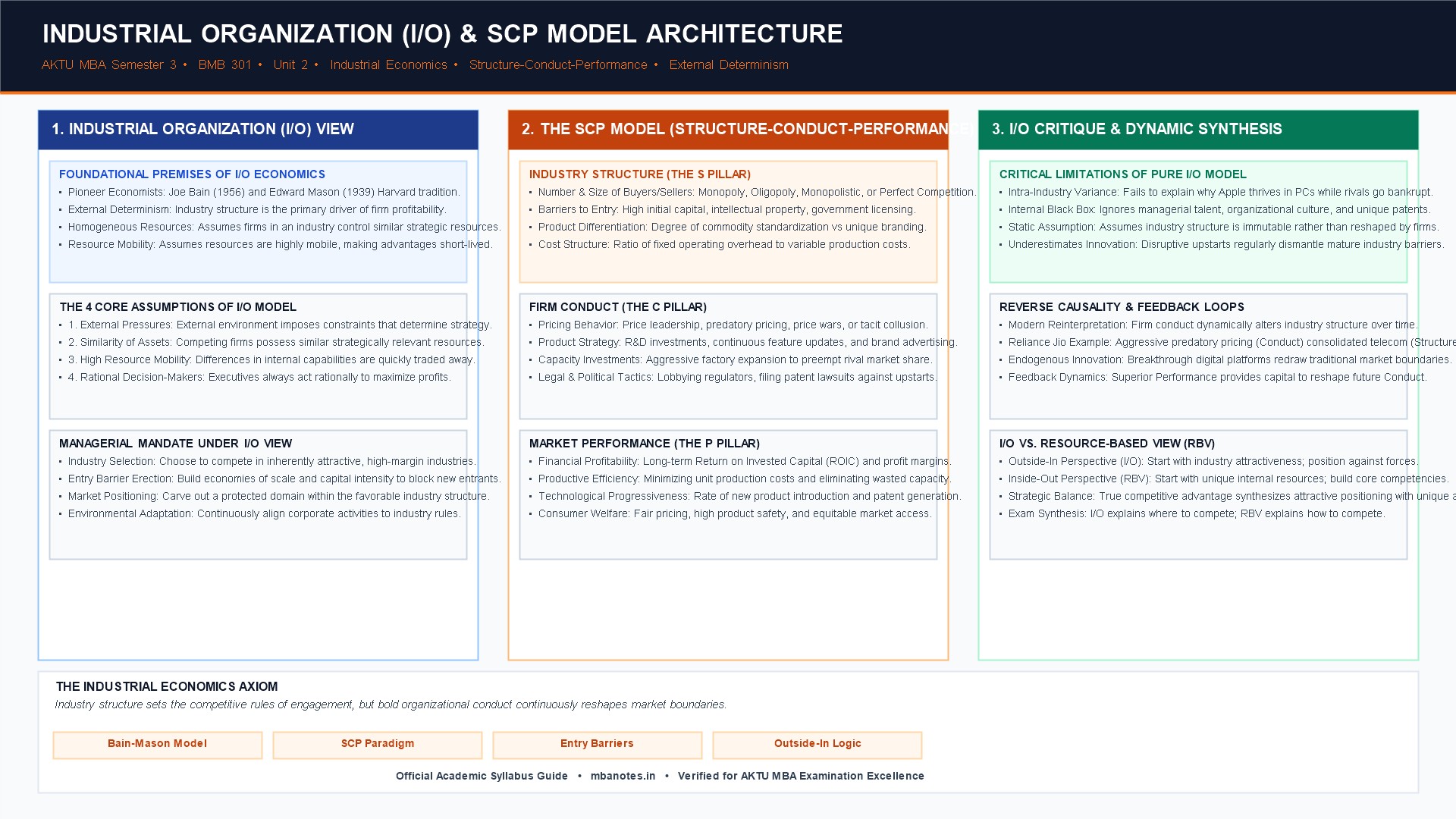
1. Foundations of Industrial Organization (I/O) Economics: Nature & Assumptions
Where does competitive advantage originate? During the 1960s to 1980s, strategic management was dominated by Industrial Organization (I/O) Economics. Developed by Harvard economists Edward Mason (1939) and Joe Bain (1956), and later adapted into business strategy by Michael Porter (1980), the I/O perspective adopts an "outside-in" approach to strategic management:
Core Concept of External Determinism
The foundational premise of the I/O model is external determinism: the external environment—specifically the structural characteristics of the industry in which an enterprise competes—exerts a vastly stronger influence on firm profitability than the internal managerial decisions made inside the company. In simple terms: "An average firm in a structurally attractive industry consistently outperforms a brilliant firm in an unattractive, structurally broken industry."
The 4 Core Assumptions of the I/O Paradigm
- 1. External Environmental Constraints: The external industry environment imposes systemic pressures, cost structures, and competitive rules that dictate which strategies will earn above-average returns.
- 2. Resource Homogeneity: Most competing firms operating within a given industry control similar strategically relevant resources and pursue similar business strategies (competing on similar terms).
- 3. High Resource Mobility: Resources utilized to implement business strategies are highly mobile across firms. If one firm discovers an efficient production practice, rivals can quickly purchase or license those same machines, software, or talent, making resource-based advantages temporary.
- 4. Rational Economic Actors: Corporate decision-makers are rational economic actors committed strictly to profit maximization, behaving in predictable patterns when faced with industry structural pressures.
The 6 Strategic Imperatives under the I/O View
- 1. Rigorous Industry Selection: Executive leadership must prioritize finding and entering inherently attractive industries characterized by high entry barriers and minimal price rivalry.
- 2. Positioning Against Five Forces: Locating an attractive competitive position where the firm can best defend itself against the collective strength of buyers, suppliers, and substitutes.
- 3. Erecting Defensive Entry Barriers: Investing heavily in economies of scale, brand advertising, and proprietary distribution channels to deter new market entrants.
- 4. Exploiting Scale Economies: Expanding production capacity aggressively to push down unit costs along the experience curve, creating cost disadvantages for smaller rivals.
- 5. Strategic Group Alignment: Understanding mobility barriers that insulate the firm's strategic group from aggressive incursions by competitors in lower tiers.
- 6. Anticipating Structural Shifts: Continuously monitoring regulatory, technological, and demographic forces that threaten to dismantle established industry entry barriers.
2. The Structure-Conduct-Performance (SCP) Framework: Detailed Deconstruction
The analytical engine of I/O economics is the Structure-Conduct-Performance (SCP) Model. It establishes a direct, deterministic causal chain flowing from Industry Structure to Firm Conduct and ultimately to Market Performance:
1. Industry Structure (The "S" Dimension)
Industry structure encompasses the persistent economic and technical characteristics of a market that establish the competitive environment:
- Number & Size Distribution of Sellers and Buyers: Ranges from Perfect Competition (infinite tiny firms) and Monopolistic Competition to Oligopoly (few dominant giants) and Monopoly. High seller concentration (where top 4 firms control >70% market share) typically dampens price wars.
- Height of Barriers to Entry: Capital requirements, statutory licensing, patents, customer switching costs, and economies of scale that prevent new firms from entering the market during profitable periods.
- Product Differentiation: The degree to which buyers perceive products as commodities (fuel, raw steel) versus uniquely differentiated offerings (luxury perfume, high-end smartphones).
- Cost Structure & Operating Leverage: The ratio of fixed capital costs to variable operating costs. High fixed-cost industries (airlines, semiconductors) suffer intense price cutting when demand drops to cover overhead.
- Vertical Integration Boundaries: The extent to which firms control upstream raw material extraction and downstream retail distribution channels.
2. Firm Conduct (The "C" Dimension)
Conduct refers to the specific behavioral choices, strategies, and competitive actions that firms adopt in response to the underlying industry structure:
- Pricing Strategies: Price leadership by dominant firms, marginal cost pricing, predatory pricing, or tacit price collusion (avoiding ruinous price wars).
- Product & Innovation Strategies: Research and development (R&D) expenditure intensity, product feature differentiation, and speed of new model launches.
- Marketing & Promotional Tactics: Heavy brand advertising campaigns designed to build psychological consumer switching costs and brand loyalty.
- Capacity Investment & Preemption: Building massive, anticipatory factory capacity to signal commitment and discourage potential rivals from entering.
- Legal & Regulatory Tactics: Aggressive patent litigation, lobbying policymakers for favorable tariff protections, and forming strategic joint ventures.
3. Market Performance (The "P" Dimension)
Performance measures the economic, financial, and societal outcomes generated by the interaction between structure and conduct:
- Financial Profitability: Sustained Return on Invested Capital (ROIC), Return on Equity (ROE), and operating EBITDA margins achieved over multiple business cycles.
- Productive & Allocative Efficiency: Producing goods at the lowest possible cost curve without wasting societal capital, while pricing close to economic costs.
- Technological Progressiveness: The rate at which the industry generates innovations, introduces energy-saving technologies, and upgrades consumer utility.
- Consumer & Social Welfare: Fair product pricing, adherence to environmental emission standards, employee wage equity, and product safety.
3. Reverse Causality & Feedback Realities in Modern Markets
While the classical Bain-Mason model assumed a unidirectional flow ($Structure ightarrow Conduct ightarrow Performance$), modern strategic management recognizes the reality of Reverse Causality and Endogenous Feedback:
How Firm Conduct Reshapes Industry Structure
- 1. Predatory Conduct Alters Concentration: In the Indian telecom sector, Reliance Jio's aggressive pricing conduct (free voice calls and dirt-cheap 4G data) bankrupted several mid-sized players (Aircel, Reliance Communications) and forced Vodafone and Idea to merge, collapsing an unconcentrated 12-player industry into a tight 3-player oligopoly.
- 2. Platform Innovation Redefines Market Boundaries: Apple's introduction of the iPhone and App Store transformed the mobile phone industry from a hardware manufacturing sector into a global digital platform ecosystem.
- 3. Scale Expansion Creates Entry Barriers: Aggressive capacity investments by Amazon and Walmart in automated fulfillment centers established multi-billion-dollar logistical moats that no startup can replicate.
Schumpeterian Creative Destruction
Austrian economist Joseph Schumpeter demonstrated that industry structures are never permanently static. Waves of Creative Destruction—unleashed by technological discontinuities, regulatory deregulation, or business model innovations—regularly destroy the entry barriers of seemingly invincible oligopolies (e.g., streaming services dismantling traditional cable television monopolies).
4. Core Theoretical Framework: Bain-Mason Model & I/O vs. RBV Comparison
The Bain-Mason Structure-Conduct-Performance (SCP) Paradigm
The Bain-Mason SCP framework establishes that market outcomes are systematically determined by industrial economic forces flowing through three sequential tiers:
Basic Market Conditions
Underlying supply conditions (raw materials, unionization, technology) and demand conditions (price elasticity, growth rate, seasonality) that set industry boundaries.
Industry Structure (S)
Number and size of buyers and sellers, height of barriers to entry, degree of product differentiation, cost structures, and vertical integration.
Firm Conduct (C)
Competitive pricing behavior, product differentiation, advertising investments, capacity expansion, research & development, and legal maneuvers.
Market Performance (P)
Enterprise profitability (ROIC), productive efficiency, technological progress, employment stability, and consumer welfare.
To achieve top marks in AKTU university examinations, students must understand the philosophical debate between the Industrial Organization (I/O) View and the Resource-Based View (RBV):
| Comparison Dimension | Industrial Organization (I/O) View | Resource-Based View (RBV) |
|---|---|---|
| Strategic Perspective | Outside-In: Starts with external industry attractiveness. | Inside-Out: Starts with internal unique resources. |
| Primary Source of Advantage | Favorable industry structure and defensive market positioning. | Rare, valuable, and inimitable internal core competencies. |
| Assumption about Resources | Resources are homogeneous and mobile across competitors. | Resources are heterogeneous and immobile across firms. |
| Key Theoretical Champions | Edward Mason, Joe Bain, Michael Porter (1980). | Birger Wernerfelt, Jay Barney (1991), Gary Hamel, C.K. Prahalad. |
| Primary Managerial Question | "Which industry should we enter, and how do we position against forces?" | "What unique competencies do we possess, and how do we leverage them?" |
| Critical Limitation | Cannot explain why firms inside the same industry earn vastly different profits. | May develop brilliant internal capabilities that have zero external market demand. |
6. Corporate Case Vignette: Structural Realities of Indian Civil Aviation
Indian Commercial Aviation: How Brutal Industry Structure Dictates Survival
The Indian commercial aviation industry serves as a textbook real-world validation of the Industrial Organization (I/O) View. Aviation is structurally one of the most hostile, capital-punishing industries in modern economics. Examining its Industry Structure (S) reveals crushing economic constraints: Aviation Turbine Fuel (ATF) accounts for 40% of operating costs and is pegged to volatile global crude oil prices, aircraft leases are dollar-denominated exposing carriers to rupee depreciation, airport landing charges are rigid monopolies, and Indian consumers are notoriously price-sensitive with zero brand loyalty.
Over two decades, legacy carriers like Kingfisher Airlines, Jet Airways, and Go First attempted complex, high-overhead Conduct (C): operating mixed aircraft fleets (Boeing and Airbus), offering expensive full-service catering, running multi-tier frequent flyer programs, and chasing unviable market share through debt-fueled expansion. When environmental shocks occurred (COVID-19 lockdowns, crude price spikes), their high-cost operating structures dragged all three airlines into catastrophic bankruptcy and liquidation.
In contrast, InterGlobe Aviation (IndiGo) survived and dominated because its Conduct was ruthlessly engineered to survive the industry's brutal Structure. IndiGo adopted an unyielding Low-Cost Carrier (LCC) discipline: operating a single, standardized aircraft family (Airbus A320/A321) to minimize pilot training and maintenance parts, maintaining a world-leading 25-minute aircraft turnaround time, maximizing seat density, and executing continuous sale-and-leaseback financial engineering.
IndiGo's conduct enabled it to maintain the lowest Available Seat Kilometer (ASK) cost in the industry. As rivals collapsed under structural overhead, IndiGo's Performance (P) soared: capturing over 63% domestic market share, maintaining substantial cash reserves exceeding ₹30,000 Crore, and generating consistent operational profits. IndiGo proved that in structurally challenging industries, superior performance requires aligning firm conduct strictly to the structural economic realities of the market.
7. AKTU University Exam Drill: Questions & Model Answers
AKTU MBA Semester Examination Question Bank
Q1. State the central premise of the Industrial Organization (I/O) View. [AKTU 2021, 2024]
Model Answer: The central premise of the I/O View is external determinism: external industry structure exerts a primary, decisive influence on firm performance, and above-average returns are earned by selecting structurally attractive industries and positioning the firm defensively against industry competitive forces.
Q2. What are the three components of the SCP model in industrial economics? [AKTU 2020, 2023]
Model Answer: The three sequential components of the SCP model are: (1) Structure (number and size distribution of buyers/sellers, entry barriers, cost structure), (2) Conduct (pricing strategies, advertising, R&D, capacity investment), and (3) Performance (profitability, productive efficiency, technological progress).
Q3. Differentiate between resource homogeneity and resource immobility assumptions. [AKTU 2022, 2025]
Model Answer: The I/O model assumes resource homogeneity (competing firms control similar strategic resources) and resource mobility (resources easily move between firms). In contrast, the Resource-Based View (RBV) assumes resource heterogeneity (firms possess unique asset bundles) and resource immobility (core competencies cannot be easily bought or copied).
Q4. Critically analyze the Structure-Conduct-Performance (SCP) paradigm of Industrial Organization economics. Contrast the Outside-In (I/O) perspective with the Inside-Out (RBV) perspective of strategic management with suitable corporate examples. [AKTU 2020, 2022, 2024]
Comprehensive Model Essay:
1. Introduction to the I/O Paradigm
The Industrial Organization (I/O) perspective, developed by Edward Mason and Joe Bain and brought to strategic management prominence by Michael Porter, posits that an enterprise's external environment is the primary determinant of its strategic actions and financial profitability. The paradigm asserts that differences in firm performance across industries are driven by industry structure rather than internal managerial uniqueness.
2. Detailed Deconstruction of the SCP Paradigm
- Industry Structure (S): Comprises the foundational economic architecture of a market. Key elements include the concentration of buyers and sellers (monopoly, oligopoly, perfect competition), barriers to entry (economies of scale, patent protection, capital costs), product differentiation (commodity vs luxury), and the ratio of fixed to variable costs. For example, the telecommunications and aviation sectors have massive fixed capital costs that dictate fierce competition.
- Firm Conduct (C): How companies behave within that structure. Encompasses pricing policies (price wars vs price leadership), capacity expansions, marketing advertising expenditures, and R&D pipelines. In an oligopolistic market with high barriers, firms avoid destructive price competition and compete via branding and service quality.
- Market Performance (P): The economic results yielded by the interaction of structure and conduct, evaluated through financial profitability (Return on Invested Capital), productive efficiency, technological innovation, and consumer equity.
3. The Outside-In vs. Inside-Out Strategic Debate
Strategic management has long experienced a productive theoretical tension between two dominant paradigms:
- The Outside-In Approach (I/O Model): Advocates that competitive strategy must begin with external industry analysis. Management analyzes external forces (PESTEL, Porter's Five Forces), identifies an attractive market segment, and configures the firm's assets to exploit that positioning. For example, Bharti Airtel and Jio shaped their strategies around the structural demands of spectrum licensing and digital data consumption in India.
- The Inside-Out Approach (Resource-Based View): Championed by Jay Barney and C.K. Prahalad, it argues that external industry structure is secondary. Sustainable competitive advantage arises from possessing internal resources that are Valuable, Rare, Inimitable, and Organized (VRIO). For example, Apple earns extraordinary margins in the mature, commoditized personal computer and smartphone industries not because the industries are structurally benevolent, but because Apple controls proprietary operating systems (iOS), custom silicon chips (M-series), and iconic brand loyalty.
4. Synthesis & Modern Strategic Consensus
In contemporary strategic practice, the I/O View and the Resource-Based View are recognized as complementary rather than mutually exclusive:
- The I/O model explains WHERE to compete by diagnosing industry attractiveness, structural profit ceilings, and competitive threats.
- The Resource-Based View explains HOW to compete by identifying internal capabilities and defensible core competencies required to win within that industry.
5. Exam Takeaway & Conclusion
A purely outside-in firm risks becoming a directionless opportunist chasing fashionable industries without internal competencies. A purely inside-out firm risks developing engineering masterpieces that no external market desires. True strategic mastery requires synchronizing external industry structural realities with internal core competencies.
Discussion & Questions
0 CommentsAcademic insights, questions, and conceptual clarifications from students & faculty.
No questions or comments yet
Have a doubt about this topic, an exam tip, or a conceptual perspective? Start the discussion below!
Leave a Comment / Ask a Question
Your email address will not be published. Required fields are marked *