
Managerial Decision Making: Make or Buy, Key Factor, Pricing & Shutdown
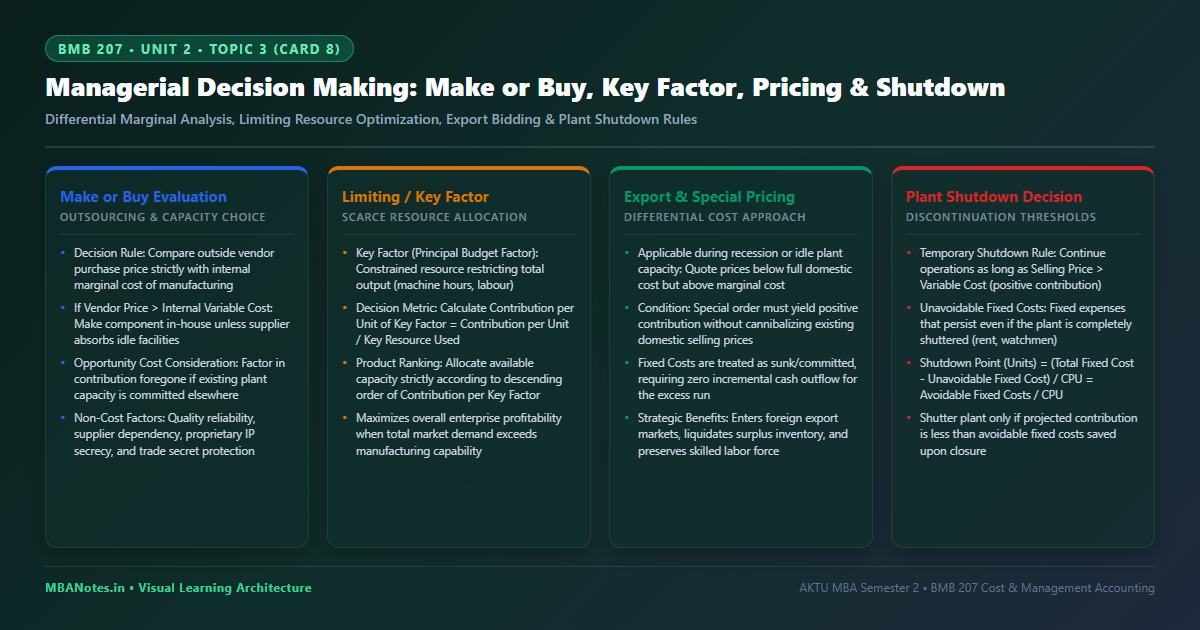
1. Relevant Costs & Differential Analysis in Strategic Choices
Management decision-making is fundamentally about choosing among alternative future courses of action. In evaluating alternatives, traditional financial accounting data can be misleading because historical records contain sunk costs and apportioned common overheads. Marginal costing provides the framework for Differential Cost Analysis (or Relevant Costing), focusing exclusively on costs that will change as a direct result of the decision.
To apply marginal costing effectively in managerial choices, cost accountants enforce the following decision principles:
- Relevant Costs: Future costs that differ among competing alternatives. Only incremental variable costs and specific discretionary fixed overheads that would be incurred or avoided are relevant.
- Sunk Costs: Historical expenses already committed or incurred (e.g., past R&D spending or existing factory depreciation). Sunk costs cannot be altered by future decisions and must be excluded.
- Opportunity Costs: The economic benefit or contribution foregone by choosing one alternative over the next best alternative (e.g., rental income lost by using a warehouse internally).
- Committed vs. Avoidable Fixed Costs: Committed fixed costs (corporate headquarter rent, executive salaries) persist regardless of tactical plant decisions. Avoidable fixed costs (specialized machine leasing, departmental supervisory wages) are eliminated if an activity is discontinued.
2. Make or Buy Decisions: Financial Criteria & Qualitative Realities
A Make or Buy Decision arises when an enterprise that currently manufactures a component component is offered the same item by an outside supplier, or when a new product requires parts that could either be fabricated in-house or outsourced. In traditional accounting, full absorption cost (including apportioned factory overheads) is often compared with the supplier's price—leading to mistaken outsourcing decisions that fail to lower company-wide fixed overheads.
Decision Rules for Make or Buy Evaluations
Scenario A: Idle Capacity Available (No Alternative Use)
• If Vendor Price (P) > Variable Cost (VC) → MAKE IN-HOUSE (Cheaper internally)
• If Vendor Price (P) < Variable Cost (VC) → BUY FROM SUPPLIER
Scenario B: Plant at Full Capacity (Alternative Profitable Use Exists)
• If Vendor Price (P) < (VC + Opportunity Contribution Foregone) → BUY FROM SUPPLIER
• If Vendor Price (P) > (VC + Opportunity Contribution Foregone) → MAKE IN-HOUSE
Beyond pure mathematical cost comparisons, management must weigh critical non-cost qualitative factors:
- Quality Consistency & Technical Precision: Outsourcing components with critical tolerances may risk customer brand reputation if the supplier's quality control fails.
- Supply Chain Reliability: Dependency on a single outside vendor exposes the enterprise to delivery delays, transport bottlenecks, and labor strikes.
- Protection of Intellectual Property: Outsourcing proprietary designs risks reverse engineering and intellectual property theft by external contractors.
- Vendor Price Gouging: Outside vendors may offer introductory below-cost quotes to induce a company to decommission its internal machinery, subsequently hiking prices once the client loses manufacturing capability.
3. Limiting / Key Factor Allocation & Product Mix Optimization
In an ideal operating environment, a firm produces and sells unlimited quantities of its highest-margin products. In practice, production is frequently constrained by a Limiting Factor (also termed Key Factor or Principal Budget Factor). A key factor is any operational resource that restricts the enterprise's ability to satisfy total market demand.
Common limiting factors include: (1) Total available machine hours on critical CNC tooling lines; (2) Limited supply of specialized imported raw materials; (3) Shortage of certified skilled machinists; (4) Cash liquidity constraints; or (5) Government import quotas.
The Limiting Factor Optimization Algorithm
When a limiting factor exists, ranking products by highest unit contribution ($CPU$) or highest P/V ratio leads to suboptimal decisions. Instead, management must rank products based on the Contribution per Unit of the Limiting Factor:
Optimization Rule: Allocate available scarce resources first to satisfy 100% of the market demand for Rank 1 products, then apply the remaining capacity to Rank 2, and so forth, until the limiting resource is fully exhausted.
4. Export Pricing Below Full Cost & Plant Shutdown Thresholds
Marginal costing enables leadership to make two critical tactical decisions during difficult market conditions: special export order pricing and temporary plant shutdowns.
Special Export Pricing Below Full Cost
When a company operates below installed capacity due to sluggish domestic demand, it may receive an inquiry from an overseas customer offering a purchase price significantly lower than prevailing domestic prices and lower than the company's full absorption cost. Management should accept the special export order if:
- Positive Incremental Contribution: The export price exceeds the marginal variable cost ($P_{export} > VC$), generating an operational contribution to absorb fixed overheads.
- Zero Domestic Cannibalization: The foreign market is geographically isolated or trade-barrier protected, preventing export buyers from re-importing the product into the domestic market to undercut standard prices.
- No Idle Plant Capacity Expansion: Existing fixed overheads are already fully committed; no additional capital investments or incremental fixed expenses are triggered.
Plant Shutdown Point
In times of severe industrial recession or raw material embargoes, an enterprise may operate at a heavy loss. The question arises: Should the plant be temporarily shut down? Shuttering the plant does not eliminate all costs. Fixed costs are split into:
- Unavoidable Fixed Costs (Sunk Fixed Costs): Costs that continue even if production is zero (e.g., factory rent, building insurance, basic security, property taxes, minimum maintenance).
- Avoidable Fixed Costs (Discretionary Fixed Costs): Fixed overheads that can be eliminated if operations cease (e.g., temporary plant supervisor salaries, power standing charges, leased tooling).
The Mathematical Plant Shutdown Point
Shutdown Point (in ₹) = Avoidable Fixed Costs / P/V Ratio
Decision Criterion: If projected sales volume exceeds the Shutdown Point, continuing operations is financially preferable because the contribution earned offsets a portion of unavoidable fixed costs. If projected sales volume falls below the Shutdown Point, shuttering the plant minimizes total operational cash losses.
5. Mathematical Formulary & Solved Key Factor Numerical Problem
The following solved numerical demonstrates the standard AKTU 10-mark multi-product limiting factor problem, requiring product ranking and optimal profit scheduling.
AKTU Exam Problem: Optimum Product Mix with Limiting Machine Capacity
Vanguard Precision Tools Ltd. manufactures three industrial components: Product X, Product Y, and Product Z. The cost and market demand data for the upcoming quarter are as follows:
| Cost & Operational Elements | Product X | Product Y | Product Z |
|---|---|---|---|
| Selling Price per unit | ₹ 150 | ₹ 200 | ₹ 250 |
| Direct Materials (₹ 10 per kg) | ₹ 40 | ₹ 60 | ₹ 80 |
| Direct Labour (₹ 15 per hour) | ₹ 30 | ₹ 45 | ₹ 30 |
| Variable Overheads | ₹ 20 | ₹ 25 | ₹ 40 |
| Machine Hours Required per unit | 2 Hours | 3 Hours | 5 Hours |
| Maximum Market Demand | 4,000 units | 3,000 units | 2,000 units |
Operating Constraint: Total machine hours available in the machining shop for the quarter are strictly restricted to 18,000 hours. Total quarterly fixed overheads amount to ₹ 2,50,000.
Required: (a) Determine the contribution per unit and rank the products based on the limiting factor. (b) Determine the optimal production mix to maximize quarterly profit. (c) Compute the maximum net operating profit generated.
Step-by-Step Solution Guide
Step 1: Compute Contribution per Unit (CPU)
• Product Y: VC = ₹ 60 + ₹ 45 + ₹ 25 = ₹ 130 | CPU = ₹ 200 - ₹ 130 = ₹ 70
• Product Z: VC = ₹ 80 + ₹ 30 + ₹ 40 = ₹ 150 | CPU = ₹ 250 - ₹ 150 = ₹ 100
Step 2: Evaluate Total Machine Hours Required vs. Hours Available
Hours Required for Product Y = 3,000 × 3 hrs = 9,000 hrs
Hours Required for Product Z = 2,000 × 5 hrs = 10,000 hrs
Total Machine Hours Needed = 8,000 + 9,000 + 10,000 = 27,000 Hours
Available Capacity = 18,000 Hours (Deficit of 9,000 hours confirms Machine Capacity is the Key Factor!)
Step 3: Compute Contribution per Machine Hour & Product Ranking
• Product Y: Contribution per Hour = ₹ 70 / 3 hrs = ₹ 23.33 / hr → RANK 2
• Product Z: Contribution per Hour = ₹ 100 / 5 hrs = ₹ 20.00 / hr → RANK 3
(Crucial Observation: Although Product Z has the highest CPU of ₹ 100, it consumes too many machine hours and ranks LAST!)
Step 4: Optimal Capacity Allocation Schedule
1. Satisfy Demand for Rank 1 (Product X):
Produce 4,000 units × 2 hrs = 8,000 hours utilised | Hours Remaining: 18,000 - 8,000 = 10,000 hrs
2. Satisfy Demand for Rank 2 (Product Y):
Produce 3,000 units × 3 hrs = 9,000 hours utilised | Hours Remaining: 10,000 - 9,000 = 1,000 hrs
3. Allocate Balance to Rank 3 (Product Z):
Units of Z to produce = 1,000 balance hours / 5 hrs per unit = 200 units (out of 2,000 demand)
Step 5: Compute Maximum Quarterly Profit
Contribution from Product Y = 3,000 units × ₹ 70 = ₹ 2,10,000
Contribution from Product Z = 200 units × ₹ 100 = ₹ 20,000
Total Optimum Contribution Generated = ₹ 4,70,000
Less: Total Fixed Overheads = ₹ 2,50,000
Maximum Net Operating Profit = ₹ 4,70,000 - ₹ 2,50,000 = ₹ 2,20,000
7. Corporate Case Vignette: Maruti Suzuki & Bosch India Strategic Sourcing
Corporate Application: Make or Buy & Key Factor Rationing in Automotive Supply Chains
During the global automotive electronic control unit (ECU) shortage, Maruti Suzuki India Ltd. faced production constraints at its Gurgaon and Manesar facilities. Sourcing partner Bosch India experienced limited semiconductor supplies, restricting ECU shipments to 65% of contract quotas. Maruti had to decide whether to develop secondary in-house testing assemblies (Make) or wait for Tier-1 deliveries (Buy), and how to allocate constrained ECUs across its vehicle lines.
Deploying Limiting Factor Marginal Costing, Maruti evaluated its models based on the critical constrained resource: ECU chip modules. $$\text{Key Metric} = \frac{\text{Vehicle Contribution Margin}}{\text{ECU Modules Required per Vehicle}}$$ Entry-level cars (Alto, WagonR) consumed 2 ECU modules while yielding ₹ 42,000 contribution (₹ 21,000 per ECU). Premium SUVs (Brezza, Grand Vitara) consumed 3 ECU modules but delivered ₹ 1,35,000 contribution (₹ 45,000 per ECU module).
Maruti prioritized 100% of available ECU modules toward premium SUVs and mid-size sedans, and outsourced simpler mechanical wiring harnesses (Make-or-Buy) to domestic Tier-2 suppliers. This strategy allowed Maruti Suzuki to maintain healthy margins and achieve record operating profits despite a 12% drop in overall unit production volume.
8. AKTU Exam Orientation: Model Solved Numerical & Analytical Solutions
Section A (2 Marks Conceptual Questions)
Answer: A limiting factor (or key factor) is any production resource whose availability is insufficient to satisfy total potential market demand. Examples include machine hours, direct labour hours, raw material supply, and working capital.
Answer: When idle plant capacity is available with no alternative use, the decision rule is to compare the outside vendor price ($P$) with internal marginal variable cost ($VC$). If $P > VC$, manufacture in-house; if $P < VC$, buy from the supplier.
Answer: A special export order should be accepted if the export price exceeds the marginal variable cost ($P_{export} > VC$), idle capacity exists with no increase in fixed costs, and the overseas sale will not cannibalize domestic market prices.
Answer: $\text{Shutdown Point (Units)} = \frac{\text{Avoidable Fixed Costs}}{\text{Contribution per Unit (CPU)}} = \frac{\text{Total Fixed Costs} - \text{Unavoidable Fixed Costs}}{\text{CPU}}$.
Section B & C (10 Marks Analytical Questions)
Structuring the 10-Mark Answer:
- Theoretical Overview: Explain that during economic crises, operating at an accounting loss does not automatically warrant closing the plant if revenues cover variable costs and contribute toward fixed expenses.
- Categorization of Fixed Overheads:
- Unavoidable Fixed Costs: Expenses that continue even during complete shutdown (e.g., factory rent, building insurance, property taxes, minimum maintenance).
- Avoidable Fixed Costs: Fixed expenses eliminated when operations halt (e.g., supervisory salaries, power standing charges, leased tooling).
- Derivation of the Shutdown Point: Show that Loss if Continuing = Total Fixed Costs - Contribution. Loss if Closed = Unavoidable Fixed Costs. Equating the two: $\text{Avoidable Fixed Costs} = \text{Contribution} = Q \times CPU$. Therefore: $\text{Shutdown Point (Units)} = \frac{\text{Avoidable Fixed Costs}}{CPU}$.
- Strategic Caveats: Discuss non-financial shutdown consequences: loss of skilled labor force, contract termination penalties, plant restart costs, and loss of distributor goodwill.
Structuring the Numerical Solution:
- Identify Marginal Cost per Unit: $VC = \text{Direct Material } (₹ 35) + \text{Direct Labour } (₹ 20) + \text{Variable Overhead } (₹ 15) = \mathbf{₹ 70 \text{ per unit}}$.
- Analyze the Export Offer: Export Price offered = ₹ 75 per unit. Unit Contribution from Export = $\text{Export Price} - VC = ₹ 75 - ₹ 70 = \mathbf{+₹ 5 \text{ per unit}}$.
- Evaluate Available Capacity: Installed Capacity = 20,000 units. Domestic Sales = 12,000 units. Idle Capacity Available = $20,000 - 12,000 = \mathbf{8,000 \text{ units}}$. The export order requires 6,000 units, which fits well within available idle capacity without affecting domestic supply.
- Profit Impact Calculation: Additional Contribution from Export = $6,000 \text{ units} \times ₹ 5 = \mathbf{+₹ 30,000}$. Since fixed costs are already absorbed by domestic sales, this ₹ 30,000 increases net profit by the full amount.
- Managerial Recommendation: Recommend ACCEPTING the export order. Although the price of ₹ 75 is below the full absorption cost of ₹ 90 ($₹ 70 + ₹ 20$), it yields a positive incremental contribution of ₹ 30,000 and utilizes idle production capacity without displacing domestic sales.
Discussion & Questions
0 CommentsAcademic insights, questions, and conceptual clarifications from students & faculty.
No questions or comments yet
Have a doubt about this topic, an exam tip, or a conceptual perspective? Start the discussion below!
Leave a Comment / Ask a Question
Your email address will not be published. Required fields are marked *