

Probabilistic and Advanced Classifiers: Naive Bayes, Support Vector Machines (SVM), and Neural Networks
1. Theoretical Landscape of Statistical Classification
While decision trees partition feature space via orthogonal rectangular hyperplanes, complex enterprise patterns—such as sentiment analysis, credit default risk, and medical diagnosis—often require sophisticated mathematical boundary modeling. Probabilistic classifiers (Naive Bayes) model explicit probability distributions, optimization classifiers (Support Vector Machines) construct maximum-margin geometric boundaries, and connectionist models (Neural Networks) capture intricate non-linear relationships.
2. The Naive Bayes Classifier & Laplace Smoothing
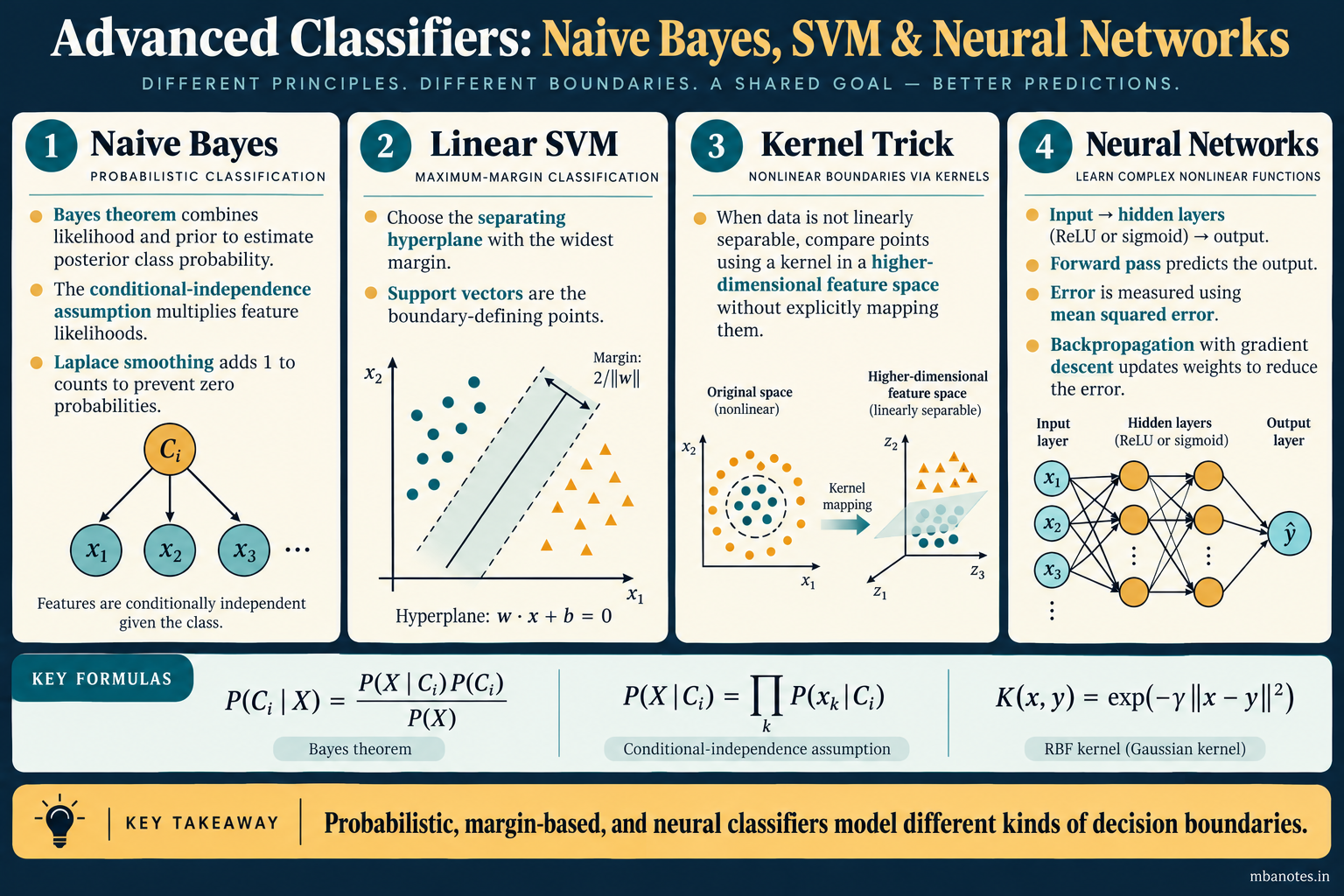
The Naive Bayes classifier is grounded in Bayes’ Theorem of conditional probability:
Where (mathbf{X} = (x_1, x_2, dots, x_n)) is a feature tuple, (P(C_i)) is the prior probability of class (C_i), and (P(C_i | mathbf{X})) is the posterior probability. To bypass the intractable calculation of joint conditional probabilities (P(mathbf{X} | C_i)), Naive Bayes makes the "naive" assumption of Class-Conditional Independence:
Laplace Correction (Smoothing): If an attribute value (x_k) never appears with class (C_i) in the training sample, its conditional probability becomes zero ((P(x_k | C_i) = 0)), causing the entire product product to collapse to zero regardless of all other evidence. Laplace correction resolves this by adding 1 to each count numerator and (q) (number of possible values) to the denominator.
3. Support Vector Machines (SVM): Maximum Margin Geometry
For linearly separable two-class data, an infinite number of separating hyperplanes exist. Support Vector Machines (SVM) search for the single Optimal Separating Hyperplane that maximizes the geometric margin between classes:
- Hyperplane Equation: (mathbf{w} cdot mathbf{x} + b = 0), where (mathbf{w}) is the normal weight vector and (b) is the bias.
- Margin Width: The distance between the parallel bounding hyperplanes ((mathbf{w} cdot mathbf{x} + b = pm 1)) is given by:$$\boxed{( ext{Margin} = rac{2}{|mathbf{w}|})}$$Maximizing the margin corresponds to minimizing ( rac{1}{2} |mathbf{w}|^2) subject to constraint (y_i(mathbf{w} cdot mathbf{x}_i + b) ge 1).
- Support Vectors: The specific training tuples that lie directly on the margins. If all other training points were removed, the position of the separating hyperplane would remain identical. This property makes SVM remarkably resilient against overfitting.
4. The Kernel Trick for Non-Linear Decision Boundaries
When training points cannot be linearly separated in the original low-dimensional input space, SVM applies the Kernel Trick: mathematically mapping the original data into a higher-dimensional Hilbert space (Phi(mathbf{x})) where linear separation becomes possible. The genius of the kernel function (K(mathbf{x}_i, mathbf{x}_j) = Phi(mathbf{x}_i) cdot Phi(mathbf{x}_j)) is that dot products in the high-dimensional space can be computed directly in the original space without ever explicitly calculating the expensive high-dimensional coordinates:
- Polynomial Kernel: (K(mathbf{x}, mathbf{y}) = (mathbf{x} cdot mathbf{y} + 1)^d)
- Radial Basis Function (RBF / Gaussian) Kernel: (K(mathbf{x}, mathbf{y}) = expleft(-gamma |mathbf{x} - mathbf{y}|^2 ight)) (Maps data into infinite-dimensional space; premier choice for complex real-world data).
5. Artificial Neural Networks & Backpropagation Overview
Multi-Layer Perceptrons (MLP) consist of an Input Layer, one or more Hidden Layers, and an Output Layer of interconnected artificial neurons. During training, the network performs a Forward Pass (propagating weighted inputs through non-linear activation functions such as Sigmoid or ReLU), computes the error at the output layer, and executes a Backward Pass (Backpropagation) using Gradient Descent to update synaptic connection weights backwards through the network, iteratively minimizing Mean Squared Error.
University Examination Question Bank & Model Solutions
Designed as per Dr. A.P.J. Abdul Kalam Technical University (AKTU) MBA Examination Pattern.
Part A: Conceptual 2-Mark Short Answer Questions
Q1 [2 Marks]: Define the core algorithmic objective of Advanced Classifiers & SVM in data analytics.
Ans: It represents a foundational machine learning and pattern mining paradigm designed to extract frequent itemset affinities, induce predictive decision boundaries, or discover unsupervised taxonomic cluster structures.
Q2 [2 Marks]: What is the significance of Naive Bayes in pattern discovery?
Ans: It establishes the formal mathematical foundations—such as joint support probabilities, Shannon entropy impurity metrics, maximum margin hyperplanes, or intra-cluster centroid convergence—that guarantee rigorous pattern validity.
Part B & C: Analytical 10-Mark Detailed Solutions & Technical Frameworks
Question 1
Model Examination Answer Blueprint:
Strategic Executive Summary: 15. Advanced Classifiers & SVM
- Affinity Merchandising: Leveraging association rule Lift metrics to architect optimal product bundles and cross-sell recommendation engines.
- Transparent Predictive Modeling: Deploying Decision Trees for credit risk and customer churn to deliver explainable, audit-compliant IF-THEN rules.
- Boundary Optimization: Implementing SVM with RBF kernels to achieve maximum generalization margins on non-linear enterprise data.
- Targeted Customer Segmentation: Utilizing K-Means and Hierarchical Dendrograms to partition customer bases into distinct actionable behavioral personas.
Frequently Asked Questions (Academic & Technical FAQ)
Q1. What makes Advanced Classifiers & SVM critical for modern enterprise managers?
It enables organizations to transform vast historical databases into predictive automated models, powering recommender systems, fraud detection, and targeted marketing campaigns.
Q2. How do practitioners apply these principles in corporate environments?
Practitioners run Apriori algorithms on retail POS data, train gradient-boosted decision trees for churn prediction, deploy SVMs for fraud scoring, and apply K-Means for marketing segmentation.
Q3. What are the most frequent examination questions asked from this topic in AKTU?
AKTU examinations frequently require solving numericals on the Apriori algorithm (calculating Support, Confidence, Lift), calculating Entropy and Information Gain for decision trees, explaining the SVM maximum margin hyperplane and kernel trick, and walking through K-Means clustering step-by-step.
Discussion & Questions
0 CommentsAcademic insights, questions, and conceptual clarifications from students & faculty.
No questions or comments yet
Have a doubt about this topic, an exam tip, or a conceptual perspective? Start the discussion below!
Leave a Comment / Ask a Question
Your email address will not be published. Required fields are marked *