Classification and Prediction: Decision Tree Induction, Attribute Selection Measures (Entropy, Gain, Gini), and Tree Pruning
1. Foundations of Supervised Classification
Classification is a two-step supervised machine learning process. In Step 1 (Model Construction), an algorithm analyzes a historical training dataset where each tuple has an assigned categorical class label (e.g., Credit Risk = "High" vs "Low"). In Step 2 (Model Usage), the trained model classifies new, unseen test records and estimates classification accuracy. Among all classifiers, Decision Trees are the most widely deployed in enterprise management because they do not require domain knowledge, handle multidimensional data, and represent knowledge as transparent, human-interpretable IF-THEN rules.
2. Mechanics of Decision Tree Induction
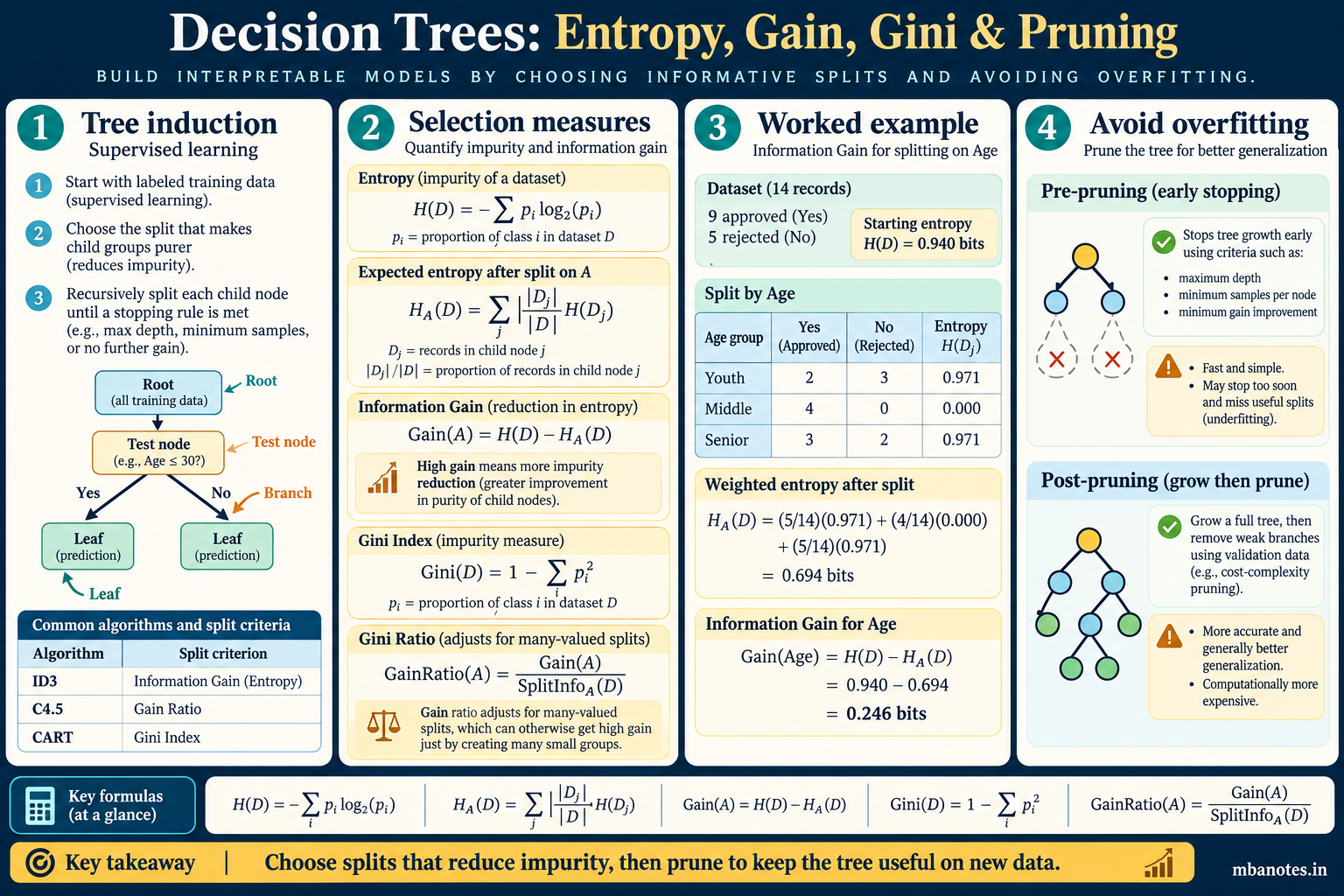
A decision tree is a hierarchical flowchart-like tree structure consisting of:
- Root Node: The topmost node representing the single attribute that best partitions the entire dataset.
- Internal Nodes (Test Nodes): Intermediate nodes testing specific attribute values.
- Branches: The outcome of the test (e.g., Age ≤ 30 vs Age > 30).
- Leaf Nodes (Terminal Nodes): Nodes holding the final categorical class label.
Induction proceeds via a greedy top-down recursive divide-and-conquer strategy (Hunt’s algorithm). At each split, the algorithm selects the attribute that produces the "purest" child partitions (partitions where almost all samples belong to the same class).
3. Attribute Selection Measures: Mathematical Formulations
Three primary mathematical measures determine which attribute should be selected at each node:
- 1. Information Gain (ID3 Algorithm): Based on Claude Shannon’s Information Theory.
- Entropy of Dataset (D): Measures the impurity or randomness of class distribution across (m) classes:$$\boxed{( ext{Info}(D) = -sum_{i=1}^{m} p_i log_2(p_i))}$$(If all tuples belong to the same class, ( ext{Info}(D) = 0); if classes are split 50/50, ( ext{Info}(D) = 1.0)).
- Expected Information Requirement after Splitting on Attribute (A):$$\boxed{( ext{Info}_A(D) = sum_{j=1}^{v} rac{|D_j|}{|D|} imes ext{Info}(D_j))}$$
- Information Gain: The reduction in entropy achieved by partitioning on (A):$$\boxed{( ext{Gain}(A) = ext{Info}(D) - ext{Info}_A(D))}$$The attribute with the maximum Information Gain is chosen as the splitting node.
- Entropy of Dataset (D): Measures the impurity or randomness of class distribution across (m) classes:
- 2. Gain Ratio (C4.5 Algorithm): Information Gain exhibits a pathological bias toward selecting attributes with a large number of distinct values (e.g., splitting on
Customer_IDcreates single-tuple pure partitions with maximum gain, but zero predictive value). Gain Ratio overcomes this by penalizing multi-valued splits via Split Information:$$\boxed{( ext{SplitInfo}_A(D) = -sum_{j=1}^{v} rac{|D_j|}{|D|} log_2left( rac{|D_j|}{|D|} ight) quad Longrightarrow quad ext{GainRatio}(A) = rac{ ext{Gain}(A)}{ ext{SplitInfo}_A(D)})}$$ - 3. Gini Index (CART Algorithm): Measures the impurity of dataset (D):$$\boxed{( ext{Gini}(D) = 1 - sum_{i=1}^{m} p_i^2)}$$The attribute that minimizes ( ext{Gini}_A(D)) (maximizing impurity reduction) is selected for the split.
4. Overfitting and Tree Pruning Strategies
When a tree grows unchecked, it creates branches tailored to noise or anomalies in the training sample, causing Overfitting (near 100% training accuracy but disastrous test accuracy). Pruning eliminates superfluous branches:
- Pre-Pruning: Halts tree construction early if the number of samples in a node falls below a threshold or if the impurity gain is statistically insignificant. Faster, but risks premature stopping ("horizon effect").
- Post-Pruning: Allows the full tree to grow to maximum depth, then systematically removes non-informative subtrees from the bottom up using validation data (Cost-Complexity Pruning). Widely considered superior in production machine learning.
5. Step-by-Step Numerical Walkthrough
Problem: Given a dataset of 14 loan records: 9 "Yes" (approved) and 5 "No" (rejected).
- Calculate Total Dataset Entropy ( ext{Info}(D)):
(p_{ ext{Yes}} = 9/14 = 0.643), (p_{ ext{No}} = 5/14 = 0.357)
( ext{Info}(D) = -[0.643 log_2(0.643) + 0.357 log_2(0.357)] = -[-0.410 - 0.530] = mathbf{0.940 ext{ bits}}) - Partitioning on Attribute "Age":
Youth: 5 records (2 Yes, 3 No) → ( ext{Info}(D_{ ext{youth}}) = -[2/5 log_2(2/5) + 3/5 log_2(3/5)] = 0.971)
Middle-aged: 4 records (4 Yes, 0 No) → ( ext{Info}(D_{ ext{middle}}) = 0.000) (Completely Pure!)
Senior: 5 records (3 Yes, 2 No) → ( ext{Info}(D_{ ext{senior}}) = 0.971) - Calculate Expected Entropy ( ext{Info}_{ ext{Age}}(D)):
( ext{Info}_{ ext{Age}}(D) = rac{5}{14}(0.971) + rac{4}{14}(0.000) + rac{5}{14}(0.971) = 0.347 + 0 + 0.347 = mathbf{0.694 ext{ bits}}) - Calculate Information Gain:
( ext{Gain}( ext{Age}) = 0.940 - 0.694 = mathbf{0.246 ext{ bits}}).
University Examination Question Bank & Model Solutions
Designed as per Dr. A.P.J. Abdul Kalam Technical University (AKTU) MBA Examination Pattern.
Part A: Conceptual 2-Mark Short Answer Questions
Q1 [2 Marks]: Define the core algorithmic objective of Decision Tree Induction in data analytics.
Ans: It represents a foundational machine learning and pattern mining paradigm designed to extract frequent itemset affinities, induce predictive decision boundaries, or discover unsupervised taxonomic cluster structures.
Q2 [2 Marks]: What is the significance of Information Theory in pattern discovery?
Ans: It establishes the formal mathematical foundations—such as joint support probabilities, Shannon entropy impurity metrics, maximum margin hyperplanes, or intra-cluster centroid convergence—that guarantee rigorous pattern validity.
Part B & C: Analytical 10-Mark Detailed Solutions & Technical Frameworks
Question 1 [10/15 Marks]: Explain the mathematical and operational framework of Decision Tree Induction. Detail its algorithms, formulas, and enterprise business impact. (10/15 Marks)
Model Examination Answer Blueprint:
Strategic Executive Summary: 14. Decision Tree Induction
- Affinity Merchandising: Leveraging association rule Lift metrics to architect optimal product bundles and cross-sell recommendation engines.
- Transparent Predictive Modeling: Deploying Decision Trees for credit risk and customer churn to deliver explainable, audit-compliant IF-THEN rules.
- Boundary Optimization: Implementing SVM with RBF kernels to achieve maximum generalization margins on non-linear enterprise data.
- Targeted Customer Segmentation: Utilizing K-Means and Hierarchical Dendrograms to partition customer bases into distinct actionable behavioral personas.
Frequently Asked Questions (Academic & Technical FAQ)
Q1. What makes Decision Tree Induction critical for modern enterprise managers?
It enables organizations to transform vast historical databases into predictive automated models, powering recommender systems, fraud detection, and targeted marketing campaigns.
Q2. How do practitioners apply these principles in corporate environments?
Practitioners run Apriori algorithms on retail POS data, train gradient-boosted decision trees for churn prediction, deploy SVMs for fraud scoring, and apply K-Means for marketing segmentation.
Q3. What are the most frequent examination questions asked from this topic in AKTU?
AKTU examinations frequently require solving numericals on the Apriori algorithm (calculating Support, Confidence, Lift), calculating Entropy and Information Gain for decision trees, explaining the SVM maximum margin hyperplane and kernel trick, and walking through K-Means clustering step-by-step.
Discussion & Questions
0 CommentsAcademic insights, questions, and conceptual clarifications from students & faculty.
No questions or comments yet
Have a doubt about this topic, an exam tip, or a conceptual perspective? Start the discussion below!
Leave a Comment / Ask a Question
Your email address will not be published. Required fields are marked *