
Strategic Audit of a Corporation and Managerial Control Guidelines
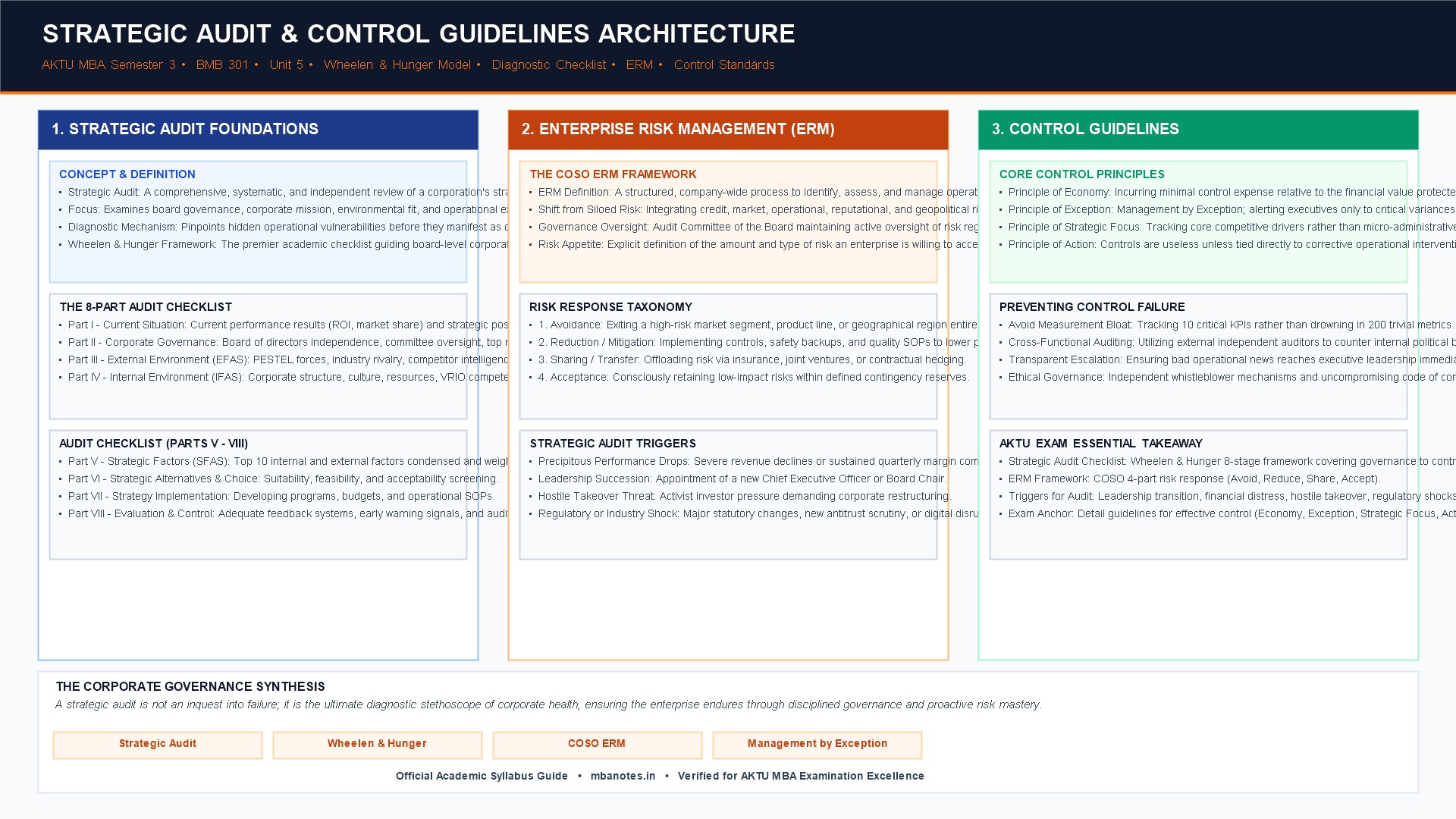
1. Foundations of Corporate Strategic Auditing: Concept, Purpose & Diagnostic Role
In financial accounting, an audit is a routine verification of ledger balances and statutory compliance conducted by chartered accountants. In strategic management, however, a Strategic Audit operates on a far grander, more critical plane. A Strategic Audit is an extremely comprehensive, systematic, and independent examination of an enterprise's total strategic position, evaluating the health of corporate governance, the continuing validity of corporate missions, the appropriateness of directional strategies, and the operational effectiveness of execution systems.
Functioning as the corporate equivalent of an intensive medical diagnostic checkup, a strategic audit does not wait for catastrophic bankruptcy before taking action. Instead, it provides the Board of Directors, executive committees, and external consultants with the diagnostic framework needed to pinpoint operational bottlenecks, hidden strategic risks, and emerging competitive blind spots.
Core Strategic Objectives of the Audit
- Holistic Organizational Scope: Unlike functional audits (which look narrowly at marketing campaigns, factory maintenance, or payroll compliance), a strategic audit evaluates the overarching enterprise architecture, scrutinizing the interrelationships among divisions, corporate headquarters, and the board.
- Early Detection of Strategic Creep: Uncovering subtle misalignments where daily operational routines have drifted away from approved board strategies, resulting in wasted capital expenditure and fragmented brand positioning.
- Objective Validation of Strategic Fit: Re-evaluating whether internal core competencies still match the evolving demands of the external macro and task environment.
- Independent Board Oversight: Equipping independent directors with verified, objective operational evidence to fulfill their fiduciary duties, holding executive leadership accountable for capital allocation decisions.
Key Triggers for a Strategic Audit
While best-in-class corporations conduct strategic audits on a regular 3-to-5-year cycle, specific external or internal crises immediately mandate an emergency strategic audit:
- Precipitous Performance Decline: Sudden or sustained drops in market share, severe quarterly operating margin collapse, or credit rating downgrades.
- Chief Executive Officer (CEO) Succession: When a new Chief Executive takes command, an audit establishes an unvarnished, objective baseline of enterprise health.
- Hostile Takeover & Activist Pressure: Hostile bids or activist hedge funds acquiring equity stakes demanding divisional spin-offs and board restructuring.
- Major Mergers, Acquisitions & Demergers: Prior to committing billions to a mega-acquisition, or immediately following merger close to audit post-merger integration.
- Catastrophic External Shocks: Unforeseen regulatory upheavals, massive technological disruptions, or sudden geopolitical trade embargoes.
2. The Wheelen & Hunger 8-Part Strategic Audit Framework: Comprehensive Checklist
The definitive academic methodology for conducting a corporate-wide audit was formulated by management scholars Thomas L. Wheelen and J. David Hunger. Their 8-Part Strategic Audit Framework provides an exhaustive, sequential checklist that covers the entire strategic management lifecycle:
The 8-Part Audit Checklist
- Part I: Current Situation Audit: Evaluates current corporate performance results (historical Return on Investment, market share trajectories, shareholder value, brand health) and documents current strategic posture (stated vision, mission, corporate objectives, generic business strategies, and policies).
- Part II: Corporate Governance Audit: Scrutinizes the Board of Directors (ratio of independent to executive directors, committee structures, active oversight, potential conflicts of interest) and Top Management (executive leadership style, strategic vision, decision speed, succession pipelines, and ethical tone at the top).
- Part III: External Environment (EFAS) Audit: Audits the Macro Environment using PESTEL diagnostics and the Task Environment using Michael Porter's Five Forces, identifying critical industry success factors, competitive moves, and regulatory exposures.
- Part IV: Internal Environment (IFAS) Audit: Examines internal organizational architecture: Corporate Structure (centralization vs decentralization, divisional communication), Corporate Culture (values, change adaptability), Corporate Resources (marketing reach, financial health, operational capacity, R&D patent pipeline, HR capabilities, and VRIO core competencies).
- Part V: Strategic Factors Analysis (SFAS) Audit: Synthesizes the external and internal audits, identifying the Top 10 Strategic Factors facing the enterprise, reviewing their relative weights and performance ratings, and evaluating the current propitious niche.
- Part VI: Strategic Alternatives & Choice Audit: Evaluates alternative courses of action generated via TOWS matrices. Assesses whether options were screened rigorously using Suitability, Feasibility, and Acceptability (S-F-A) criteria, and verifies that the selected strategy delivers sustainable competitive advantage.
- Part VII: Strategy Implementation Audit: Examines the execution machinery: Are Programs structured with clear milestone deliverables? Are Budgets allocated to strategic priorities rather than legacy political fiefdoms? Are Standard Operating Procedures (SOPs) updated? Does organizational structure follow strategy?
- Part VIII: Evaluation & Control Audit: Evaluates whether management information systems provide timely, accurate performance telemetry; assesses whether Strategic Control types (Premise, Surveillance, Implementation, Special Alert) are operational; and verifies that executive compensation incentives reward long-term value creation rather than short-term metric gaming.
3. Enterprise Risk Management (ERM) & Guidelines for Effective Managerial Control
The COSO Enterprise Risk Management (ERM) Framework
Modern strategic auditing is inextricably bound to Enterprise Risk Management (ERM). Historically, corporations managed risk in isolated, fragmented silos: the treasurer managed interest rate risk, the IT manager handled server backups, and the plant manager handled factory fire insurance.
Formulated by the Committee of Sponsoring Organizations of the Treadway Commission (COSO), modern ERM is an integrated, company-wide framework that identifies, assesses, and manages all enterprise risks—strategic, operational, reporting, and compliance—in relation to corporate strategic objectives.
- Defining Corporate Risk Appetite: The board and CEO explicitly define the amount and type of risk the enterprise is willing to accept in pursuit of strategic growth. High-growth tech firms have high strategic risk appetites; commercial banks have strictly conservative risk appetites.
- The Four Risk Response Strategies:
- 1. Risk Avoidance: Exiting a business line, geographic region, or speculative product category entirely to eliminate catastrophic downside exposure.
- 2. Risk Reduction / Mitigation: Implementing engineering controls, redundant safety systems, cybersecurity firewalls, and rigorous employee training to minimize the probability and operational impact of risk events.
- 3. Risk Sharing / Transfer: Offloading risk exposure to third parties through insurance contracts, currency hedging derivatives, joint ventures, or contractual indemnification clauses.
- 4. Risk Acceptance: Consciously choosing to retain low-impact, manageable operational risks within pre-funded contingency capital reserves.
Core Guidelines for Effective Managerial Control
To prevent control systems from suffocating innovation or degenerating into bureaucratic red tape, corporate strategists adhere to Four Fundamental Control Laws:
- 1. The Principle of Economy (Minimum Necessary Controls): The cost of administering a control system must never exceed the economic value of the assets it protects. Tracking hundreds of trivial administrative parameters wastes executive energy and creates organizational friction.
- 2. Management by Exception (MBE): Control systems must filter out operational noise. Executive alerts and management intervention should be triggered only when performance deviates significantly beyond pre-established tolerance bands.
- 3. Strategic Point Focus: Controls must be placed at critical strategic control points—bottlenecks, key milestone deliverables, and customer satisfaction gates—rather than measuring mundane procedural trivia.
- 4. Action Orientation: Measurement without corrective intervention is useless. Control data must be delivered in real time directly to operational decision-makers who possess the authority and budget to take immediate corrective action.
4. Core Theoretical Framework: Wheelen-Hunger Audit & COSO ERM Synthesized
Wheelen & Hunger's Strategic Audit & COSO ERM Governance Architecture
Corporate resilience is forged through the dual discipline of comprehensive diagnostic auditing and integrated risk management. Auditing ensures strategic fit and operational alignment; enterprise risk management protects the firm from existential external and internal shocks.
Cross-Functional Systemic Audit
Wheelen & Hunger's 8-part framework examines the entire corporate ecosystem—from board governance and culture down to standard operating procedures.
Integrated Risk Governance
COSO ERM replaces fragmented risk silos with an integrated enterprise risk register directly aligned with the board's approved risk appetite.
Fiduciary Board Independence
Strategic audits provide non-executive directors with the objective operational evidence needed to challenge managerial complacency and prevent corporate scandals.
Disciplined Control Economy
Effective control systems enforce economy of effort, management by exception, strategic point focus, and decisive corrective action.
Comprehensive Comparison: Financial Audit vs Strategic Audit
| Audit Dimension | Traditional Financial Audit | Corporate Strategic Audit |
|---|---|---|
| Core Primary Objective | Verify accuracy of historical financial statements, tax compliance, and statutory accounting integrity. | Evaluate long-term competitive health, strategic fit, governance efficacy, and operational alignment. |
| Time Horizon | Historical: Audits transactions conducted in the past fiscal year. | Future-Oriented: Evaluates multi-year strategic trajectory (3 to 5+ years) and long-term viability. |
| Scope of Examination | Narrow: Focuses strictly on financial ledgers, balance sheets, cash flows, and internal fiscal controls. | Holistic: Examines Board oversight, PESTEL forces, core VRIO competencies, corporate culture, and SOPs. |
| Auditing Personnel | External Certified Public Accountants (CPAs) / Statutory Chartered Accountants. | Board of Directors, Independent Strategic Audit Committees, Top Executives, and Strategy Consultants. |
| Primary Stakeholder Audience | Tax authorities, commercial banks, public stock exchanges, and institutional equity holders. | Board of Directors, Chief Executive Officer, Corporate Strategy Teams, and Divisional Heads. |
| Nature of Corrective Action | Restating financial earnings, adjusting ledger balances, and strengthening fiscal accounting controls. | Corporate restructuring, executive leadership changes, divisional divestment, and strategic pivoting. |
6. Corporate Case Vignette: Satyam Computer Services & The Governance Turnaround
Satyam Computer Services: The Strategic Audit & Mahindra Turnaround
In January 2009, corporate India was rocked by its most severe corporate governance scandal when B. Ramalinga Raju, founder and Chairman of Satyam Computer Services (then India's fourth-largest IT services exporter), confessed to orchestrating a massive financial fraud. Over $1 billion in fictitious bank balances, 7,500 fake employees, and forged customer invoices had been fabricated over several years to artificially inflate stock valuations.
While statutory financial auditors failed completely to spot the fabricated cash balances, the underlying crisis was a catastrophic breakdown in Corporate Governance and Internal Control. The board lacked truly independent oversight, management operated with unchecked autocratic power, and internal control systems were deliberately bypassed.
7. AKTU University Exam Drill: Questions & Model Answers
AKTU MBA Semester Exam: Model Questions & High-Score Answers
Q1: Define a Strategic Audit in corporate governance.
Model Answer: A Strategic Audit is an extremely comprehensive, independent, and systematic examination of an enterprise's total strategic management position. It reviews corporate governance, external environmental opportunities/threats, internal organizational capabilities, strategy formulation, implementation programs, and control systems to pinpoint hidden vulnerabilities and guide corrective action.
Q2: What are the four risk response options in the COSO ERM Framework?
Model Answer: In the COSO Enterprise Risk Management (ERM) framework, the four risk response strategies are: (1) Risk Avoidance (exiting high-risk business activities entirely), (2) Risk Reduction (implementing operational controls and backups to mitigate impact), (3) Risk Sharing/Transfer (offloading risk via insurance, hedging, or partnerships), and (4) Risk Acceptance (retaining low-impact risks within pre-funded reserves).
Q3: Critically examine Thomas Wheelen and David Hunger's 8-Part Strategic Audit Framework. Discuss the triggers that necessitate a strategic audit and outline the core guidelines for effective managerial control.
Model Answer Structure & Key Arguments:
- Introduction & Conceptual Foundations: Define a Strategic Audit and contrast it with traditional financial audits. Explain that a strategic audit provides a holistic, diagnostic examination of corporate health, environmental fit, and governance.
- Triggers Mandating a Strategic Audit:
- Precipitous decline in financial performance, margin compression, or market share collapse.
- Leadership succession (appointment of a new Chief Executive Officer or Board Chair).
- Hostile activist investor pressure demanding corporate breakup or capital restructuring.
- Pre-merger due diligence and post-merger integration auditing.
- Catastrophic external environmental or regulatory shocks.
- Wheelen & Hunger's 8-Part Strategic Audit Framework:
- Part I: Current Situation: Performance results, mission, and current corporate posture.
- Part II: Corporate Governance: Board independence, committee oversight, and executive leadership style.
- Part III: External Environment (EFAS): PESTEL macro factors and Porter's Five Forces task environment.
- Part IV: Internal Environment (IFAS): Structure, culture, resources, and VRIO competencies.
- Part V: Strategic Factors Analysis (SFAS): Condensing the top 10 weighted strategic factors.
- Part VI: Strategic Alternatives & Choice: Screening options via Suitability, Feasibility, and Acceptability (S-F-A).
- Part VII: Strategy Implementation: Reviewing Programs, Budgets, and Standard Operating Procedures (SOPs).
- Part VIII: Evaluation & Control: Auditing feedback loops, management information systems, and incentive alignment.
- Enterprise Risk Management (COSO ERM): Detail the integration of risk registers with corporate risk appetite, detailing the four responses: Avoidance, Reduction, Sharing, and Acceptance.
- Guidelines for Effective Control: Detail the Principle of Economy, Management by Exception (MBE), Strategic Point Focus, and Action Orientation to prevent bureaucratic measurement bloat.
- Corporate Indian Benchmark: Conclude by detailing the forensic and strategic audit of Satyam Computer Services following the 2009 scandal, demonstrating how separating core technical delivery capabilities from corrupted financials enabled Tech Mahindra to execute a historic corporate turnaround.
Discussion & Questions
0 CommentsAcademic insights, questions, and conceptual clarifications from students & faculty.
No questions or comments yet
Have a doubt about this topic, an exam tip, or a conceptual perspective? Start the discussion below!
Leave a Comment / Ask a Question
Your email address will not be published. Required fields are marked *