
Zero Based Budgeting (ZBB)
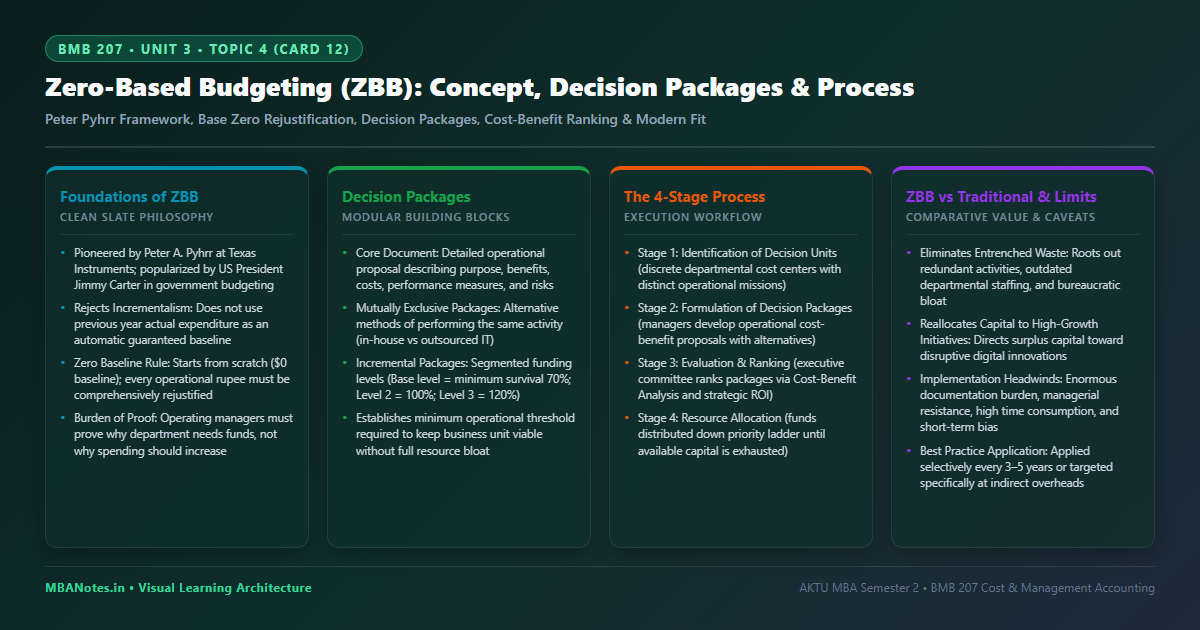
1. Conceptual Genesis & Philosophy of Zero-Based Budgeting
Traditional budgeting methods rely on incrementalism: the starting point is last year's actual expenditure, which is treated as an entitlement and adjusted upward by an arbitrary percentage for inflation or growth. This approach often embeds operational inefficiencies, protects redundant departments, and fuels budget gamesmanship.
To address these flaws, Peter A. Pyhrr developed Zero-Based Budgeting (ZBB) at Texas Instruments in 1969. Pyhrr defined ZBB as "an operating, planning, and budgeting process which requires each manager to justify their entire budget request in detail from scratch (hence zero base) and shifts the burden of proof to each manager to justify why we should spend any money at all."
Under ZBB, past spending levels provide no guarantee of future funding. Every operational activity is treated as an open proposal that must compete on cost-benefit merit against alternative uses of company resources.
2. Decision Packages: Modular Building Blocks of ZBB
The fundamental document in ZBB is the Decision Package. A decision package is an operational proposal that describes a discrete activity, outlining its purpose, operational consequences of non-approval, costs, expected benefits, and alternative ways of performing the work.
Mutually Exclusive Packages
Propose alternative ways to accomplish the same operational goal. For example, evaluating whether to run internal IT data servers versus migrating entirely to cloud providers. Management chooses only one option.
Incremental Packages
Segment an activity into different operational funding levels:
• Base Level: Minimum funding required to keep the activity viable (typically 60%–70% of current spend).
• Current Level: Funding to maintain existing service quality.
• Enhanced Level: Additional funding to expand services or performance.
3. The Four-Stage Implementation Process of ZBB
Implementing a complete Zero-Based Budgeting cycle involves four sequential stages:
- Identification of Decision Units: The organization is segmented into discrete cost centers or functional departments with clear operational missions (e.g., Quality Assurance, Recruitment, Internal Audit, Packaging R&D).
- Formulation of Decision Packages: Decision unit managers prepare detailed operational proposals, specifying minimum survival requirements, current operating levels, and alternative service delivery models.
- Evaluation and Ranking of Packages: The executive Budget Committee ranks all decision packages across the organization using Cost-Benefit Analysis (CBA) and strategic alignment scores.
- Resource Allocation and Final Budgeting: Available enterprise funding is allocated down the ranked list until capital is exhausted. Packages below the funding cut-off line are eliminated or deferred.
4. ZBB vs. Traditional Incremental Budgeting: Detailed Comparison
5. Decision Package Ranking Numerical: Constrained Capital Allocation
Below is a practical numerical illustration demonstrating how management ranks competing decision packages and applies a funding cut-off under a constrained capital ceiling.
Zero-Based Decision Package Evaluation Formulations
• Net Package Value: Net Value = Quantified Incremental Benefits − Total Operating & Capital Outlay
• Priority Index Rank: Score = Σ (Criterion Weight × Departmental Score) / Total Capital Required
Quantitative Application: Decision Package Ranking & Capital Allocation
TechnoServe Global Ltd. is conducting a ZBB review across five discretionary administrative activities for the upcoming fiscal year. Total capital available for discretionary funding is capped at ₹ 30,00,000. The Budget Committee evaluated the decision packages as follows:
| Package ID | Operational Activity | Cost (₹) | PV of Quantified Benefits (₹) | Strategic Alignment Score (out of 10) |
|---|---|---|---|---|
| DP-1 | Automated ERP Cybersecurity Shield | ₹ 8,00,000 | ₹ 24,00,000 | 9.8 |
| DP-2 | Cloud Document Digitization System | ₹ 6,00,000 | ₹ 15,00,000 | 8.5 |
| DP-3 | Executive Leadership Retreat & Hospitality | ₹ 5,00,000 | ₹ 4,00,000 | 3.2 |
| DP-4 | AI-Powered Customer Service Chatbot | ₹ 10,00,000 | ₹ 22,00,000 | 8.0 |
| DP-5 | Employee Wellness & Ergonomic Workspace | ₹ 7,00,000 | ₹ 10,50,000 | 6.5 |
Ranking & Resource Allocation Schedule
• DP-1: ₹ 24,00,000 / ₹ 8,00,000 = 3.00 → RANK 1 (Funded)
• DP-2: ₹ 15,00,000 / ₹ 6,00,000 = 2.50 → RANK 2 (Funded)
• DP-4: ₹ 22,00,000 / ₹ 10,00,000 = 2.20 → RANK 3 (Funded)
• DP-5: ₹ 10,50,000 / ₹ 7,00,000 = 1.50 → RANK 4 (Partial/Cut-off)
• DP-3: ₹ 4,00,000 / ₹ 5,00,000 = 0.80 → RANK 5 (Rejected; BCR < 1.0)
1. Fund Rank 1 (DP-1): Cost ₹ 8,00,000 | Cumulative Spent: ₹ 8,00,000 | Remaining: ₹ 22,00,000
2. Fund Rank 2 (DP-2): Cost ₹ 6,00,000 | Cumulative Spent: ₹ 14,00,000 | Remaining: ₹ 16,00,000
3. Fund Rank 3 (DP-4): Cost ₹ 10,00,000 | Cumulative Spent: ₹ 24,00,000 | Remaining: ₹ 6,00,000
4. Rank 4 (DP-5): Requests ₹ 7,00,000; only ₹ 6,00,000 remains. Funded at base minimum or deferred.
5. Rank 5 (DP-3): Completely rejected (BCR of 0.8 represents value destruction).
Managerial Takeaway: ZBB prevents entitlement spending, funding projects strictly on quantified ROI and strategic merit.
7. Corporate Case Vignette: Kraft Heinz & 3G Capital ZBB Overhaul
Corporate Application: Aggressive Overhead Reduction via Clean-Slate Budgeting
Following the merger of Kraft Foods and H.J. Heinz orchestrated by private equity firm 3G Capital and Berkshire Hathaway, the new entity faced stagnant packaged goods revenues and high administrative costs. 3G Capital deployed Zero-Based Budgeting across all corporate divisions.
Rather than trimming departmental budgets by 5% or 10%, every cost center had to rebuild its budget from a clean zero baseline. Decision packages scrutinized every category: corporate travel was replaced with videoconferencing, office leases were consolidated, and executive perks were eliminated.
Within 24 months, Kraft Heinz eliminated over $1.7 Billion in annual overhead costs, expanding operating profit margins from 18% to over 27%. The case illustrates the power of ZBB to eliminate bureaucratic bloat, while highlighting the need to balance cost cutting with long-term brand building and R&D investment.
8. AKTU Exam Orientation: Solved Conceptual & Analytical Questions
Section A (2 Marks Conceptual Questions)
Answer: Zero-Based Budgeting was developed by Peter A. Pyhrr in 1969 at Texas Instruments, and was later adopted by US President Jimmy Carter for federal government budgeting.
Answer: A Decision Package is an operational proposal that describes a discrete organizational activity, including its purpose, alternative ways of execution, costs, measurable benefits, and consequences of non-funding.
Answer: (1) Eliminates entrenched historical waste and redundant roles by rejustifying all costs from zero; (2) Reallocates corporate funds from low-value activities to high-priority strategic opportunities.
Answer: Direct manufacturing costs (raw materials, production wages) are technologically linked to output volume and are better managed through standard costing. ZBB is most effective for discretionary overhead areas like marketing, HR, and IT.
Section B & C (10 Marks Analytical Questions)
Structuring the 10-Mark Answer:
- Concept: Define ZBB using Peter Pyhrr's framework, highlighting the clean-slate zero starting point and shift in burden of proof.
- The Four-Stage Process:
- Stage 1: Identification of Decision Units – Define distinct departmental cost centers.
- Stage 2: Formulation of Decision Packages – Build modular proposals across base and incremental funding levels.
- Stage 3: Evaluation and Ranking – Prioritize packages using Cost-Benefit Analysis.
- Stage 4: Resource Allocation – Allocate funds down the priority ranking until capital is exhausted.
- Benefits: Discuss elimination of obsolete programs, capital reallocation, and improved cost awareness.
- Limitations & Implementation Challenges: Heavy documentation burden, managerial resistance, high time consumption, and risk of favoring short-term benefits over long-term strategic investments.
Structuring the 10-Mark Answer:
- Comparative Table: Present the 6-parameter contrast table covering starting baseline, focus of analysis, burden of proof, treatment of inefficiency, administrative cost, and operational fit.
- Strategic Recommendation for a Technology Firm: Recommend a Hybrid Budgeting Approach:
- Use Flexible Budgeting and Standard Costing for ongoing, repeatable technical operations like cloud server capacity and customer service.
- Use Zero-Based Budgeting periodically (every 2–3 years) for discretionary overheads such as brand marketing, corporate legal retainers, and administrative staffing to prevent organizational bloat while preserving agility.
Discussion & Questions
0 CommentsAcademic insights, questions, and conceptual clarifications from students & faculty.
No questions or comments yet
Have a doubt about this topic, an exam tip, or a conceptual perspective? Start the discussion below!
Leave a Comment / Ask a Question
Your email address will not be published. Required fields are marked *