
Corporate Governance: Board Composition, Director Roles, CSR, and Contemporary Trends
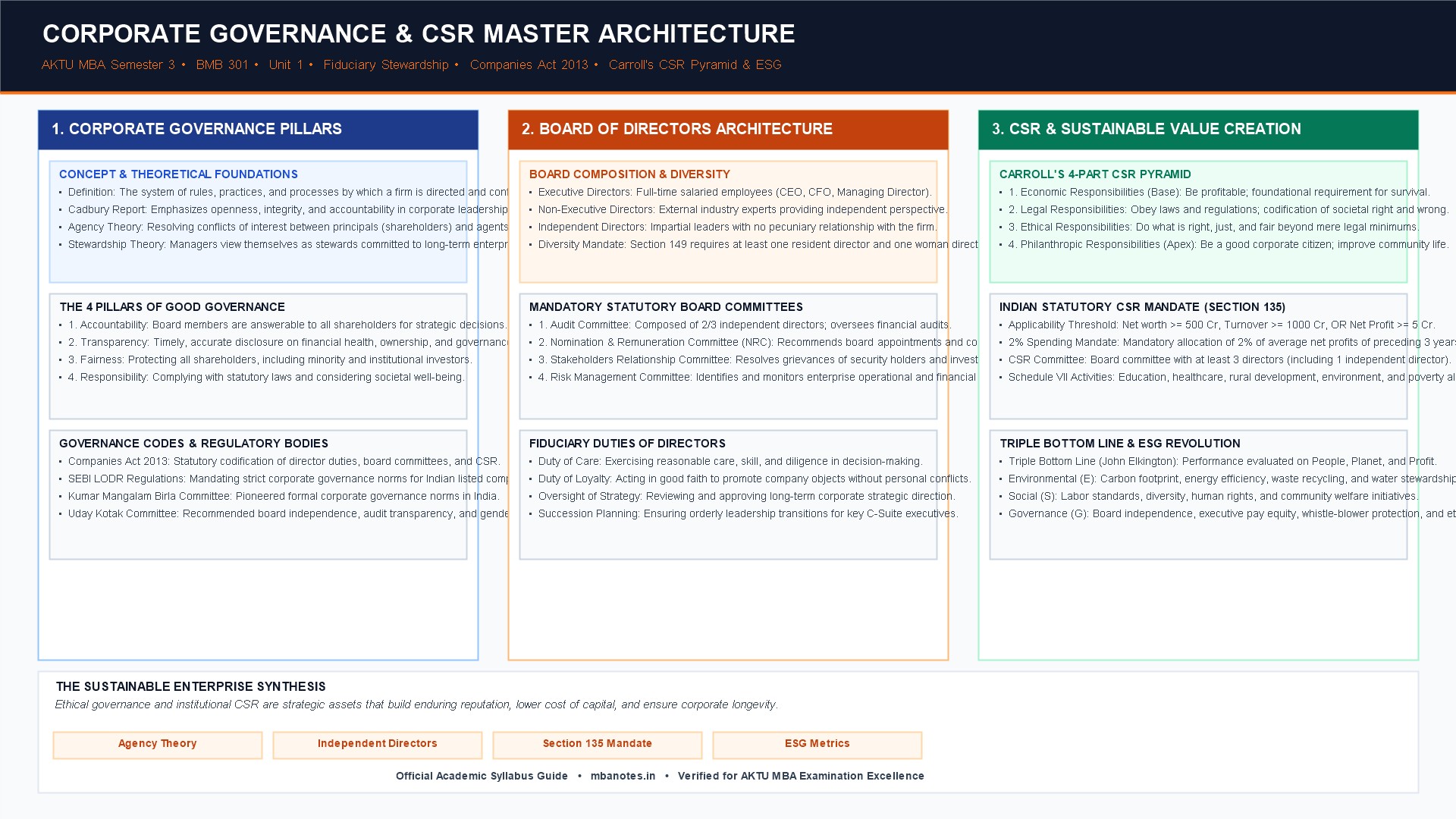
1. Foundations of Corporate Governance: Concept, Need & Theories
The modern corporation is defined by the fundamental separation of ownership from management (Berle and Means, 1932). Millions of retail and institutional shareholders provide capital, but day-to-day managerial control rests with professional salaried executives. This structural separation necessitates Corporate Governance—the system of rules, practices, principles, and processes by which a company is directed, governed, and controlled.
Classic Definitional Standards
- The Cadbury Committee Report (UK, 1992): Defined corporate governance succinctly as: "The system by which companies are directed and controlled." The report established the golden triangle of governance: Openness, Integrity, and Accountability.
- OECD Principles of Corporate Governance: "Corporate governance involves a set of relationships between a company's management, its board, its shareholders and other stakeholders... providing the structure through which corporate objectives are set and monitored."
Theoretical Foundations of Corporate Governance
Three primary theoretical paradigms explain why corporate governance is indispensable in modern capitalism:
- 1. Agency Theory (Jensen & Meckling, 1976):
- Posits that shareholders are the Principals who delegate operational authority to executives acting as Agents.
- Because human beings are self-interested, an Agency Problem arises: agents may pursue personal prestige, empire-building, and excessive compensation rather than maximizing shareholder wealth.
- Corporate governance introduces monitoring mechanisms (independent boards, external audits, performance-linked pay) to minimize "agency costs."
- 2. Stewardship Theory (Davis, Schoorman & Donaldson, 1997):
- Presents a more optimistic psychological view: managers are not opportunistic self-seekers, but responsible stewards of corporate assets.
- When given autonomy and trust, stewards naturally align their efforts with organizational success because their personal professional reputation is intertwined with enterprise health.
- 3. Stakeholder Theory (R. Edward Freeman, 1984):
- Rejects the narrow view that a corporation exists exclusively to maximize shareholder financial profits (Friedman's shareholder primacy).
- Argues that management owes fiduciary duties to a broader coalition of stakeholders—including employees, customers, suppliers, local communities, creditors, and the natural environment.
The 4 Pillars of Good Corporate Governance
- 1. Accountability: The Board of Directors and executive management must be fully answerable to all shareholders for the strategic deployment of corporate resources and financial performance.
- 2. Transparency: Providing accurate, timely, and comprehensive disclosures regarding financial earnings, related-party transactions, governance risks, and material developments without misleading obfuscation.
- 3. Fairness: Ensuring equitable treatment of all shareholders, vigorously safeguarding the rights of minority shareholders against promoter oppression.
- 4. Responsibility: Operating with ethical integrity, strictly obeying statutory laws, respecting human rights, and fulfilling societal and environmental commitments.
2. Board of Directors Architecture: Composition, Committees & Fiduciary Duties
The Board of Directors occupies the apex of the corporate governance hierarchy, acting as the primary fiduciary bridge between absentee shareholders and full-time operating management:
Typology of Board Directors
- Executive Directors (Inside Directors): Full-time salaried employees holding managerial positions within the enterprise (e.g., Managing Director, CEO, Whole-time Finance Director). While they possess deep operational knowledge, they suffer from inherent conflicts of interest when evaluating their own performance.
- Non-Executive Directors: Directors who are not involved in daily operations. They bring external industrial expertise, strategic perspective, and specialized governance acumen.
- Independent Directors (The Cornerstone of Governance): Non-executive directors who have no material, financial, or personal relationship with the company, its promoters, or its subsidiaries. Under Section 149(6) of the Indian Companies Act 2013, independent directors must be persons of integrity with specialized professional expertise.
- Nominee Directors: Directors appointed by financial institutions, banks, or sovereign entities to protect specific debt or equity covenants.
Mandatory Board Diversity under Companies Act 2013 (Section 149)
- Resident Director: Every company must have at least one director who stayed in India for a total period of not less than 182 days during the financial year.
- Woman Director Mandate: Every listed company and public company with paid-up share capital of ₹100 Crore or turnover of ₹300 Crore must appoint at least one woman director to ensure boardroom cognitive diversity.
- Proportion of Independent Directors: Listed public companies must ensure that at least one-third of the total board strength consists of independent directors (raised to one-half if the Chairman is an executive promoter).
Mandatory Statutory Board Committees
Because full boards cannot deliberate deeply on every technical transaction, corporate governance relies on specialized board committees staffed primarily by independent directors:
- 1. Audit Committee (Section 177): Must comprise a minimum of 3 directors, with independent directors forming a two-thirds majority. The Chairman must be an independent director possessing financial accounting literacy. Responsibilities include appointing statutory auditors, reviewing quarterly financial statements, and monitoring internal control integrity.
- 2. Nomination & Remuneration Committee (NRC) (Section 178): Comprises at least 3 non-executive directors (minimum 50% independent). Identifies qualified board candidates, oversees succession planning, and designs balanced C-Suite executive compensation packages.
- 3. Stakeholders Relationship Committee (SRC) (Section 178): Resolves grievances of equity shareholders, debenture holders, and institutional investors regarding dividend payments, transfer of shares, and corporate actions.
- 4. Corporate Social Responsibility (CSR) Committee (Section 135): Consists of at least 3 directors, including at least one independent director. Formulates the company's CSR policy, selects eligible projects under Schedule VII, and monitors expenditure execution.
- 5. Risk Management Committee (RMC): Mandated by SEBI LODR for top listed firms to identify, monitor, and mitigate enterprise-wide cybersecurity, credit, and supply chain vulnerabilities.
The Two Fiduciary Duties of Directors
- Duty of Care: Directors must act with the degree of diligence, skill, prudence, and care that a reasonably prudent businessperson would exercise under similar circumstances. They must critically interrogate management proposals rather than acting as passive rubber stamps.
- Duty of Loyalty: Directors must act in good faith exclusively to promote the interests of the company and all its stakeholders. They are legally barred from exploiting corporate opportunities for personal gain or entering into undisclosed conflicting related-party transactions.
3. Contemporary Governance Reforms in India: Kotak Committee & SEBI LODR
Corporate governance in India has evolved through a series of high-powered committee reforms following major global and domestic financial scandals (Harshad Mehta, Enron, Satyam Computers):
Landmark Governance Committees in India
- 1. Kumar Mangalam Birla Committee (1999): Constituted by SEBI; pioneered the formal codification of corporate governance in India, resulting in the historic Clause 49 of the Listing Agreement (mandating independent directors, audit committees, and CEO/CFO certification).
- 2. Narayana Murthy Committee (2003): Recommended enhanced audit committee responsibilities, independent director term limits, formal risk management frameworks, and institutionalized Whistleblower Policies to protect employee tip-offs.
- 3. Uday Kotak Committee on Corporate Governance (2017): Established by SEBI to address sophisticated modern governance challenges. Key recommendations included:
- Separation of the roles of Board Chairperson and Chief Executive Officer (CEO/MD) to prevent concentration of unchecked power.
- At least one independent woman director on the boards of top 1,000 listed entities.
- Minimum board size increased to six directors for listed companies.
- Enhanced disclosure of related-party transactions and mandatory secretarial audits.
SEBI LODR (Listing Obligations & Disclosure Requirements) 2015
SEBI consolidated all governance regulations into the comprehensive SEBI LODR Regulations 2015. It mandates strict real-time material event disclosures (within 24 hours), quarterly governance compliance certificates, mandatory code of conduct for directors, and structured Business Responsibility and Sustainability Reporting (BRSR) aligned with global Environmental, Social, and Governance (ESG) criteria.
4. Core Theoretical Framework: Carroll's CSR Pyramid & Section 135 Mandate
Archie Carroll's 4-Part CSR Pyramid & Section 135 Mandate
Management scholar Archie Carroll established that Corporate Social Responsibility is not sporadic charity; it is a multi-layered structure encompassing four distinct, cumulative organizational responsibilities:
Economic Responsibilities (The Bedrock Base)
"Be Profitable." The foundational obligation. A firm must produce goods/services that society wants, create jobs, and earn fair returns for shareholders. Without economic solvency, no other responsibility can exist.
Legal Responsibilities (The Codified Rules)
"Obey the Law." Society's codification of right and wrong. Firms must operate within the rule of law—complying with tax rules, labor safety standards, environmental statutes, and consumer protection laws.
Ethical Responsibilities (Beyond the Law)
"Be Ethical; Do What is Right, Just, and Fair." Meeting societal expectations and moral norms that are not codified into formal law. Involves fair treatment of employees, honesty in advertising, and transparent sourcing.
Philanthropic Responsibilities (The Apex)
"Be a Good Corporate Citizen." Discretionary contributions of corporate financial and human resources toward community welfare, education, healthcare, and cultural preservation.
Statutory CSR Mandate under Section 135 (Companies Act 2013)
India made global corporate history by becoming the first country to enact mandatory statutory Corporate Social Responsibility through Section 135 of the Companies Act 2013:
- Applicability Threshold (Any one condition met during preceding financial year):
- Net Worth ≥ ₹500 Crore, OR
- Turnover ≥ ₹1,000 Crore, OR
- Net Profit ≥ ₹5 Crore.
- The 2% Spending Mandate: Eligible companies must spend at least 2% of the average net profits earned during the three immediately preceding financial years on approved CSR activities.
- Permissible Activities (Schedule VII): Eliminating hunger, poverty, and malnutrition; promoting healthcare and sanitation; promoting education and vocational skills; gender equality and women empowerment; environmental sustainability; rural sports; Prime Minister's National Relief Fund.
- Strict "Comply or Explain / Penalize" Rule: Unspent CSR funds cannot be absorbed back into corporate profits. Unspent funds related to ongoing projects must be transferred to a special "Unspent CSR Account" within 30 days and spent within 3 years, failing which heavy statutory financial penalties apply to the company and defaulting officers.
| Comparison Dimension | Shareholder Primacy Model (Milton Friedman) | Stakeholder Stewardship Model (Modern ESG) |
|---|---|---|
| Primary Enterprise Purpose | Maximizing short-term financial return for equity shareholders. | Creating sustainable, long-term multi-capital value for all stakeholders. |
| View on CSR Activities | Viewed as an inappropriate diversion of shareholder capital. | Viewed as an essential strategic investment in societal legitimacy. |
| Governance Horizon | Short-term quarterly earnings per share (EPS) orientation. | Generational horizon; balancing quarterly returns with ecological longevity. |
| Board Accountability | Accountable strictly to financial owners and capital markets. | Accountable to shareholders, employees, suppliers, society, and nature. |
| Handling Negative Externalities | Externalities (pollution, stress) ignored unless legally penalized. | Internalized proactively through Triple Bottom Line (People, Planet, Profit). |
| Cost of Capital Impact | High vulnerability to regulatory penalties and consumer boycotts. | Lower cost of debt/equity due to superior ESG ratings and investor trust. |
6. Corporate Case Vignette: Infosys Limited's Governance & CSR Benchmark
Infosys Limited: Setting India's Gold Standard for Transparency, Governance & CSR
When Infosys Limited was founded in 1981 by N.R. Narayana Murthy and six engineers, the Indian private sector was widely criticized for promoter nepotism, opaque balance sheets, and tax evasion under the License Raj. Murthy established a radical governing axiom that redefined Indian capitalism: "When in doubt, disclose." Infosys resolved to practice governance standards exceeding statutory minimums, demonstrating that ethical leadership accelerates enterprise valuation.
In 1993, long before Indian law mandated it, Infosys became the first Indian enterprise to voluntarily adopt US GAAP accounting standards and publish quarterly audited balance sheets. In 1999, it became the first Indian firm listed on NASDAQ. The company instituted an exemplary Board of Directors Architecture, ensuring that independent directors held the overwhelming majority and chaired the Audit and Remuneration Committees. Renowned global academic and corporate figures (including Marti Subrahmanyam and Rama Bijapurkar) were empowered to challenge promoter decisions openly.
In the realm of Corporate Social Responsibility, Infosys established the Infosys Foundation in 1996, decades before Section 135 made CSR mandatory. Led by Sudha Murty, the foundation directed 1.5% of Infosys' post-tax profits into constructing rural schools, sponsoring higher education scholarships for underprivileged girls, building hospitals, and preserving traditional Indian cultural arts.
During the catastrophic 2009 Satyam Computer Services accounting fraud—where Satyam's promoter falsified ₹7,000 Crore in fake bank accounts—investors panicked across emerging markets. However, foreign institutional investors poured capital into Infosys, rewarding its untarnished corporate governance track record with premium P/E multiples. Infosys proved that transparent governance and authentic CSR are not ornamental public relations expenses, but strategic moats that protect corporate reputation and drastically lower the enterprise cost of capital.
7. AKTU University Exam Drill: Questions & Model Answers
AKTU MBA Semester Examination Question Bank
Q1. Define Corporate Governance and state its two core objectives. [AKTU 2021, 2024]
Model Answer: Corporate Governance is the system of rules, processes, and fiduciary principles by which an enterprise is directed, controlled, and held accountable. Its two core objectives are: (1) Protecting Shareholder & Stakeholder Interests (preventing promoter exploitation and agency costs), and (2) Ensuring Transparency & Ethical Integrity in financial disclosures and strategic operations.
Q2. State the eligibility criteria for mandatory CSR under Section 135 of Companies Act 2013. [AKTU 2022, 2025]
Model Answer: Under Section 135 of the Indian Companies Act 2013, CSR spending is mandatory for any company meeting at least one of the following thresholds in the preceding financial year: (1) Net Worth of ₹500 Crore or more, OR (2) Turnover of ₹1,000 Crore or more, OR (3) Net Profit of ₹5 Crore or more.
Q3. Who is an Independent Director under the Companies Act 2013? [AKTU 2020, 2023]
Model Answer: Under Section 149(6), an Independent Director is a non-executive director who is not a promoter, has no pecuniary or business relationship with the company, its holding, or subsidiary firms, and possesses integrity and relevant industrial expertise to provide impartial, objective oversight.
Q4. Discuss the concept, principles, and significance of Corporate Governance. Detail the statutory role of the Board of Directors and Board Committees, and critically analyze the CSR provisions under Section 135 of the Companies Act 2013 with reference to Archie Carroll's CSR Pyramid. [AKTU 2020, 2022, 2024]
Comprehensive Model Essay:
1. Introduction to Corporate Governance
Corporate governance refers to the institutional framework of rules, relationships, systems, and processes within which authority is exercised and controlled in corporations. Emerging as a vital discipline following corporate collapses worldwide, governance seeks to reconcile the agency conflict between absentee owners (shareholders) and operating managers (agents).
2. Four Foundational Pillars of Governance
Effective governance rests upon four interdependent pillars:
- Accountability: Board members and executives must justify the rationale behind strategic decisions and capital deployment.
- Transparency: True and fair disclosures of financial results, executive compensation, board deliberations, and related-party transactions.
- Fairness: Strict equitable protection for all shareholders, safeguarding minority investors against promoter oppression.
- Responsibility: Adhering to statutory laws and honoring obligations to employees, creditors, communities, and the environment.
3. Board of Directors Architecture & Mandatory Committees
Under Section 149 of the Indian Companies Act 2013 and SEBI LODR Regulations, the Board is legally entrusted with fiduciary stewardship:
- Board Composition: Requires a balanced mix of Executive Directors (operational know-how), Non-Executive Directors, and Independent Directors (at least one-third of the board, or 50% if the chairman is an executive). Furthermore, at least one resident director and one woman director are legally mandatory.
- Audit Committee (Section 177): Minimum 3 directors with a two-thirds independent director majority. Oversees financial reporting, internal controls, and statutory auditor independence.
- Nomination & Remuneration Committee (NRC) (Section 178): Formulates criteria for director appointment, evaluates board performance, and structures incentive compensation.
- Risk Management Committee: Identifies and establishes mitigation protocols for systemic enterprise and operational risks.
4. Archie Carroll's CSR Pyramid & Section 135 Analysis
Archie Carroll structured Corporate Social Responsibility across four cumulative layers: (1) Economic Responsibilities (foundational requirement to be profitable), (2) Legal Responsibilities (strict adherence to laws), (3) Ethical Responsibilities (moral fairness beyond legal minimums), and (4) Philanthropic Responsibilities (discretionary corporate citizenship).
India's Statutory Transformation (Section 135): India converted Carroll's philanthropic layer into a statutory legal mandate through Section 135 of the Companies Act 2013:
- Threshold Criteria: Applies to firms with Net Worth ≥ ₹500 Cr, Turnover ≥ ₹1,000 Cr, or Net Profit ≥ ₹5 Cr.
- The 2% Rule: Mandatory expenditure of at least 2% of average net profits of preceding 3 financial years on Schedule VII initiatives (education, health, poverty alleviation, rural development).
- CSR Committee Governance: Board must form a dedicated CSR Committee (including at least 1 independent director) to formulate policy, select projects, and monitor fund execution.
- Legal Penalties: Failure to spend or transfer unspent CSR funds to designated statutory escrow accounts attracts severe monetary penalties for the enterprise and imprisonment/fines for defaulting officers.
5. Exam Takeaway & Conclusion
Corporate governance and statutory CSR are not adversarial burdens imposed on business; they are complementary pillars of long-term sustainable value creation. By combining rigorous board oversight, independent auditing, and institutionalized social responsibility, modern corporations build unassailable stakeholder trust, lower their cost of debt and equity capital, and insulate the enterprise against market crises.
Discussion & Questions
0 CommentsAcademic insights, questions, and conceptual clarifications from students & faculty.
No questions or comments yet
Have a doubt about this topic, an exam tip, or a conceptual perspective? Start the discussion below!
Leave a Comment / Ask a Question
Your email address will not be published. Required fields are marked *