
Strategic Management Model: Process Stages and Levels of Strategy
1. Foundations of the Strategic Management Model: Nature & Evolution
Strategic management is not a collection of disconnected ad-hoc business decisions; it is an overarching, systematic managerial process. The Strategic Management Model provides a formalized conceptual blueprint that guides top corporate leadership from environmental diagnostics to market execution and performance feedback.
Historical Evolution of Strategic Systems
- Phase 1: Basic Financial Planning (1900s–1940s): Organizations relied strictly on annual operating budgets, historical accounting ratios, and short-term cash flow projections. Planning focused internally on operational cost minimization.
- Phase 2: Forecast-Based Planning (1950s–1960s): Multi-year macroeconomic forecasting models emerged. Corporate planners assumed that future market growth would follow linear, predictable trends extrapolated from historical data.
- Phase 3: Externally Oriented Strategic Planning (1970s–1980s): Characterized by portfolio planning matrices (BCG, GE Nine-Cell) and industrial organization economics. Planning shifted to dedicated corporate staff analyzing industry competitive forces.
- Phase 4: Strategic Management (1990s–Present): Strategic thinking is decentralized from planning staff to line managers and cross-functional teams. It emphasizes organizational learning, dynamic capabilities, continuous environmental scanning, and total executive engagement.
The 6 Organizational Imperatives of a Formal Strategic Model
- 1. Holistic Enterprise Integration: Unifies fragmented departmental agendas (marketing, production, finance, HR) under a coherent strategic umbrella, eliminating functional gridlock.
- 2. Systematic Risk Anticipation: Replaces intuitive guesswork with structured analytical rigor, enabling leadership to detect emerging competitive threats before they erode enterprise margins.
- 3. Explicit Strategy-Structure Matching: Mandates that changes in corporate direction are backed by appropriate reporting hierarchies, delegation of authority, and technological systems.
- 4. Transparent Capital Allocation: Provides objective criteria for funding high-growth Strategic Business Units (SBUs) while divesting or restructuring chronically underperforming divisions.
- 5. Proactive Change Management: Prepares the workforce for market transformations by institutionalizing continuous learning, agile reskilling, and cultural adaptability.
- 6. Verifiable Executive Accountability: Establishes clear performance benchmarks and strategic milestones against which Board members and shareholders evaluate C-Suite leadership.
2. The 4 Sequential Process Stages: Scanning, Formulation, Implementation & Control
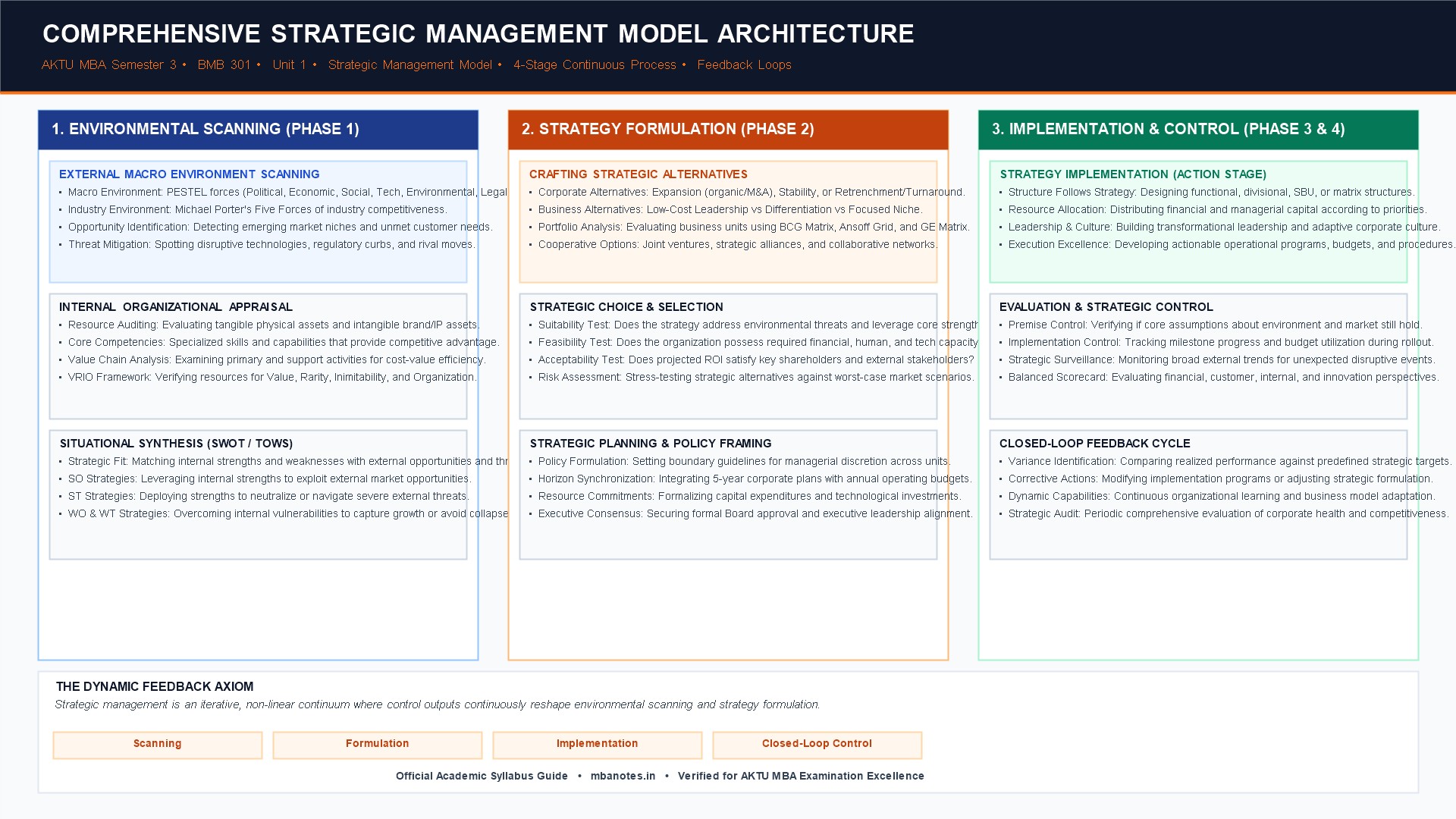
The canonical Strategic Management Model, synthesized by scholars such as Fred David, Thomas Wheelen, and J. David Hunger, organizes strategic activity across four tightly coupled, sequential stages:
Stage 1: Environmental Scanning (Strategic Diagnostics)
Environmental scanning involves monitoring, evaluating, and disseminating information from external and internal environments to key decision-makers. Its purpose is to identify Strategic Factors—external elements that determine the firm's future:
- External Scanning (Opportunities & Threats):
- Societal Environment (PESTEL): Broad macro forces including political stability, economic GDP/inflation indicators, socio-cultural demographic shifts, disruptive technologies, environmental sustainability rules, and legal frameworks.
- Task/Industry Environment (Porter's 5 Forces): Direct competitive elements impacting operating margins: threat of new entrants, rivalry among existing competitors, bargaining power of buyers, bargaining power of suppliers, and threat of substitute offerings.
- Internal Scanning (Strengths & Weaknesses):
- Organizational Structure: Chain of command, centralization vs decentralization, and departmental coordination.
- Corporate Culture: Shared beliefs, organizational values, employee work ethic, and resistance to change.
- Resource Auditing: Physical plant capacity, patent portfolios, brand reputation, financial liquidity, and employee core competencies evaluated via the VRIO framework.
Stage 2: Strategy Formulation (Strategic Crafting)
Formulation is the intellectual and analytical process of developing long-range plans to manage environmental opportunities and threats in light of organizational strengths and weaknesses:
- Defining Strategic Intent: Clarifying the corporate vision, revising the formal mission statement, and establishing Derek Abell's 3D business boundaries.
- Setting SMART Objectives: Translating broad corporate goals into quantified, time-bound financial and non-financial performance milestones.
- Generating Strategic Alternatives: Utilizing analytical tools such as the TOWS Matrix, BCG Growth-Share Matrix, Ansoff's Grid, and Porter's Generic Strategies.
- Strategic Choice & Selection: Evaluating candidate strategies against rigorous criteria: Suitability (does it exploit opportunities?), Feasibility (can we afford it?), and Acceptability (will shareholders approve the risk-return profile?).
- Policy Articulation: Formulating broad administrative guidelines that channel managerial decisions toward chosen strategies.
Stage 3: Strategy Implementation (Operational Execution)
Often called the action stage of strategic management, implementation requires translating written strategic plans into daily organizational realities. Over 70% of strategic failures occur during implementation:
- Designing Action Programs: Breaking corporate strategies into concrete, departmental projects and operational milestones with designated project managers.
- Capital & Operating Budgeting: Allocating financial funds, capital expenditures, and operational resources to support newly prioritized strategic initiatives.
- Standard Operating Procedures (SOPs): Updating manufacturing, customer service, and procurement protocols to reflect new competitive priorities.
- Organizational Restructuring: Realigning the corporate reporting structure (functional, divisional, SBU, or matrix) to support strategic requirements.
- Strategic Leadership & Culture Alignment: Managing employee resistance, motivating staff through incentive compensation, and instilling execution discipline.
Stage 4: Strategy Evaluation and Control (Performance Feedback)
Evaluation and control is the cybernetic monitoring mechanism that ensures the organization achieves what it set out to accomplish:
- Establishing Performance Standards: Setting clear historical, competitive, and industry benchmarks for profitability, market share, customer satisfaction, and ESG compliance.
- Measuring Actual Organizational Results: Utilizing Management Information Systems (MIS), ERP dashboards, and Kaplan-Norton Balanced Scorecards.
- Variance Analysis: Comparing actual performance metrics against predetermined standards to isolate significant positive or negative deviations.
- Corrective Interventions: If actual results lag behind targets, management must determine whether the failure stems from poor operational execution (demanding implementation adjustments) or flawed assumptions (demanding strategic reformulation).
3. Dynamic Strategy Realities: Mintzberg's Intended vs. Emergent Strategies
A major critique of the classical strategic management model is that it assumes strategic formulation and implementation occur in neat, predictable chronological order. Management scholar Henry Mintzberg demonstrated that in turbulent real-world markets, strategy is rarely formed purely through rational top-down planning:
The 5 Strands of Mintzberg's Strategy Formation Model
- 1. Intended Strategy: The formal, deliberate strategic plan conceived by top management and corporate planners, documented in annual strategic reports.
- 2. Deliberate Strategy: The portion of the intended strategy that is successfully realized in practice without significant alteration, occurring when the external environment behaves exactly as forecast.
- 3. Unrealized Strategy: The portion of the intended strategy that is abandoned due to unrealistic initial assumptions, sudden environmental disruptions, or unexpected competitor countermeasures.
- 4. Emergent Strategy: Unplanned strategic patterns that bubble up from the operational grass-roots of the enterprise in response to immediate market challenges, customer feedback, and employee experimentation.
- 5. Realized Strategy: The actual strategy the organization executes in the marketplace—an organic blend of deliberate planned elements and pragmatic emergent adaptations.
The Cybernetic Feedback Principle
Rather than an open-ended line that terminates at Phase 4, the Strategic Management Model is a closed-loop cybernetic feedback system:
- Single-Loop Feedback: Operational control detects small execution variances (e.g., minor quarterly sales dip) and triggers tactical corrective actions without changing the core strategy.
- Double-Loop Learning: Strategic surveillance detects profound environmental shifts (e.g., arrival of generative AI or radical regulatory bans), forcing management to question foundational corporate premises, discard obsolete visions, and trigger fresh environmental scanning.
4. Core Theoretical Framework: The Wheelen & Hunger Continuum & Strategy Matrix
Wheelen & Hunger's Strategic Management Model Continuum
The Wheelen and Hunger strategic management framework establishes that strategy operates as a continuous, four-tier cybernetic hierarchy. Each tier feeds directly into the next, while control mechanisms feed back into scanning and formulation:
Environmental Scanning Tier
Systematically monitoring Societal PESTEL factors, Industry Task forces, and Internal organizational resources/competencies to define critical Strategic Factors.
Strategy Formulation Tier
Developing corporate Vision, Mission, SMART Objectives, Portfolio Strategies, and Administrative Policies to exploit external opportunities.
Strategy Implementation Tier
Translating strategy into organizational action through structured Programs, Capital/Operating Budgets, Standard Operating Procedures, and Restructured Hierarchies.
Evaluation & Control Tier
Measuring actual performance against benchmarks, evaluating variances, and routing cybernetic feedback loops back to Phase 1 and Phase 2.
To achieve high marks in AKTU examinations, candidates must master the theoretical comparison between Deliberate Strategy and Emergent Strategy:
| Comparison Dimension | Deliberate Strategy (Planned) | Emergent Strategy (Adaptive) |
|---|---|---|
| Primary Source of Origin | Top-down executive leadership and corporate planning staff. | Bottom-up operational frontline, customer interactions, and field teams. |
| Foundational Mindset | Strict strategic intention, formal blueprints, and structured analysis. | Organizational learning, continuous trial-and-error, and opportunism. |
| Environmental Context | Best suited for stable, mature, and predictable market conditions. | Essential in turbulent, highly volatile, and disruptive environments. |
| Role of Leadership | The master architect who formulates plans and directs compliance. | The facilitator who nurtures innovation, filters ideas, and legitimizes patterns. |
| Risk Profile | Prone to strategic rigidity, arrogance, and blind spots to disruption. | Risk of strategic drift, loss of cohesive direction, and fragmented goals. |
| Managerial Synthesis | Provides structural order, long-term focus, and capital discipline. | Injects tactical agility, customer responsiveness, and entrepreneurial vitality. |
6. Corporate Case Vignette: Maruti Suzuki's Closed-Loop Strategic Pivot
Maruti Suzuki India Limited: Navigating Market Disruption via Strategic Adaptation
For over three decades, Maruti Suzuki India Limited held an impregnable 50%+ market share in the Indian passenger vehicle market, anchored by its low-cost manufacturing mastery in entry-level hatchbacks (Alto, WagonR, Swift). However, between 2018 and 2022, rigorous Environmental Scanning revealed profound strategic threats: tightening government safety and emission standards (BS-VI transition) made small diesel engines unviable, while shifting consumer demographics caused hatchback demand to collapse from 48% of the market to below 28%, superseded by an explosive consumer preference for Compact and Mid-size SUVs.
In the Strategy Formulation phase, Maruti faced an existential dilemma: rivals like Hyundai, Kia, and Tata Motors were aggressively dominating the SUV landscape. Maruti made the bold deliberate decision to exit diesel engines entirely and formed a global cross-shareholding alliance with Toyota Motor Corporation. The formulated strategy pivoted toward hybrid electric vehicle (HEV) technology, advanced compressed natural gas (CNG), and an aggressive rollout of premium SUVs.
During Strategy Implementation, Maruti re-engineered its manufacturing lines, launched a dedicated premium retail network (NEXA) with distinct branding, and co-developed the Grand Vitara and Invicto with Toyota. In the Evaluation & Control phase, real-time dealer inventory tracking and customer waiting-list analytics revealed an emergent opportunity: Indian buyers were willing to pay premium prices for factory-fitted smart CNG and strong-hybrid drivetrains to offset rising fuel prices. Maruti immediately adapted its production schedules to prioritize hybrid and CNG SUV variants.
By executing a closed-loop strategic management process, Maruti Suzuki regained leadership in the Indian SUV segment, captured over 70% share of the utility vehicle CNG market, and restored operating margins above 10.5%, proving that long-term corporate dominance requires continuous strategic scanning, disciplined execution, and agile emergent adaptation.
7. AKTU University Exam Drill: Questions & Model Answers
AKTU MBA Semester Examination Question Bank
Q1. Enumerate the four primary phases of the Strategic Management Model. [AKTU 2021, 2024]
Model Answer: The four sequential and continuous phases of the Strategic Management Model are: (1) Environmental Scanning (external PESTEL/industry analysis and internal resource auditing), (2) Strategy Formulation (defining mission, objectives, and choosing strategies), (3) Strategy Implementation (programs, budgets, procedures, and restructuring), and (4) Evaluation & Control (measuring performance standards, variance analysis, and cybernetic feedback).
Q2. What is the difference between Deliberate Strategy and Emergent Strategy? [AKTU 2020, 2023]
Model Answer: A Deliberate Strategy is an intentional, top-down plan formulated in advance and realized as intended. An Emergent Strategy is an unplanned, organic pattern of action that bubbles up from frontline operational experimentation in response to unexpected market changes. A firm's actual Realized Strategy is a combination of both.
Q3. What is meant by "Single-Loop" vs. "Double-Loop" feedback in strategic control? [AKTU 2022, 2025]
Model Answer: Single-loop feedback corrects tactical variances within existing operational guidelines without altering core strategy (e.g., adjusting sales quotas). Double-loop feedback questions underlying corporate assumptions, norms, and objectives, triggering fundamental reformulation of the corporate strategy itself when environmental conditions change permanently.
Q4. Explain the comprehensive Strategic Management Model. Discuss in detail the interdependence between Strategy Formulation and Strategy Implementation, highlighting why excellent formulation often fails during implementation. [AKTU 2020, 2022, 2024]
Comprehensive Model Essay:
1. Introduction to the Comprehensive Strategic Management Model
The comprehensive strategic management model provides an organizational framework that integrates environmental diagnostics, visionary crafting, operational execution, and performance control. Derived from the seminal works of Fred David, Wheelen and Hunger, and Henry Mintzberg, the model operates not as a static linear checklist, but as an interactive cybernetic loop where each stage informs and refines the others.
2. The Four Stages of the Strategic Management Process
- Phase 1: Environmental Scanning: Gathers intelligence across the societal macro environment (PESTEL), task industry environment (Porter's Five Forces), and internal organizational capability (VRIO resource auditing). It identifies critical strategic factors that establish the foundation for strategic choice.
- Phase 2: Strategy Formulation: Develops long-range corporate blueprints. Management establishes vision, crafts mission statements, sets SMART quantitative objectives, generates portfolio alternatives (using tools like BCG Matrix and SWOT/TOWS), and selects the optimal competitive strategy.
- Phase 3: Strategy Implementation: The action phase where plans are converted into organizational reality. Involves developing detailed operational programs, allocating capital budgets, establishing standard operating procedures (SOPs), aligning organizational structure, and motivating human capital through change management.
- Phase 4: Strategy Evaluation & Control: Compares actual performance against pre-established standards through Management Information Systems (MIS) and Balanced Scorecards, generating feedback that triggers corrective actions or strategic reformulation.
3. The Interdependence Between Formulation and Implementation
Strategy formulation and implementation are two sides of the same managerial coin. While formulation is primarily an intellectual, analytical, and conceptual process requiring intuitive and analytical skills, implementation is an administrative, behavioral, and operational process requiring leadership, motivational, and coordination skills.
The Implementation Bottleneck: Empirical studies indicate that between 60% and 80% of brilliant corporate strategies fail to achieve their projected results. The primary causes of implementation failure include:
- The Strategy-Structure Mismatch: Top management adopts an aggressive product-diversification strategy but retains a rigid, highly centralized functional structure, creating bureaucratic approval bottlenecks (violating Chandler's axiom that Structure must follow Strategy).
- Resource Misallocation: Capital budgets and top executive talent are hoarded by declining legacy units due to corporate politics, starving newly prioritized growth initiatives of critical resources.
- Underestimating Cultural Resistance: Management treats strategy execution purely as a technical exercise, ignoring employee fears of job obsolescence, loss of status, and cultural disruption.
- Vague Accountability & Poor Information Systems: Lack of real-time MIS tracking dashboards leaves managers unaware of operational deviations until quarterly financial statements reveal irreversible losses.
4. Exam Takeaway & Conclusion
To ensure organizational success, strategy formulation and implementation must be synchronized in a continuous feedback loop. A mediocre strategy executed with operational brilliance frequently outperforms a brilliant strategy executed poorly. Top leadership must master both the analytical rigor of formulation and the organizational empathy, leadership discipline, and structural alignment required for flawless implementation.
Discussion & Questions
0 CommentsAcademic insights, questions, and conceptual clarifications from students & faculty.
No questions or comments yet
Have a doubt about this topic, an exam tip, or a conceptual perspective? Start the discussion below!
Leave a Comment / Ask a Question
Your email address will not be published. Required fields are marked *