
Material Variance Overhead Variance Sales Variance
1. Direct Material Variances: Formulation & Mathematical Verification
Material Variances quantify differences between standard material cost allowed for actual output and actual material costs incurred. The total variance is broken down into specific purchasing and operational causes:
Direct Material Variance Equations
MCV = (Standard Quantity for Actual Output × Standard Price) - (Actual Quantity × Actual Price)
MCV = (SQ × SP) - (AQ × AP)
2. Material Price Variance (MPV):
MPV = Actual Quantity × (Standard Price - Actual Price)
MPV = AQ × (SP - AP)
3. Material Usage / Quantity Variance (MUV):
MUV = Standard Price × (Standard Quantity - Actual Quantity)
MUV = SP × (SQ - AQ)
In multi-material manufacturing processes (such as chemical refining or food processing), Material Usage Variance is further sub-divided into:
- Material Mix Variance (MMV): Arises when the actual proportion of raw materials differs from the standard blend: MMV = SP × (Revised Standard Quantity - Actual Quantity).
- Material Yield Variance (MYV): Measures the difference between standard yield from actual material input and actual finished output produced: MYV = Standard Cost per unit × (Actual Yield - Standard Yield).
2. Direct Labour Variances: Wage Rate, Efficiency & Idle Time
Labour Variances measure differences between standard wage costs allowed for actual production and actual wages paid. The total variance is separated into rate, productivity, and downtime factors:
Direct Labour Variance Equations
LCV = (Standard Hours for Actual Output × Standard Rate) - (Actual Hours × Actual Rate)
LCV = (SH × SR) - (AH × AR)
2. Labour Rate Variance (LRV):
LRV = Actual Hours Worked × (Standard Rate - Actual Rate)
LRV = AH × (SR - AR)
3. Labour Efficiency Variance (LEV):
LEV = Standard Rate × (Standard Hours - Actual Hours Worked)
LEV = SR × (SH - AH)
4. Idle Time Variance (ITV):
ITV = Idle Hours × Standard Hourly Rate = Idle Hours × SR (Always Adverse/Unfavorable)
3. Overhead & Sales Variances: Absorption & Profit Margin Systems
Overhead and sales variances complete the variance analysis system:
Variable Overhead Variances
• Expenditure Variance: (Actual Hours × Standard Rate) - Actual VOH
• Efficiency Variance: Standard Rate × (Standard Hours - Actual Hours)
Fixed Overhead Variances
• Expenditure Variance: Budgeted FOH - Actual FOH
• Volume Variance: (Actual Output - Budgeted Output) × Standard Rate per unit
Sales Margin Variances
• Margin Price Variance: Actual Quantity × (Actual Margin - Budgeted Margin)
• Margin Volume Variance: Budgeted Margin × (Actual Qty - Budgeted Qty)
4. Master Variance Formulary & Comprehensive Solved Numerical (10-Mark AKTU Parity)
Below is a comprehensive AKTU 10-mark examination problem requiring the calculation and verification of Material and Labour Variances.
AKTU Exam Problem: Comprehensive Material & Labour Variances
The standard cost specifications for manufacturing 1 unit of Product "Zeta" are as follows:
- Direct Material: 5 kg @ ₹ 20 per kg
- Direct Labour: 4 hours @ ₹ 15 per hour
During the month of September, the company manufactured 800 units of Product Zeta. The actual operational costs were:
- Direct Material Consumed: 4,200 kg @ ₹ 19 per kg
- Direct Labour Hours Worked: 3,100 hours @ ₹ 16 per hour
- Abnormal Idle Time recorded due to a power outage: 100 hours (included in the 3,100 hours paid)
Required: Compute (a) Material Cost, Price, and Usage Variances with mathematical verification; and (b) Labour Cost, Rate, Efficiency, and Idle Time Variances with mathematical verification.
Part (A): Computation of Direct Material Variances
Standard Quantity (SQ) = 800 units × 5 kg = 4,000 kg
Standard Price (SP) = ₹ 20 per kg
Actual Quantity (AQ) = 4,200 kg
Actual Price (AP) = ₹ 19 per kg
1. Material Cost Variance (MCV):
MCV = (SQ × SP) - (AQ × AP)
MCV = (4,000 × ₹ 20) - (4,200 × ₹ 19) = ₹ 80,000 - ₹ 79,800 = ₹ 200 (Favorable)
2. Material Price Variance (MPV):
MPV = AQ × (SP - AP)
MPV = 4,200 × (₹ 20 - ₹ 19) = 4,200 × (+₹ 1) = ₹ 4,200 (Favorable)
3. Material Usage Variance (MUV):
MUV = SP × (SQ - AQ)
MUV = ₹ 20 × (4,000 - 4,200) = ₹ 20 × (-200) = ₹ 4,000 (Adverse)
Verification:
MCV = MPV + MUV
₹ 200 (F) = ₹ 4,200 (F) + ₹ 4,000 (A) = ₹ 200 (F) → VERIFIED!
Part (B): Computation of Direct Labour Variances
Standard Hours (SH) = 800 units × 4 hours = 3,200 Hours
Standard Rate (SR) = ₹ 15 per hour
Actual Hours Paid (AH) = 3,100 Hours | Actual Rate Paid (AR) = ₹ 16 per hour
Abnormal Idle Hours = 100 Hours
Actual Hours Worked (Productive) = 3,100 - 100 = 3,000 Hours
1. Labour Cost Variance (LCV):
LCV = (SH × SR) - (AH × AR)
LCV = (3,200 × ₹ 15) - (3,100 × ₹ 16) = ₹ 48,000 - ₹ 49,600 = ₹ 1,600 (Adverse)
2. Labour Rate Variance (LRV):
LRV = AH Paid × (SR - AR)
LRV = 3,100 × (₹ 15 - ₹ 16) = 3,100 × (-₹ 1) = ₹ 3,100 (Adverse)
3. Labour Efficiency Variance (LEV):
LEV = SR × (SH - Actual Productive Hours Worked)
LEV = ₹ 15 × (3,200 - 3,000) = ₹ 15 × (+200) = ₹ 3,000 (Favorable)
4. Idle Time Variance (ITV):
ITV = Idle Hours × SR = 100 × ₹ 15 = ₹ 1,500 (Adverse)
Verification:
LCV = LRV + LEV + ITV
₹ 1,600 (A) = ₹ 3,100 (A) + ₹ 3,000 (F) + ₹ 1,500 (A)
₹ 1,600 (A) = -3,100 + 3,000 - 1,500 = -₹ 1,600 (A) → VERIFIED!
5. Visual Framework: Variance Analysis Taxonomy & Formulas
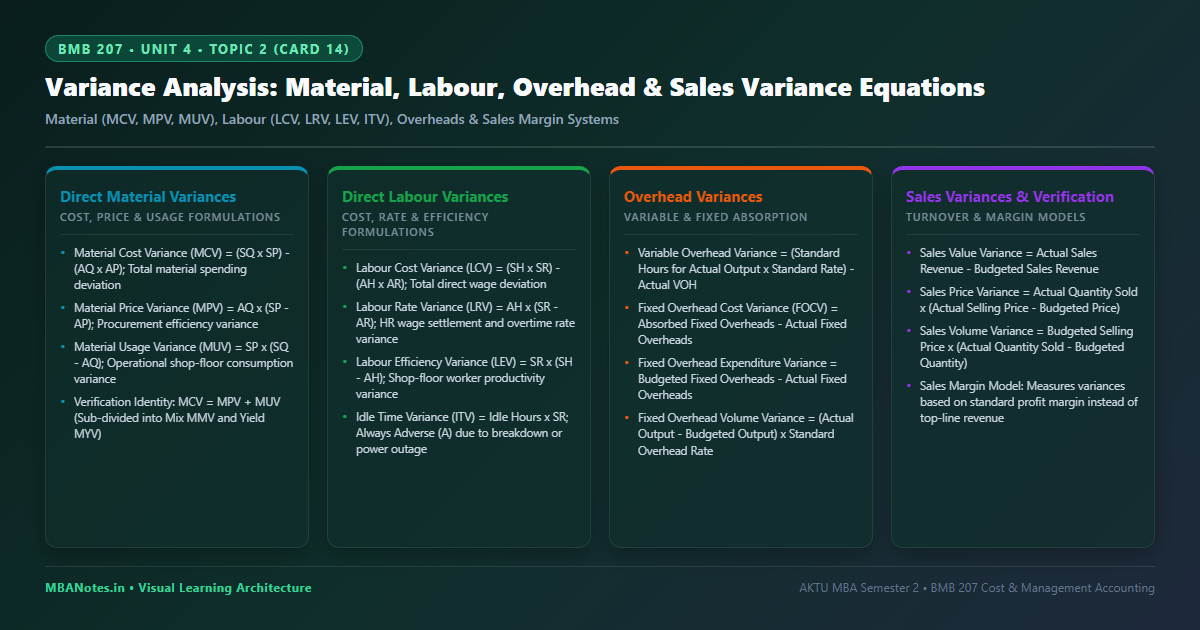
The visual layout below summarizes the full taxonomy of variances: Material (Cost, Price, Usage), Labour (Cost, Rate, Efficiency, Idle Time), Overhead Absorption, and Sales Margin Systems:
6. Corporate Case Vignette: Tata Steel Blast Furnace Material Yield Control
Corporate Application: Real-Time Material Mix & Yield Tracking in Primary Metallurgy
At Tata Steel Ltd. in Jamshedpur, blast furnaces consume thousands of tonnes of iron ore sinter, metallurgical coking coal, and limestone daily. Blast furnace operational costs are heavily sensitive to the chemical composition of raw material inputs.
Tata Steel's management accounting team tracks Material Price Variance (MPV), Material Mix Variance (MMV), and Material Yield Variance (MYV) on a 24-hour cycle. When metallurgical coke import prices surged, procurement purchased cheaper high-ash domestic coal, resulting in a favorable Material Price Variance.
However, higher ash content reduced blast furnace heat efficiency, triggering a severe Adverse Material Usage Variance (MUV) that exceeded the purchase price savings. Real-time variance reporting enabled plant metallurgists to quickly rebalance the input mix, demonstrating how integrated variance analysis prevents local procurement savings from degrading shop-floor productivity.
7. AKTU Exam Orientation: Solved Theoretical & Practical Questions
Section A (2 Marks Conceptual Questions)
Answer: $\text{MPV} = \text{Actual Quantity (AQ)} \times [\text{Standard Price (SP)} - \text{Actual Price (AP)}]$.
Answer: An Adverse Labour Efficiency Variance occurs when actual hours worked exceed standard hours allowed for production, often due to inadequate worker training, sub-standard materials, or poor supervision.
Answer: Idle time represents unproductive hours paid for without generating output (due to power failures, machine breakdowns, or material shortages). Because standard idle time is zero, any actual idle time produces an adverse variance.
Answer: $\text{Material Cost Variance (MCV)} = \text{Material Price Variance (MPV)} + \text{Material Usage Variance (MUV)}$.
Section B & C (10 Marks Analytical Questions)
Structuring the 10-Mark Answer:
- Definition: Define variance analysis as the process of breaking down total cost differences into price, rate, quantity, and efficiency factors.
- Formulas: State the equations for MCV, MPV, MUV, LCV, LRV, LEV, and ITV.
- Accountability Matrix:
- Material Price Variance: Assigned to the Purchase / Procurement Department.
- Material Usage Variance: Assigned to Factory Production Supervisors.
- Labour Rate Variance: Assigned to the HR / Personnel Department.
- Labour Efficiency Variance: Assigned to Shop-Floor Production Managers.
Structuring the Numerical Solution:
- Identify Parameters: $$SH = 500 \text{ units} \times 10 \text{ hrs} = 5,000 \text{ Standard Hours}$$ $$SR = ₹ 25 \text{ per hour}$$ $$AH = 5,400 \text{ Actual Hours}$$ $$AR = \frac{₹ 1,40,400}{5,400 \text{ hrs}} = ₹ 26.00 \text{ per hour}$$
- Labour Cost Variance (LCV): $$LCV = (SH \times SR) - (AH \times AR) = (5,000 \times 25) - 1,40,400 = ₹ 1,25,000 - ₹ 1,40,400 = \mathbf{₹ 15,400 \text{ (Adverse)}}$$
- Labour Rate Variance (LRV): $$LRV = AH \times (SR - AR) = 5,400 \times (25 - 26) = 5,400 \times (-1) = \mathbf{₹ 5,400 \text{ (Adverse)}}$$
- Labour Efficiency Variance (LEV): $$LEV = SR \times (SH - AH) = 25 \times (5,000 - 5,400) = 25 \times (-400) = \mathbf{₹ 10,000 \text{ (Adverse)}}$$
- Verification: $$LCV = LRV + LEV \implies ₹ 15,400 \text{ (A)} = ₹ 5,400 \text{ (A)} + ₹ 10,000 \text{ (A)} = \mathbf{₹ 15,400 \text{ (A)} \implies \text{VERIFIED!}}$$
Discussion & Questions
0 CommentsAcademic insights, questions, and conceptual clarifications from students & faculty.
No questions or comments yet
Have a doubt about this topic, an exam tip, or a conceptual perspective? Start the discussion below!
Leave a Comment / Ask a Question
Your email address will not be published. Required fields are marked *