Data Warehouse Schema Designs: Star Schema, Snowflake Schema, and Fact Constellation (Galaxy) Architecture
1. Overview of Relational Schema Topologies in Data Warehousing
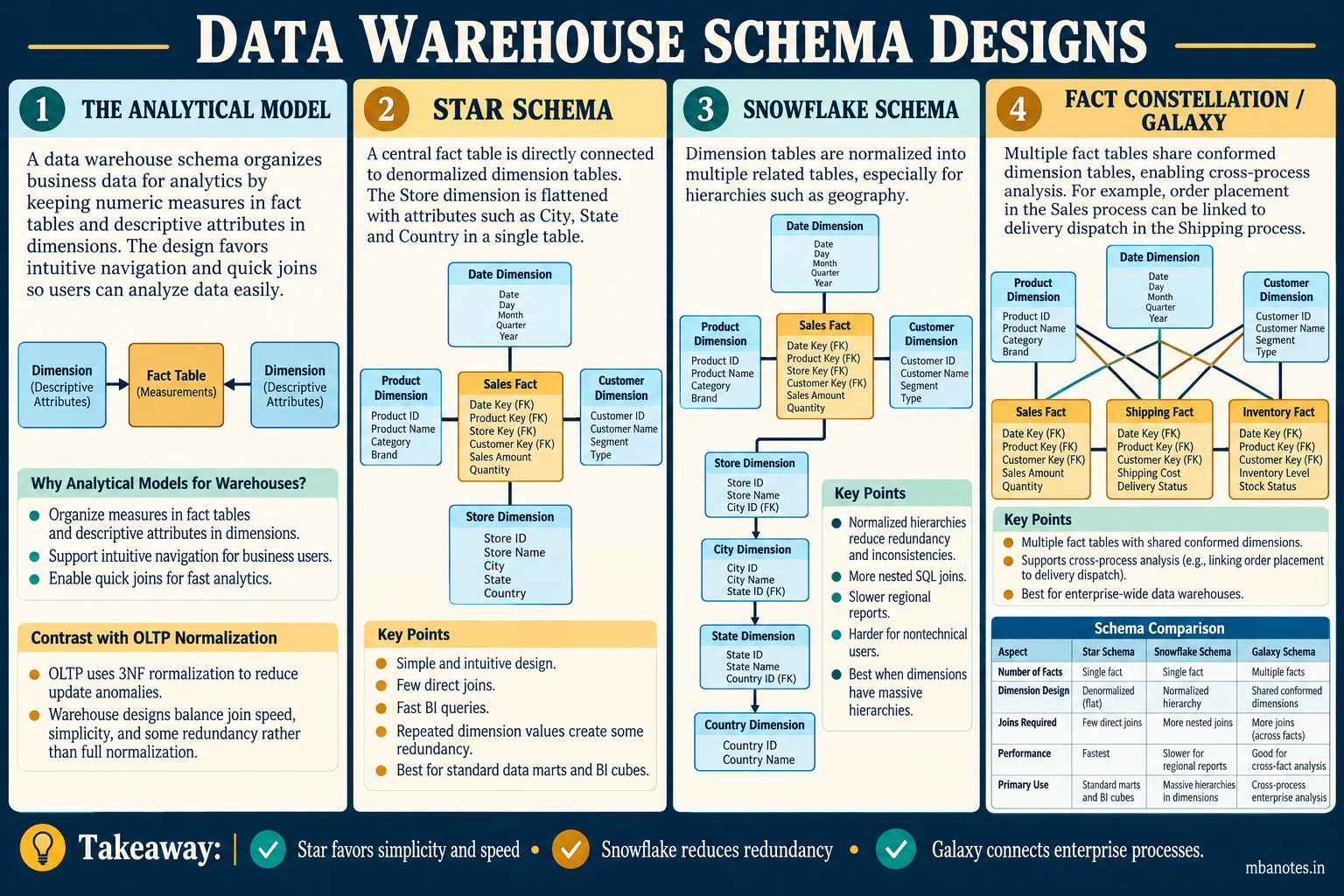
The physical implementation of multidimensional models in relational database engines requires specific schema layouts. In classical OLTP systems, database normalization (3NF) creates dozens of small lookup tables to eliminate update anomalies. In analytical data warehousing, the primary engineering objective is rapid SQL join traversal and intuitive business comprehensibility. This objective is achieved via three standard architectural topologies: the Star Schema, the Snowflake Schema, and the Fact Constellation (Galaxy) Schema.
2. The Star Schema: Design Principles & Query Optimization
The Star Schema is the simplest and most widely implemented architectural design. Structurally, it resembles a star radiating from a central core:
- Central Fact Table: Contains numerical metrics and the foreign keys of all linked dimensions.
- Radially Linked Dimensions: Completely denormalized dimension tables directly connected to the fact table via a single foreign key-to-primary key relationship. Dimension tables are not connected to each other.
- Performance Advantages: Because dimension hierarchies are flattened into single tables (e.g., City, State, Country all stored in the Store Dimension table), analytical queries require minimal SQL table joins. Modern RDBMS query optimizers utilize star join bitmap indexing to filter and aggregate across dimensions simultaneously with blistering speed.
- Tradeoffs: Significant data redundancy in dimension tables (e.g., repeating the string "California" across thousands of store records). However, given modern cheap disk storage and the small relative size of dimension tables compared to multi-million-row fact tables, this redundancy is highly acceptable.
3. The Snowflake Schema: Normalization & Hierarchy Decomposition
The Snowflake Schema is an architectural variation where dimension tables are partially or completely normalized into sub-dimension tables. The resulting structure resembles a branching snowflake:
- Decomposed Hierarchies: Instead of storing geographic attributes in a single Store table, the schema normalizes the structure into Store → City → State → Country lookup tables.
- Advantages: Eliminates data redundancy, reduces storage space slightly, and prevents data entry inconsistencies in dimension hierarchies.
- Tradeoffs: Severe query performance degradation. Executing a basic regional sales report requires complex multi-table SQL joins across nested dimension levels. Furthermore, the visual complexity of the schema intimidates non-technical business analysts browsing via self-service BI tools.
4. The Fact Constellation (Galaxy Schema) Architecture
Real-world enterprises possess multiple intersecting business processes rather than an isolated sales transaction. The Fact Constellation Schema (often called the Galaxy Schema) models complex enterprise environments by deploying multiple central fact tables that share standardized conformed dimension tables:
- Multiple Fact Cores: E.g., an enterprise retailer simultaneously maintains a Sales Fact Table, a Shipping Fact Table, and an Inventory Fact Table.
- Shared Conformed Dimensions: The Date Dimension, Product Dimension, and Customer Dimension are shared across all three fact tables.
- Strategic Power: Enables sophisticated cross-process analytical queries, such as calculating the time elapsed between order placement (Sales Fact) and warehouse delivery dispatch (Shipping Fact).
5. Comprehensive Architectural Comparison & Selection Matrix
The following comparative matrix synthesizes the structural and performance tradeoffs of all three schema topologies:
| Design Dimension | Star Schema | Snowflake Schema | Fact Constellation (Galaxy) |
|---|---|---|---|
| Dimension Normalization | Completely Denormalized | Partially or Fully Normalized (3NF) | Mixed (Denormalized Dimensions) |
| Fact Table Count | Single Fact Table | Single Fact Table | Multiple Fact Tables |
| SQL Join Complexity | Low (Direct 1-hop joins) | High (Complex multi-table nested joins) | Moderate to High (Cross-fact drill-across) |
| Query Performance | Maximum (Fastest execution) | Moderate to Slow | High for individual facts; optimized |
| Business Intuitiveness | Very High (Simple conceptual navigation) | Low (Complex for non-technical users) | High (Enterprise business domain mapping) |
| Best Practical Application | Standard enterprise data marts & BI cubes | Specific domains with massive hierarchies | Full Enterprise Data Warehouses (EDW) |
University Examination Question Bank & Model Solutions
Designed as per Dr. A.P.J. Abdul Kalam Technical University (AKTU) MBA Examination Pattern.
Part A: Conceptual 2-Mark Short Answer Questions
Q1 [2 Marks]: Define the primary distinction relevant to Data Warehouse Schema Designs in analytical system design.
Ans: It represents a core dimensional engineering and data processing paradigm governing how enterprise facts and dimensions are modeled, structured into relational schemas, or transformed via automated data integration pipelines.
Q2 [2 Marks]: What is the significance of Star Schema in data warehouse architecture?
Ans: It establishes the formal structural mechanisms—such as additive fact table metrics, denormalized star topologies, or log-based CDC—that optimize SQL query performance and data reliability.
Part B & C: Analytical 10-Mark Detailed Solutions & Technical Frameworks
Question 1 [10/15 Marks]: Explain the architectural and operational framework of Data Warehouse Schema Designs. Detail its components, implementation methodologies, and enterprise strategic impact. (10/15 Marks)
Model Examination Answer Blueprint:
Strategic Executive Summary: 6. Data Warehouse Schema Designs
- Dimensional Modeling Excellence: Declaring atomic grain and employing surrogate keys to insulate the data warehouse from operational source churn.
- Schema Optimization: Selecting Star Schemas for fast departmental queries and Fact Constellations with conformed dimensions for enterprise cross-functional analytics.
- Interactive Analytical Exploration: Providing business executives with sub-second multidimensional OLAP slicing, dicing, and roll-up drill-down capabilities.
- Modern Data Pipelines: Adopting log-based Change Data Capture (CDC) and cloud-native ELT architectures to ensure continuous, reliable data delivery.
Frequently Asked Questions (Academic & Technical FAQ)
Q1. What makes Data Warehouse Schema Designs critical for modern enterprise managers?
It enables organizations to structure complex enterprise data into intuitive, lightning-fast analytical models, empowering managers to make confident, data-driven decisions.
Q2. How do practitioners apply these principles in corporate environments?
Practitioners implement Kimball dimensional modeling with SCD Type 2 tracking, build Star Schemas with bitmap indexes, configure automated CDC pipelines, and deploy cloud ELT models using dbt.
Q3. What are the most frequent examination questions asked from this topic in AKTU?
AKTU examinations frequently require comparing Fact vs Dimension tables, detailing measure additivity types, comparing Star vs Snowflake vs Constellation schemas with diagrams, explaining OLAP operations (Roll-up, Drill-down, Slice, Dice, Pivot), and detailing the ETL pipeline and CDC.
Discussion & Questions
0 CommentsAcademic insights, questions, and conceptual clarifications from students & faculty.
No questions or comments yet
Have a doubt about this topic, an exam tip, or a conceptual perspective? Start the discussion below!
Leave a Comment / Ask a Question
Your email address will not be published. Required fields are marked *