
ETL Architecture: Extraction, Transformation, Loading Pipelines, Change Data Capture (CDC), and Metadata Management
1. The Crucial Role of ETL in Enterprise Data Warehousing
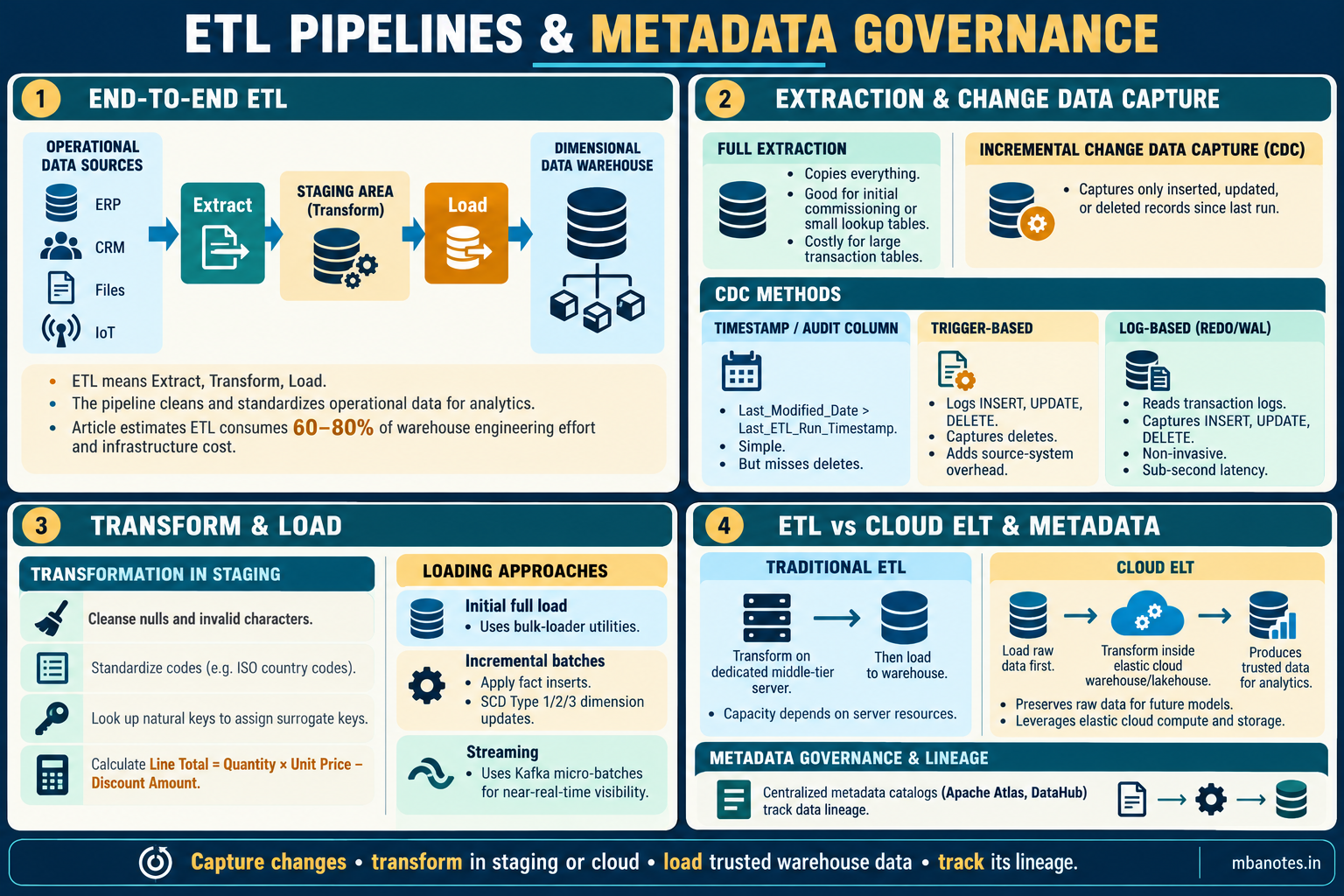
The Extract, Transform, and Load (ETL) architecture serves as the operational engine room of an enterprise data warehouse. Accounting for 60% to 80% of total engineering effort and infrastructure cost in a warehouse implementation, ETL pipelines systematically harvest raw, messy operational data from heterogeneous source systems, convert it into standardized, high-quality information models, and reliably load it into dimensional analytical stores.
2. Extraction Mechanisms & Change Data Capture (CDC)
Data extraction captures data from diverse operational backends (ERP relational databases, legacy flat files, CRM SaaS APIs, IoT event streams):
- Full Extraction: Completely extracts the entire operational dataset. Feasible only during initial warehouse commissioning or for small static lookup tables. Running full extractions daily over multi-terabyte transactional tables is computationally prohibitive.
- Incremental Extraction (Change Data Capture - CDC): Detects and extracts only the specific data records that were inserted, updated, or deleted since the last ETL execution. Standard CDC implementations include:
- Timestamp / Audit Column CDC: Queries records where
Last_Modified_Date > Last_ETL_Run_Timestamp. Simple to implement, but fails to capture deleted records and requires application tables to reliably maintain timestamp audit columns. - Trigger-Based CDC: Database triggers log every INSERT, UPDATE, and DELETE event into a shadow audit table. Captures hard deletes, but introduces operational performance overhead on source transaction throughput.
- Log-Based CDC (Golden Standard): ETL engines (such as Debezium, Oracle GoldenGate) directly read the database transaction redo/WAL logs. Completely non-invasive: introduces zero CPU overhead on operational databases and captures all inserts, updates, and deletes with sub-second latency.
- Timestamp / Audit Column CDC: Queries records where
3. Data Transformation Pipelines & Business Logic
The transformation stage executes within the intermediate Staging Area, applying critical data quality routines:
- Data Cleansing & Filtering: Resolving missing null fields, stripping whitespace, removing non-printable control characters, and rejecting corrupted records into error quarantine logs.
- Field Standardization & Decoding: Converting disparate categorical representations into uniform enterprise codes (e.g., standardizing country codes to ISO 3166-1 alpha-2, or mapping disparate marital status codes "M/S/D" into standardized terms).
- Surrogate Key Lookups: Matching operational natural keys (e.g., SAP Customer Number) against the customer dimension table to retrieve or generate the synthetic integer surrogate key assigned to that entity.
- Calculation & Aggregation: Deriving analytical fields (e.g., Line Total = Quantity * Unit Price - Discount Amount).
4. Loading Strategies: Bulk Load versus Incremental Updates
The loading phase commits transformed records into the production enterprise data warehouse:
- Initial Full Load: Populates empty warehouse tables with baseline historical records. Utilizes specialized high-speed bulk-loader utilities (bypassing standard SQL insert logging, disabling table indexes and foreign keys temporarily, and rebuilding indexes post-load).
- Incremental Periodic Load: Executes on scheduled batches (hourly, nightly, weekly). Inserts new fact records and executes Slowly Changing Dimension (SCD Type 1/2/3) updates on dimension tables.
- Streaming / Real-Time Load: Utilizes distributed event brokers (Apache Kafka) to continuously micro-batch records into warehouse staging tables with near-real-time visibility.
5. ETL versus ELT Paradigms & Metadata Governance
In recent years, the explosion of elastic cloud data warehouses (Snowflake, BigQuery, Databricks) has triggered an architectural migration from traditional ETL to modern ELT (Extract, Load, Transform):
| Evaluation Parameter | Traditional ETL Architecture | Modern Cloud ELT Architecture |
|---|---|---|
| Transformation Engine | Dedicated on-premise middle-tier ETL server (Informatica, DataStage) | Target cloud data warehouse / lakehouse distributed SQL engine (dbt, Snowflake) |
| Data Landing Order | Transformed before loading into the warehouse | Raw data loaded immediately into data lake/staging; transformed in-place |
| Scalability & Flexibility | Limited by ETL server memory/CPU; rigid transformation logic | Virtually infinite cloud elasticity; raw data preserved for future models |
| Metadata Management | Proprietary ETL tool metadata repository | Open centralized metadata catalogs (Apache Atlas, DataHub) tracking data lineage |
University Examination Question Bank & Model Solutions
Designed as per Dr. A.P.J. Abdul Kalam Technical University (AKTU) MBA Examination Pattern.
Part A: Conceptual 2-Mark Short Answer Questions
Q1 [2 Marks]: Define the primary distinction relevant to ETL Pipelines & Metadata in analytical system design.
Ans: It represents a core dimensional engineering and data processing paradigm governing how enterprise facts and dimensions are modeled, structured into relational schemas, or transformed via automated data integration pipelines.
Q2 [2 Marks]: What is the significance of Extraction Topologies in data warehouse architecture?
Ans: It establishes the formal structural mechanisms—such as additive fact table metrics, denormalized star topologies, or log-based CDC—that optimize SQL query performance and data reliability.
Part B & C: Analytical 10-Mark Detailed Solutions & Technical Frameworks
Question 1 [10/15 Marks]: Explain the architectural and operational framework of ETL Pipelines & Metadata. Detail its components, implementation methodologies, and enterprise strategic impact. (10/15 Marks)
Model Examination Answer Blueprint:
Strategic Executive Summary: 8. ETL Pipelines & Metadata
- Dimensional Modeling Excellence: Declaring atomic grain and employing surrogate keys to insulate the data warehouse from operational source churn.
- Schema Optimization: Selecting Star Schemas for fast departmental queries and Fact Constellations with conformed dimensions for enterprise cross-functional analytics.
- Interactive Analytical Exploration: Providing business executives with sub-second multidimensional OLAP slicing, dicing, and roll-up drill-down capabilities.
- Modern Data Pipelines: Adopting log-based Change Data Capture (CDC) and cloud-native ELT architectures to ensure continuous, reliable data delivery.
Frequently Asked Questions (Academic & Technical FAQ)
Q1. What makes ETL Pipelines & Metadata critical for modern enterprise managers?
It enables organizations to structure complex enterprise data into intuitive, lightning-fast analytical models, empowering managers to make confident, data-driven decisions.
Q2. How do practitioners apply these principles in corporate environments?
Practitioners implement Kimball dimensional modeling with SCD Type 2 tracking, build Star Schemas with bitmap indexes, configure automated CDC pipelines, and deploy cloud ELT models using dbt.
Q3. What are the most frequent examination questions asked from this topic in AKTU?
AKTU examinations frequently require comparing Fact vs Dimension tables, detailing measure additivity types, comparing Star vs Snowflake vs Constellation schemas with diagrams, explaining OLAP operations (Roll-up, Drill-down, Slice, Dice, Pivot), and detailing the ETL pipeline and CDC.
Discussion & Questions
0 CommentsAcademic insights, questions, and conceptual clarifications from students & faculty.
No questions or comments yet
Have a doubt about this topic, an exam tip, or a conceptual perspective? Start the discussion below!
Leave a Comment / Ask a Question
Your email address will not be published. Required fields are marked *